Taliban Suspends Maintenance and Expansion of Afghanistan's Fiber Optic Network

Taliban suspends Afghanistan's fiber optic network maintenance and expansion, worsening the country's fragile digital infrastructure.
Afghanistan's Taliban authorities have announced a suspension of national fiber optic network maintenance and expansion, further weakening the country's already fragile internet infrastructure. Fiber networks are critical for communications, financial services, and education across Afghan cities. The suspension means damaged lines cannot be promptly repaired, raising outage risks and leaving remote areas without prospects for stable connectivity. The decision impacts residents' access to information, cross-border business operations, and the country's long-term digital development. Public information remains extremely limited, and the specific reasons, duration, and policy rationale behind the move are still unclear.
Overview
According to Hacker News, Afghanistan's Taliban authorities have announced a suspension of maintenance and expansion work on the country's fiber optic network. This decision adds further uncertainty to Afghanistan's already fragile internet infrastructure, with potentially far-reaching consequences for residents' internet access, business operations, and the flow of information.
Given that the original source material is extremely limited — consisting only of a headline and source with no detailed body text or images — this article can only provide context and background analysis based on known facts. Specific policy details, implementation timelines, and the full scope of impact still require confirmation from authoritative sources.
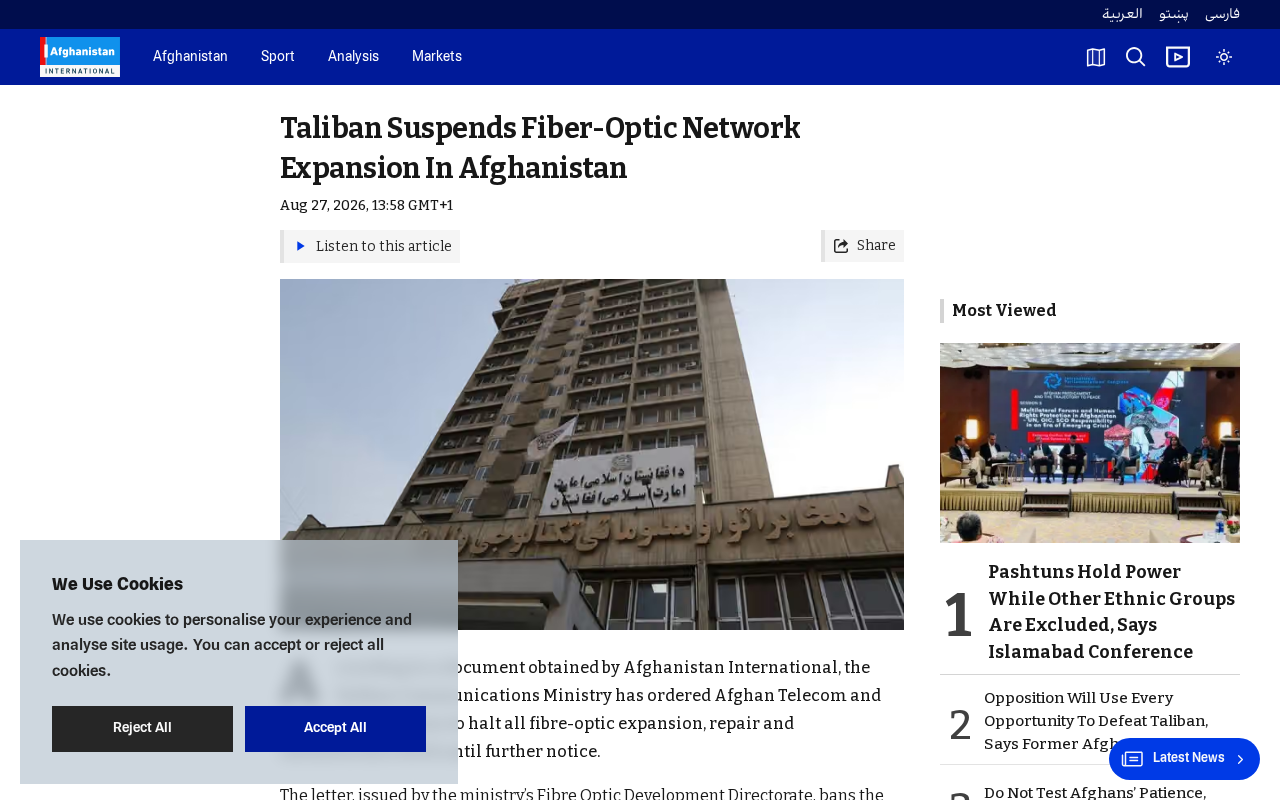
Why Fiber Optic Networks Are Critical for Afghanistan
Fiber optic networks form the backbone of modern internet transmission. Compared to traditional copper cables or satellite links, fiber offers greater bandwidth, lower latency, and improved reliability. For a country like Afghanistan, where infrastructure is relatively underdeveloped, fiber lines play a critical role in connecting major cities and supporting government communications, financial services, and educational resources.
Once maintenance work is suspended, existing lines will have no way to be promptly repaired when they suffer physical damage, equipment degradation, or the effects of natural factors — significantly raising the risk of network outages. Meanwhile, halting expansion means remote areas not yet covered may go without stable connectivity for the foreseeable future.
Afghanistan's internet development history has itself been deeply troubled. After 2001, with international aid, Afghanistan began laying its first fiber backbone lines, connecting to the global internet primarily through cross-border cables via neighboring countries in Asia and Central Asia. Due to complex terrain and persistent conflict, Afghanistan has long suffered from low internet penetration rates. As of 2021, just before the Taliban retook power, only around 18% of the population were internet users, with most accessing the internet via mobile networks rather than fixed broadband. Fiber networks were largely concentrated in major cities like Kabul, while rural areas relied on 3G/4G base stations or satellite communications. After the Taliban came to power, numerous international telecommunications partners and aid organizations withdrew, leaving a severe shortage of maintenance funding and technical talent that compounded the already fragile network infrastructure. The current suspension of fiber maintenance and expansion is a continuation of these long-standing challenges, not an isolated incident.
Analysis of Potential Impact
For Ordinary Residents
Declining internet access will directly affect people's ability to obtain information, pursue remote education, and communicate online. In an environment where information channels are already restricted, stagnating infrastructure could further deepen the information isolation effect.
For the Economy and Business
Modern commercial activity is heavily dependent on stable network connectivity — from electronic payments to cross-border trade communications. Network outages will raise operating costs for businesses and weaken Afghanistan's economic ties with the outside world.
For Long-Term Development
Digital infrastructure is a vital pillar of a nation's long-term development. If the suspension of maintenance and expansion becomes prolonged, Afghanistan risks falling further behind in the global digitalization process, widening the digital divide between it and neighboring regions.
Information Limitations and Perspective
It is worth noting that currently available public information is very limited. The report received minimal engagement on Hacker News (only 4 upvotes and no comments at the time of writing). The specific reasons for the suspension, whether it is a temporary measure, and the underlying policy considerations all remain unclear.
For readers who follow global internet infrastructure and digital rights, this event is worth tracking closely. It is not only relevant to Afghanistan's current network conditions, but also reflects how political factors can directly affect the operation and evolution of technical infrastructure.
The Taliban's internet governance model deserves attention. Since retaking power in 2021, Taliban authorities have repeatedly ordered the blocking of specific platforms (such as VPN services and certain social media), and have pressured telecommunications operators to hand over user data. There is currently no direct evidence linking the suspension of fiber maintenance to controlling internet content or surveilling communications, but it warrants careful consideration within the political context. At the same time, some sections of Afghanistan's fiber network pass through areas with weak government control, meaning security concerns could also be a practical reason behind the operational halt. Organizations such as the International Telecommunication Union (ITU) have listed Afghanistan among the countries with the weakest digital access, and any further infrastructure regression will keep it at the bottom of global digital inclusion metrics.
Conclusion
While the maintenance and expansion of fiber optic networks may seem like a purely technical matter, it is deeply intertwined with social governance, economic development, and the rights of ordinary citizens. The downstream consequences of Afghanistan's suspension decision — and its real impact on the local digital ecosystem — will require further details to emerge before a complete picture can be formed.
Related articles

OpenAI Partners with Shield: How the Astra Agent Revolutionizes IT Troubleshooting
OpenAI and Shield launch the Astra agent, which autonomously logs into computers and legacy systems to fix IT issues in real time, 35-40% faster than traditional models, with humans involved only when judgment is needed.

iPhone Duo Battery Life Tested: One Charge a Day Is Unavoidable, and the Large Screen Is the Culprit
iPhone Duo battery test: heavy use needs at least one charge a day, and about 30% remains after 6.5 hours of screen-on time. How often the large screen is unfolded is key; a MagSafe battery pack helps, and long-term degradation is also worth watching.

Kimi K3.1 Pro Open-Sourced: 2.8 Trillion Parameters Close In on Opus
Moonshot releases the open-source MoE model Kimi K3.1 Pro, with 2.8T total parameters and 104B activated, trailing Opus 5.5 by under 1 point on Terminal Bench 4.0.