Tallhorn: The MongoDB Client That Makes AI Ask Before Writing to Your Database

Native Mac MongoDB client Tallhorn includes an MCP server that requires manual approval for AI agent writes by default.
Tallhorn is a native Mac MongoDB client built with SwiftUI and AppKit, offering table, tree, and JSON views, JavaScript query scripts, stage-by-stage aggregation pipeline building, and explain plans. Its standout feature is a built-in MCP server that connects AI coding tools like Claude Code, Cursor, and VS Code to the database—while requiring manual approval for every agent write by default. Free with a $29.99 one-time Pro upgrade, no account, no analytics.
Title
Tallhorn: The MongoDB Client That Makes AI Ask Before Writing to Your Database
Meta Description
Tallhorn is a native MongoDB client built with SwiftUI, featuring a built-in MCP server that lets AI agents like Claude Code and Cursor query your database—with writes requiring manual approval by default. Pro version is a $29.99 one-time purchase.
Article Content
Developer tools are seeing a subtle but important shift: as AI agents increasingly operate directly on databases, how do we put guardrails on them? Tallhorn, recently launched on Product Hunt, offers a telling answer—a native MongoDB client built with SwiftUI and AppKit, featuring a built-in MCP server that connects Claude Code, Cursor, and VS Code to your database, while all agent write operations require user approval by default.
Native Experience and Multi-View Data Browsing
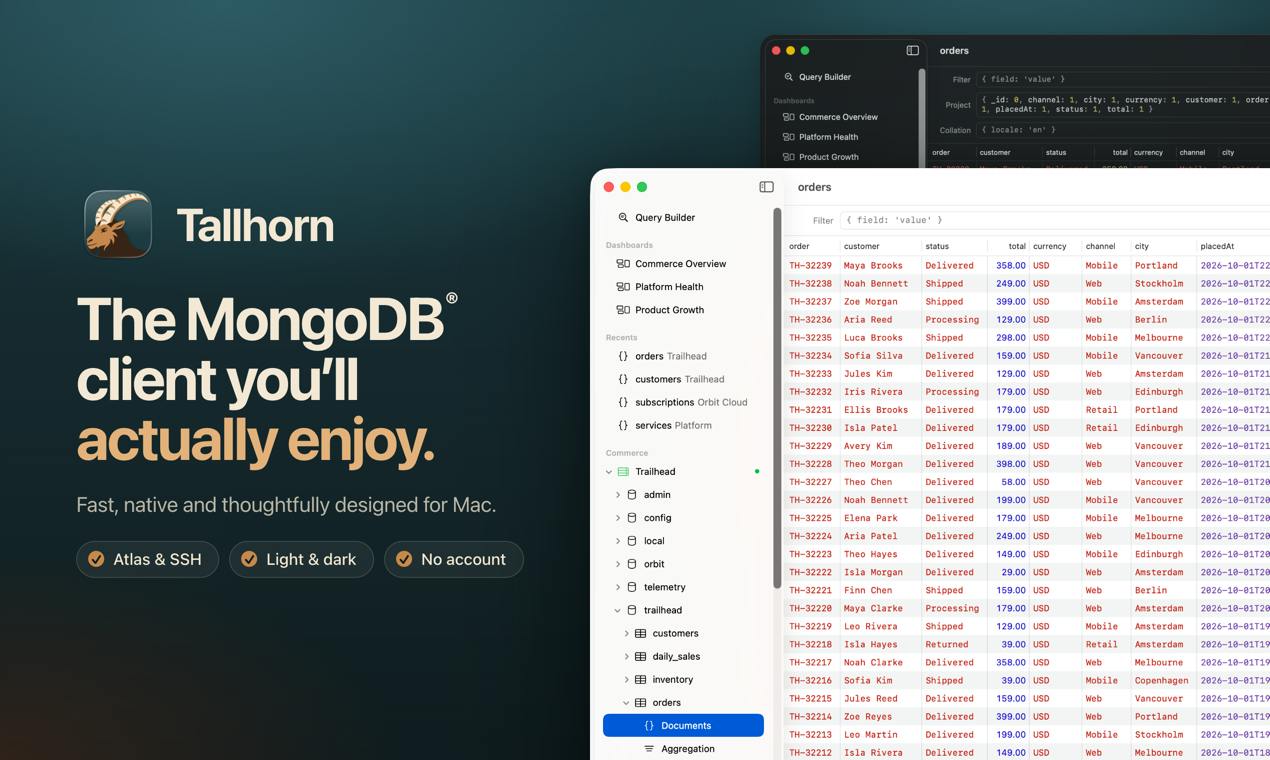
Tallhorn positions itself as a fast native client for Mac, which means it doesn't take the common Electron wrapper route. For MongoDB users who have long endured sluggish web-based or cross-platform packaged tools, the SwiftUI and AppKit combination should theoretically deliver interaction responsiveness that feels more native to the system.
On the data browsing side, it supports switching between table, tree, and JSON views. These three views serve different use cases: table view is good for quickly scanning field structures, tree view helps trace the hierarchy of nested documents, and JSON view aligns with developers' habit of directly reading and writing raw documents. Querying supports JavaScript scripts, aggregation pipelines can be built stage by stage, explain plans can be viewed, and query results can be turned into dashboards.
The thinking behind this feature set is clear—consolidating the actions scattered across command lines, GUI tools, and ad-hoc scripts during everyday MongoDB debugging into a single interface.
SwiftUI and AppKit are two complementary UI frameworks in the Apple ecosystem. AppKit has a long history, offering mature, low-level macOS controls and event handling capabilities; SwiftUI is a declarative UI framework introduced in 2019 that drives interface updates through state, resulting in more concise code, but it had early limitations in complex lists and fine-grained control. Native Mac apps often adopt a hybrid strategy: using SwiftUI for overall layout and modern interactions, and AppKit to fill in high-performance tables, menus, drag-and-drop, and other system-level capabilities. Compared to Electron wrappers (which bundle Chromium and Node.js into the app), native solutions typically have advantages in memory usage, startup speed, and system integration (such as trackpad gestures, Dark Mode, and accessibility), at the cost of being Apple-platform-only and requiring developers to be familiar with Apple's tech stack.
MCP Server: An Approval Gate for AI Agents
The most notable design in Tallhorn is its built-in MCP server. MCP (Model Context Protocol) is becoming the de facto standard for AI tools connecting to external data sources, and Tallhorn uses it to let AI coding environments like Claude Code, Cursor, and VS Code directly query the user's database.
What's really interesting is the permission model: users can set rules per connection, and by default every agent write operation waits for manual approval. This contrasts with the approach of many current AI database tools—"allow by default, audit afterward." Writes are the highest-risk part of database operations; a mistakenly executed update or delete can cause losses that are hard to roll back. Putting approval before execution effectively downgrades AI agents from "autonomous operators" to "proposers."
For teams that need to handle production data with AI assistance, this default choice may matter more than the feature list itself in determining whether the tool can be trusted.
MCP (Model Context Protocol) is an open-source protocol proposed by Anthropic for establishing standardized connections between AI applications (such as Claude Desktop and IDE plugins) and external data sources and tools. You can think of it as the "USB-C port for AI tools": before this, every AI coding assistant needed a separate adapter layer to connect to databases, file systems, or APIs; MCP defines a unified specification for exposing Resources, Tools, and Prompts, letting AI clients communicate with servers via standard JSON-RPC. For database tools, implementing an MCP server means any MCP-compatible AI environment can discover schemas, execute queries, or invoke management functions in a consistent way—without needing to build separate integrations for each AI product. This also explains why Tallhorn chose a built-in MCP server rather than separate plugins for Claude Code and Cursor—implement once, use everywhere.
Aggregation Pipeline is MongoDB's core data processing mechanism, chaining a series of stages into a pipeline where each stage transforms the document stream—such as $match for filtering, $group for grouping, $lookup for joining, and $project for projection. It's similar to a combination of GROUP BY, JOIN, and subqueries in SQL, but expressed as an array of stages, making it easy to debug and optimize stage by stage. An explain plan is the query execution detail returned by MongoDB, showing which index the query optimizer chose, how many documents were scanned, and how long each stage took—a key tool for diagnosing slow queries. Tallhorn's support for stage-by-stage pipeline construction and explain plan viewing means it brings the most commonly used debugging techniques from the MongoDB Shell into a graphical interface, reducing the mental overhead of hand-writing pipeline syntax.
Pricing and Privacy Stance
Tallhorn uses a free-plus-one-time-purchase model: core features are free, while the Pro version adds dashboards and agent features for a one-time fee of $29.99. No subscription, and no account required.
The company explicitly states it does no analytics. In an era where even local tools habitually embed tracking, this commitment has real appeal for developers who care about data boundaries—especially when the tool itself handles database credentials and business data.
What to Watch
With 67 upvotes and 1 comment on Product Hunt, Tallhorn is still in an early exposure phase, and the community feedback sample is limited. The rule granularity of the MCP integration in practice, whether the approval flow becomes a burden for high-frequency operations, and whether permission management is smooth in multi-connection scenarios—these all need real-world use to judge.
From a product direction standpoint, Tallhorn has captured a need that is taking shape: as AI agents plug into development environments, permission control at the database layer can't rely on after-the-fact remediation. Making "ask before writing" the default behavior is a pragmatic starting point.
One-line Summary
Native Mac MongoDB client Tallhorn includes a built-in MCP server, making AI agent database writes require manual approval by default.
Paragraph Summary
Tallhorn is a native Mac MongoDB client built with SwiftUI and AppKit, supporting table, tree, and JSON document views, JavaScript query scripts, stage-by-stage aggregation pipeline construction, and explain plan viewing. Its most differentiated design is the built-in MCP server, which allows AI coding environments like Claude Code, Cursor, and VS Code to connect directly to the database—but by default requires user approval for every agent write operation, downgrading AI from autonomous operator to proposer. The product uses a free-plus-one-time-purchase model, with the Pro version costing $29.99 with no account required and no analytics. It's currently in an early exposure phase with limited community feedback, and the real-world experience of the MCP approval flow and the granularity of permission management remain to be validated.
Related articles

Has AI Surpassed the Median Economist? A Debate on Perceiving Capability
A YouTube discussion argues AI's comprehension in soft fields like economics has surpassed the median professional economist, but people resist acknowledging it due to the lack of hard metrics. The article analyzes this perception gap and its industry implications.

Banks No Longer Profitable? The Industry Shift Sparking Debate on HN
Hacker News debates the claim that "banks are no longer profitable." This article analyzes the real picture of profit divergence in banking, explains failure and seizure mechanisms, and examines the structural pressures on bank profitability from interest rates, deposit competition, and technology costs.

Govee Smart Outdoor Lights 30% Off for Black Friday: 50-Foot Model Drops to All-Time Low
Govee Black Friday sale: 50-foot Permanent Outdoor Lights 2 drops to $125.99, matching its all-time low; 100-foot model drops to $179.99, a $100 discount. We analyze value and buying advice.