Taobao Sign Signature Reverse Engineering: AI-Assisted MD5 Encryption Cracking Full Workflow

Step-by-step reverse engineering of Taobao's MD5 sign signature with AI-assisted analysis
This article uses Taobao's sign signature parameter as a case study to systematically explain the reverse engineering workflow for e-commerce platform anti-scraping signature mechanisms. Through packet capture to locate the target interface, AI-assisted filtering of dynamic parameters requiring reverse engineering, and breakpoint debugging to locate encryption code, it ultimately confirms that sign is generated by concatenating token, timestamp, appKey, and data through standard MD5 hashing, with the token sourced from the _m_h5_tk Cookie field, reproducible directly with Python's hashlib.
E-commerce Platform Anti-Scraping Mechanisms and Signature Reverse Engineering
Anti-scraping mechanisms on e-commerce platforms are often the most challenging aspect of crawler development. A seemingly simple data collection task can get stuck for days because of a single encrypted signature parameter. This article uses Taobao's sign signature parameter as an example to break down in detail how to efficiently complete MD5 encryption reverse analysis with the help of AI tools, helping you establish a reusable methodology for signature reverse engineering.
E-commerce platform anti-scraping systems typically operate at multiple levels: IP rate limiting, User-Agent detection, behavioral verification (such as slider CAPTCHAs), and request signature validation. Signature parameters represent the most technically sophisticated layer, with their core concept derived from the HMAC (Hash-based Message Authentication Code) approach in API security design — by mixing request parameters with a secret key and hashing them together, it ensures that request content hasn't been tampered with and originates from a trusted source.
HMAC was formally defined by Mihir Bellare et al. in 1996 in RFC 2104, with the design goal of achieving message integrity verification and source authentication without relying on public key infrastructure. In engineering practice, HMAC variants are widely used in mainstream scenarios such as OAuth authorization, AWS API signatures, and WeChat Pay signatures. Taobao's sign mechanism is essentially a "handshake protocol" between server and client: the client generates a signature according to an agreed-upon algorithm, the server verifies it using the same algorithm, and rejects the response if they don't match. Unlike standard HMAC, Taobao's implementation concatenates multiple parameters and directly performs an MD5 hash, omitting HMAC's double-hash structure, but the core anti-tampering logic remains consistent.
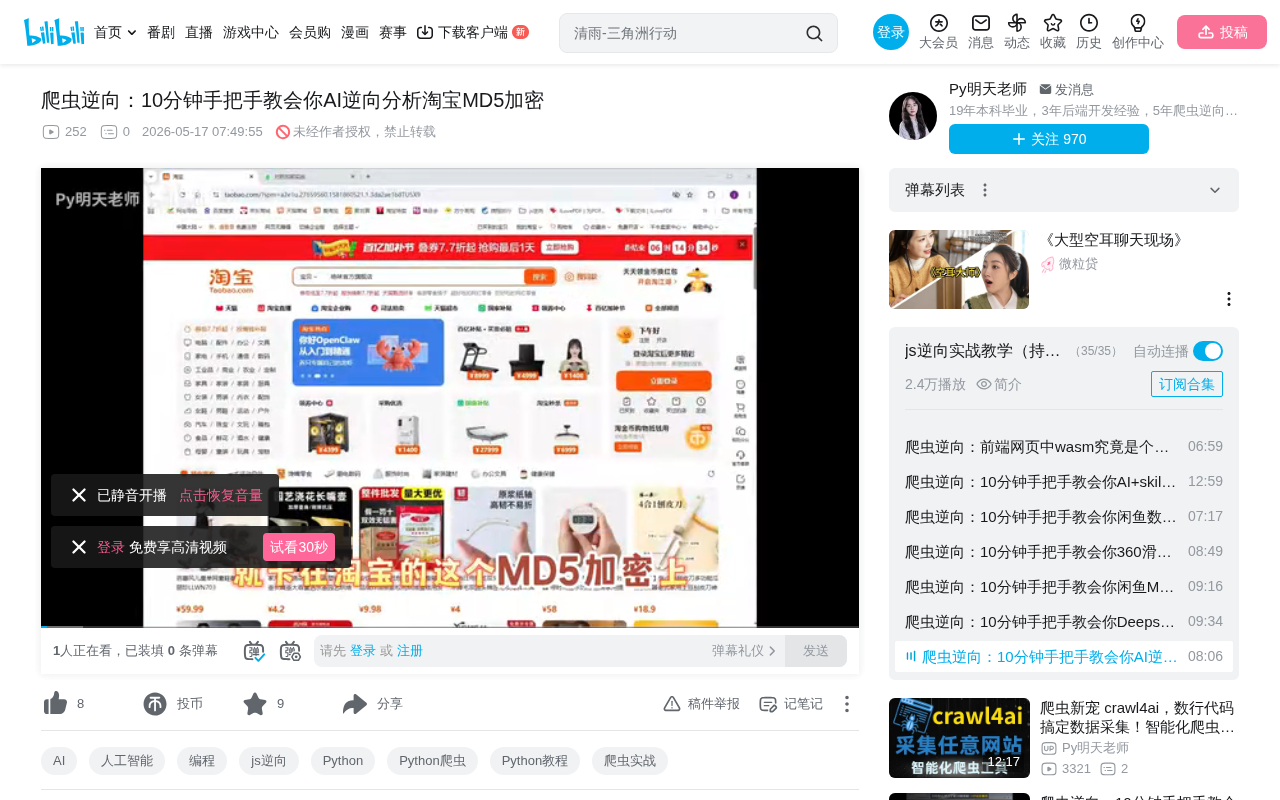
Problem Background: Sign Parameter Causing Request Rejection
Packet Capture to Locate the Target Interface
The first step is to open the browser's developer tools for packet capture. After scrolling on Taobao's product listing page to trigger pagination requests, you can find a 2.0 data interface in the Network panel. Click to view the response data and confirm it contains the product information we need.
Next, copy the request in cURL format, convert it to Python code using a crawler tool, and run it directly. However, the result is disappointing — the server returns an "illegal request" error. The reason is clear: the request contains a dynamic signature parameter called sign that validates the legitimacy and integrity of the request, and a simply copied static value cannot pass validation.
There's a noteworthy detail here: a cURL-copied request might occasionally succeed within a short time window, because the sign contains a timestamp, and the server typically sets a tolerance window (usually 5 to 10 minutes). Once this window is exceeded, even if the signature algorithm is correct, an expired timestamp will cause the request to be rejected. This "time window validation" mechanism is a standard defense against Replay Attacks — even if an attacker intercepts a legitimate request, they cannot reuse it outside the time window.
Using AI to Quickly Identify Which Parameters Need Reverse Engineering
When facing a pile of request parameters and unable to quickly determine which ones are dynamically generated versus fixed values, you can directly hand the parameter list to AI for analysis. AI will help you identify the following key information:
tparameter: Millisecond-level timestamp, dynamically generated but doesn't require complex reverse engineering — it just needs to stay consistent with the timestamp used in thesignsignature calculation.signparameter: Request signature, the core reverse engineering target. Typically generated from request parameters (data), timestamp (t), andappKeyvalues through an encryption algorithm.
The value of this step is: letting AI narrow down your reverse engineering scope, avoiding wasted time on irrelevant parameters. In real-world engineering, a complex interface might carry dozens of parameters, many of which are A/B test markers, tracking IDs, or UI state identifiers that have no impact on signature calculation. AI's parameter classification capability is essentially pattern recognition based on naming semantics and value domain characteristics, compressing what would take hours of manual parameter screening into minutes.
Reverse Analyzing the Sign Signature Generation Logic
Precisely Locating Encryption Code Through Breakpoints
Once sign is confirmed as the reverse engineering target, the next step is finding its generation location in the JavaScript code. Modern web applications' JavaScript code is typically processed through Obfuscation and Minification, with variable names replaced by single letters or meaningless strings, making direct code reading extremely difficult.
Understanding the technical layers of JS obfuscation helps in choosing the correct cracking strategy. Obfuscation is typically divided into three layers: the first layer is compression obfuscation, performed by tools like UglifyJS and Terser, which mainly removes whitespace and comments and shortens variable names — readability decreases but logical structure is preserved; the second layer is control flow obfuscation, which rewrites sequentially executing code into state machines or switch-case jump structures, greatly increasing static analysis difficulty; the third layer is string encryption and anti-debugging, which encrypts string constants for storage and decrypts them at runtime, while injecting debugger statements or detecting DevTools open status to counter dynamic debugging. Taobao's JS typically falls between the first and second layers, making breakpoint debugging still an efficient and viable approach.
In reverse analysis, Breakpoint Debugging is the core technique for breaking through obfuscation: by pausing code execution at key positions, you can directly observe the real values of variables at runtime, bypassing the difficulties of static analysis. Since the name sign is relatively distinctive, you can directly search globally for sign: in the developer tools' Sources panel (note the colon, which more precisely locates assignment statements). Chrome DevTools' Sources panel provides advanced features like conditional breakpoints and log breakpoints, which combined with Call Stack tracing, can efficiently reconstruct the complete execution chain of encryption functions.
After finding the suspected location and setting a breakpoint, refresh the page. If the breakpoint is hit successfully, it confirms that the request passes through this code before being sent. At the breakpoint, you can observe that the sign value (variable name K in the code) is generated by a function.
Dissecting the Input Parameters of the MD5 Encryption Function
Entering the encryption function's internals, you can see it receives the following parameters:
| Parameter | Meaning | Source |
|---|---|---|
token | User token | Extracted from the _m_h5_tk field in Cookie, taking the part before the underscore |
j (timestamp) | Millisecond-level timestamp | Dynamically generated, must stay consistent with the t in request parameters |
h (appKey) | Application key | Hard-coded fixed value in the code |
c.data | Request data | Fixed string parameter |
The way token is obtained deserves attention: it comes from the _m_h5_tk field in Cookie, formatted as tokenValue_timestamp, and we only need the part before the underscore. _m_h5_tk is essentially a lightweight session token designed by Taobao for H5 pages, working in conjunction with full login-state Cookies (such as cookie2, sgcookie) to form the credential system for request legitimacy verification. In actual code, this Cookie can be automatically obtained and parsed through a session request. It's important to note that _m_h5_tk has its own independent expiration mechanism — in long-running crawlers, it needs to be periodically refreshed; otherwise, even if the signature algorithm is correct, an expired token will still cause request failures.
Verifying Whether the Encryption Algorithm is Standard MD5
After analyzing the input parameters, the most critical question is: what algorithm does the encryption function actually use?
Observing the function output, we find it's a 32-character hexadecimal string. This characteristic immediately suggests the MD5 hash algorithm. MD5 (Message Digest Algorithm 5) was designed by Ronald Rivest in 1991 and is a widely used cryptographic hash function that converts input data of arbitrary length into a fixed 128-bit (16-byte) hash value, typically represented as 32 hexadecimal characters.
MD5's core properties include: one-way nature (cannot reverse-engineer original data from the hash), avalanche effect (tiny input changes cause dramatic output changes), and determinism (same input always produces same output). From an algorithmic structure perspective, MD5 uses the Merkle–Damgård construction, padding input data to a multiple of 512 bits, then processing blocks through four rounds of nonlinear transformations, with 16 steps per round for a total of 64 operations, ultimately outputting a 128-bit digest. Although MD5 has been proven to have collision vulnerabilities in cryptographic security (Wang Xiaoyun's team first publicly demonstrated a practical collision attack in 2004, and researchers further exploited collisions to forge CA certificates in 2008), in request signature scenarios, its primary purpose is tamper prevention rather than collision attack resistance — an attacker would need to forge a signature without knowing the token and appKey, which remains computationally infeasible. Therefore, MD5 is still widely used in such scenarios.
The verification method is straightforward: call the encryption function in the console, pass in a known value (such as the string "1"), and observe whether the output matches the standard MD5 result. The standard MD5 hash of "1" is the fixed value c4ca4238a0b923820dcc509a6f75849b. If the function output matches this, it confirms that an unmodified standard MD5 implementation is being used, and subsequent reproduction can be done directly by calling Python's hashlib.md5() without any additional algorithm porting work.
Key Takeaways
- Taobao's sign parameter uses the standard MD5 algorithm, generated by concatenating token, timestamp, appKey, and data before hashing
- The token comes from the
_m_h5_tkfield in Cookie — just take the part before the underscore, but be aware of its independent expiration mechanism - Method to verify whether the encryption algorithm is standard MD5: compare output with known input — a 32-character hexadecimal string is a typical MD5 characteristic
- AI can serve two roles in reverse analysis: helping identify which parameters need reverse engineering in the early stage, and automatically generating complete code based on analysis conclusions in the later stage
- The key to handling signature parameters is precise breakpoint positioning rather than global search — searching for
parameterName:quickly locates assignment positions - Understanding the layers of JS obfuscation (compression → control flow → string encryption) helps choose the most efficient reverse engineering strategy; breakpoint debugging can bypass most static obfuscation techniques
Related articles
 Tutorials
ChatGPT Plus Subscription Guide: Are GPT-5.5, image-2, and Codex Worth the Upgrade?
A detailed look at ChatGPT Plus features — GPT-5.5, image-2, and Codex — with a Plus vs Pro comparison and a complete step-by-step subscription guide for users outside the US.
 Tutorials
Harness AI Engineering in Practice: Using Claude Code to Master Enterprise-Level E-Commerce Development
Deep dive into Harness AI Engineering: master enterprise e-commerce development with Claude Code using the Rules, Skills, Wiki, and Changes framework.
 Tutorials
Cursor + Codex Dual-IDE Collaboration: A Practical Methodology for Open-Source Project Customization
A complete methodology for open-source project customization based on real-world experience, detailing the Cursor+Codex dual-IDE workflow, seven-stage process, MVP validation, and AI source code reading techniques.