Tata Electronics Confirms Data Breach: Apple and Tesla Supply Chain Security Under Threat

Tata Electronics confirms data breach, raising security concerns across Apple and Tesla supply chains.
Tata Electronics, a key supplier to Apple and Tesla, has officially confirmed a data breach during a critical period of expansion. As a major player in India's electronics manufacturing rise and a direct iPhone assembler, the incident raises serious concerns about product secrets, supply chain intelligence, and the cascading effects of supply chain attacks on the broader tech ecosystem.
Event Overview
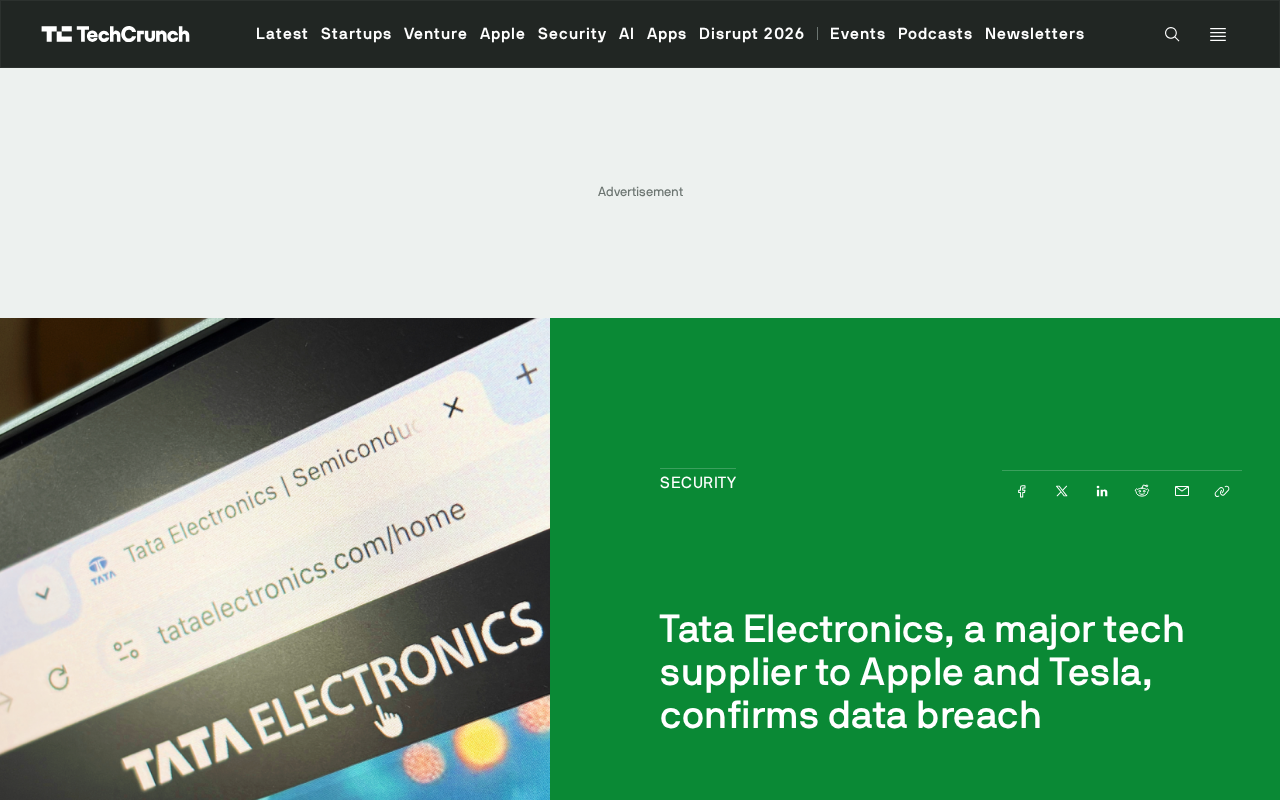
Tata Electronics recently officially confirmed that the company suffered a data breach. As a key supplier to top global tech companies including Apple and Tesla, this security incident quickly drew widespread attention across the industry.
The timing of this data breach is particularly sensitive—occurring right as Tata Electronics is aggressively expanding its role in the global tech supply chain. This not only poses challenges to Tata Electronics' own business development but also sounds an alarm for the security of the entire tech supply chain.
Tata Electronics' Critical Position in the Global Supply Chain
A Core Node Connecting Tech Giants Like Apple and Tesla
Tata Electronics belongs to one of India's largest conglomerates—Tata Group—and has been accelerating its global presence in electronic manufacturing and semiconductors in recent years. Founded in 1868, Tata Group is one of India's oldest and largest business conglomerates, with subsidiaries including Tata Consultancy Services (TCS), Tata Motors (parent company of Jaguar Land Rover), Tata Steel, and many other well-known enterprises, with annual revenue exceeding $150 billion. As the group's core play in electronic manufacturing, Tata Electronics carries Tata Group's strategic ambitions to enter global semiconductor and high-end electronic manufacturing.
The company is a vital link in Apple's iPhone supply chain—in 2024, Tata Electronics acquired Wistron's iPhone assembly plant in India, officially becoming a direct contract manufacturer for Apple iPhones. This also made it the first Indian domestic company to enter Apple's core supply chain. Simultaneously, Tata Electronics provides critical electronic components to new energy vehicle giants like Tesla, including automotive Electronic Control Units (ECUs), sensor modules, and other core components.
Amid the broader trend of supply chain "de-concentration," Tata Electronics is actively absorbing manufacturing capacity shifting out of China, becoming a flagship enterprise in India's electronics manufacturing rise. Behind this trend is the Indian government's "Production Linked Incentive Scheme" (PLI), launched in 2020, which provides electronics manufacturers with fiscal subsidies of up to 4%-6% of output value, aiming to transform India into a global electronics manufacturing hub. Driven by the PLI policy, India's electronics exports grew from approximately $11 billion in 2020 to over $29 billion in 2024. Tata Electronics is one of the biggest beneficiaries of this policy dividend.
The company's investment in semiconductor packaging, electronic assembly, and other areas continues to expand. Notably, Tata Electronics is also investing over $11 billion to build an advanced semiconductor packaging and testing facility in Gujarat, India, planning to produce packaging products for advanced-node chips. This means Tata Electronics is not just an end-product assembler but is extending upstream into the semiconductor value chain, with its strategic importance growing by the day.
Security Crisis During Rapid Expansion
It is precisely against this backdrop of rapid expansion that the data breach is particularly concerning. As Tata Electronics takes on an increasingly important role in the global supply chain, the value of the sensitive data it holds—including customer product design information, supply chain logistics data, and commercial contract details—is surging dramatically, making the company a high-value target in the eyes of cyber attackers.
From a cybersecurity perspective, the data held by electronics manufacturers has extremely high intelligence value. Product design files (such as CAD drawings, BOM lists, and firmware code) can reveal the technical roadmap of unreleased products; supply chain data (such as order volumes, delivery schedules, and yield data) can be used to infer customers' product launch cadence and market strategies. For nation-state APT (Advanced Persistent Threat) groups and commercial espionage actors, the value of this data may far exceed that of direct financial data.
Deeper Concerns About Supply Chain Security
Cascading Effects That Ripple Through the Chain
In the modern tech industry, supply chain security is no longer a single-company issue. When a core supplier suffers a data breach, its impact can rapidly spread upstream and downstream along the supply chain. This phenomenon is known in cybersecurity as the "Cascading Effect" of supply chain attacks—attackers breach a relatively weak link in the supply chain to gain access to the broader supply chain ecosystem or sensitive information.
For companies like Apple and Tesla that demand extremely high product confidentiality, supplier data security directly relates to:
- Product secrets: Core trade secrets such as design drawings and technical specifications of unreleased products. Taking Apple as an example, its pre-launch product secrecy is arguably the strictest in the industry, and any premature leak could affect the market impact of product launches or even allow competitors to prepare countermeasures in advance. Historically, Apple supply chain leaks have repeatedly exposed new iPhone designs months before official announcements.
- Supply chain intelligence: Competitively sensitive information such as procurement volumes, pricing strategies, and logistics arrangements. This data can help competitors calculate product cost structures, expected production volumes, and launch timelines, gaining unfair advantages in business competition.
- Customer data: Whether end-user data has been affected. While the manufacturing stage typically doesn't directly handle end-user personal data, in certain scenarios (such as device serial numbers, activation information, and after-sales repair data), manufacturers may hold indirect data related to end users.
Escalating Attacks on Tech Supply Chains
In recent years, cyberattacks targeting tech supply chains have shown a clear upward trend. The SolarWinds incident exposed in late 2020 is a landmark case of supply chain attacks—attackers (attributed to the Russian state-sponsored hacking group APT29/Cozy Bear) compromised IT management software company SolarWinds' software update mechanism, embedding malicious code into legitimate update packages for its Orion platform. Since SolarWinds' customers included the U.S. Treasury Department, Department of Homeland Security, Microsoft, Intel, and over 18,000 other organizations and enterprises, this attack caused an unprecedented large-scale supply chain security crisis and is considered one of the most serious cyber espionage events of the past decade.
In the semiconductor and electronics manufacturing sector, similar attacks occur frequently. In 2018, TSMC was hit by a WannaCry ransomware variant that shut down multiple production lines for three days, causing direct economic losses of approximately $170 million. In 2022, NVIDIA was attacked by the LAPSUS$ hacking group, with large volumes of GPU design files and employee credentials stolen. That same year, Samsung's semiconductor division was also breached by the same group, with approximately 190GB of source code data leaked. These incidents demonstrate that supply chains have become a weak link in cybersecurity defenses.
The Tata Electronics incident once again shows that as supply chains become more globalized and digitized, the attack surface continues to expand. The "Attack Surface" refers to the sum of all possible entry points that an attacker could exploit within an organization, including network interfaces, applications, employee accounts, IoT devices, and third-party integrations. For a rapidly expanding manufacturer like Tata Electronics, every new factory added, every new customer system connected, and every new production management software deployed means an expansion of the attack surface.
Industry Lessons from the Tata Electronics Data Breach
This incident provides several important lessons for the global tech industry:
First, supplier security audits urgently need upgrading. When tech giants select and manage suppliers, cybersecurity capability should be an evaluation dimension equally important as manufacturing capability. Relying solely on security requirements in contract clauses is far from sufficient—continuous security monitoring and audit mechanisms need to be established. Currently, more mature industry practices include requiring suppliers to obtain ISO 27001 information security management system certification, SOC 2 audit reports, and industry-specific security frameworks (such as TISAX certification for the automotive industry and CMMC certification for the U.S. defense supply chain). However, these static compliance certifications often cannot reflect an enterprise's real-time security posture, and an increasing number of companies are adopting "continuous security assessment" models, dynamically monitoring suppliers through security rating platforms (such as BitSight and SecurityScorecard).
Second, rapid expansion and security development must proceed in parallel. Tata Electronics is in a period of high-speed business growth, but security infrastructure development often lags behind the pace of business expansion. This is a common challenge for many fast-growing enterprises, known in cybersecurity as "Security Debt"—similar to the concept of "technical debt" in software engineering, it refers to security investments that enterprises defer or neglect in pursuit of business speed. These deficiencies accumulate over time and eventually "explode" in the form of security incidents. Industry best practice is to implement the "Shift Left Security" philosophy—incorporating security requirements at the earliest stages of business planning and system design, rather than "patching" systems after they're built. For manufacturers, this means cybersecurity architecture should be designed simultaneously during new factory planning, and security threat modeling should be conducted when integrating new customer systems.
Third, supply chain resilience requires multi-dimensional protection. Geopolitical risks, natural disasters, cybersecurity threats—the challenges facing modern supply chains are diverse. When building supply chain resilience, enterprises need to incorporate cybersecurity into their overall risk management framework. This concept aligns closely with the "Supply Chain Risk Management" (SCRM) framework that has gained prominence in recent years. The National Institute of Standards and Technology (NIST) publication "Cybersecurity Supply Chain Risk Management Practices" (NIST SP 800-161) provides a systematic guidance framework, recommending that enterprises build supply chain cybersecurity capabilities across five dimensions: Identify, Protect, Detect, Respond, and Recover. Meanwhile, the concept of "Zero Trust Architecture" is also extending from internal enterprise cybersecurity to supply chain management—meaning no supplier's system or data access request is trusted by default, and all interactions require continuous verification.
Follow-up and Event Developments
Currently, Tata Electronics has not disclosed key details such as the specific scale of the data breach, the types of data affected, or the identity of the attackers. Whether downstream customers like Apple and Tesla have been directly impacted also remains to be confirmed.
From the typical investigation process for data breach incidents, after confirming a security event, enterprises generally go through several phases: first is "Containment"—isolating affected systems and preventing further data exfiltration; next is "Root Cause Analysis"—determining the attacker's intrusion path and exploited vulnerabilities; then "Impact Assessment"—determining the scope and sensitivity of leaked data; and finally "Notification and Remediation"—notifying affected parties as required by law and fixing security vulnerabilities. The entire investigation process typically takes weeks to months, during which third-party digital forensics firms (such as CrowdStrike, Mandiant, etc.) are often engaged to assist.
Notably, India officially passed the Digital Personal Data Protection Act (DPDP Act) in 2023, which began phased implementation in 2024. Under the DPDP Act, Data Fiduciaries are obligated to notify the Data Protection Board of India and affected data principals when personal data breaches occur. Companies that violate these provisions may face fines of up to 25 billion rupees (approximately $300 million). This means Tata Electronics must also consider compliance-related legal obligations and potential regulatory penalty risks when handling this incident.
As the investigation deepens, more details are expected to gradually emerge. For Tata Electronics, which is accelerating its global expansion, how it handles this crisis and rebuilds partner trust will be a major test of its corporate governance capabilities. Historical experience shows that an enterprise's transparency and response speed after a data breach often determines its long-term reputational impact more than the incident itself—companies that choose rapid, transparent disclosure and actively take remedial measures typically recover market trust more quickly.
Key Takeaways
Related articles

Gemini 3.7 Flash Spotted in Google Cloud Console — Launch Countdown Begins
Developers spot Gemini 3.7 Flash in Google Cloud Console, sparking discussion about its relationship to Pro and Google's model distillation strategy.

AI-Memory: Building a Cross-Tool Long-Term Memory System for Coding AIs
AI-Memory is a Rust-based open-source project providing long-term memory for Claude Code, Cursor, Aider and other Agent coding CLIs, enabling seamless handoff between vendors.

Bullet Enters the Stage: YC Newcomer Bets on a Faster Coding Agent
YC S26 startup Bullet launches a speed-focused coding Agent targeting developer latency pain points. Analysis of its differentiation, acceleration techniques, and market opportunity against Cursor and Claude Code.