TCSP3.0 Solves Crystal Structure Prediction Challenges: Element Replacement Fixes and Performance Leap

TCSP3.0 fixes coefficient-preservation and synchronization defects in element substitution, greatly improving template CSP accuracy and speed.
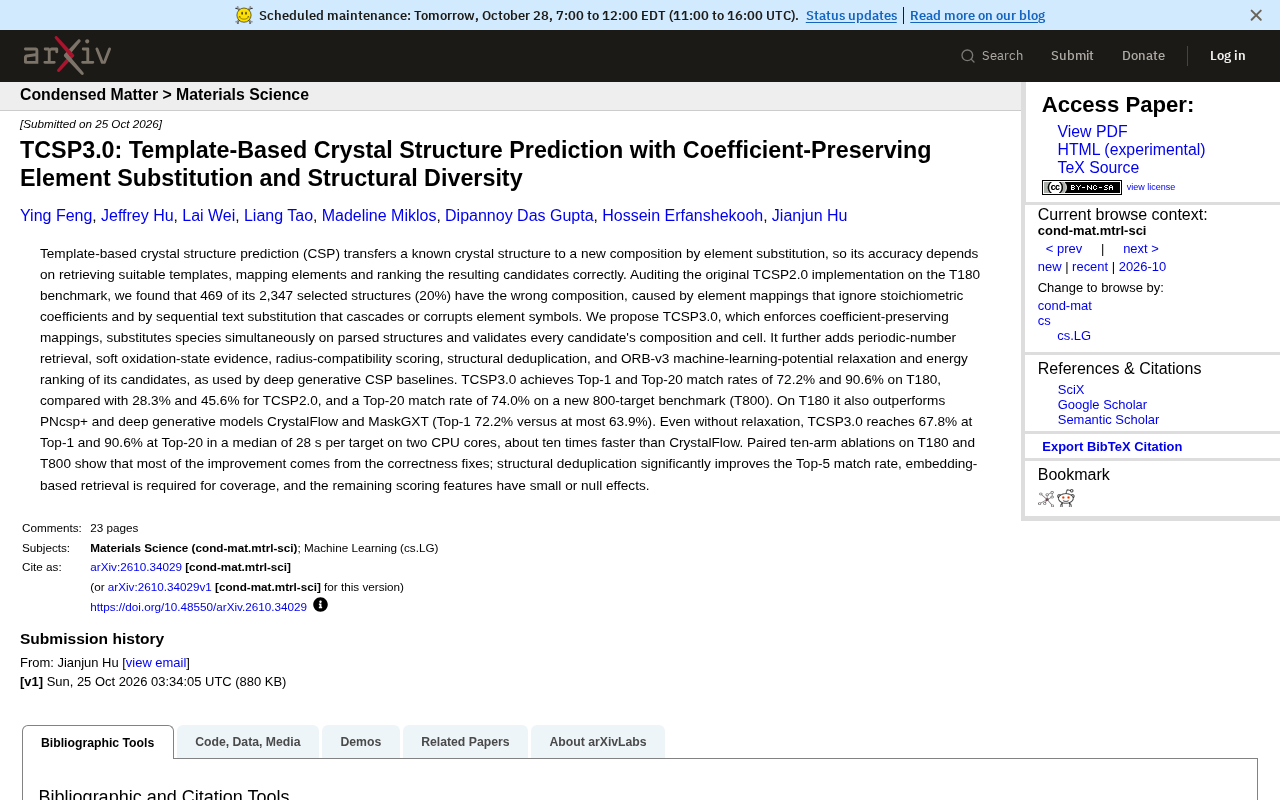
An audit found that among 2,347 structures selected by TCSP2.0 on the T180 benchmark, 469 (20%) had incorrect compositions, caused by element mapping that ignored stoichiometric coefficients and symbol cascading from sequential text replacement. TCSP3.0 rebuilds the substitution workflow, enforcing coefficient-preserving mapping and synchronous species replacement on parsed structures while validating each candidate's composition and unit cell. Ablations show gains mainly come from these correctness fixes. TCSP3.0 also adds period-number retrieval, soft oxidation-state evidence, radius compatibility scoring, deduplication, and ORB-v3 MLP relaxation/ranking. On T180 it reaches 72.2%/90.6% Top-1/Top-20 versus TCSP2.0's 28.3%/45.6%; without relaxation, median runtime is 28 s per target on a dual-core CPU, ~10x faster than CrystalFlow.
Crystal structure prediction (CSP) is a core step in materials discovery. Template-based methods transfer known structures to new compositions through element substitution, and their accuracy depends heavily on template retrieval, element mapping, and candidate ranking. However, an audit of TCSP2.0 revealed a startling flaw: among the 2,347 structures selected by the T180 benchmark, 469 (20%) had incorrect compositions. The root causes were element mappings that ignored stoichiometric coefficients and sequential text replacements that led to symbol cascading or corruption.
The Flaw in TCSP2.0: 20% of Candidate Structures Have Incorrect Compositions
While auditing TCSP2.0, the research team found systematic defects in its element substitution mechanism. Sequential text replacement not only fails to handle stoichiometric coefficients correctly, but also cascades and corrupts other element symbols during replacement, causing the final structure composition to mismatch the target. This error affects as much as 20% of the T180 benchmark, severely limiting prediction reliability.
This finding points directly to the core pain point of template-based CSP: coefficient preservation in element mapping. If the substitution process cannot strictly preserve the atomic ratios of each element, subsequent structure relaxation and energy ranking will be built on an incorrect foundation.
Stoichiometric coefficients are not an optional detail in element substitution for crystal structure prediction. For example, if the target composition is (\mathrm{LiFePO_4}), the corresponding (\mathrm{NaVPO_4}) in the template requires mapping Na to Li and V to Fe while keeping the atom counts and ratios of P and O unchanged. For structures with subscript coefficients such as (\mathrm{Fe_2O_3}), if Al in an (\mathrm{Al_2O_3}) template is simply replaced by Fe, a text-level substitution may change only the element symbol while retaining the subscript, which appears correct on the surface. But if the stoichiometries of the template and target composition differ (e.g., mapping an (\mathrm{ABO_3}) perovskite to an (\mathrm{A_2BO_4})-type structure), the atom counts must be adjusted explicitly. A more insidious risk comes from symbol cascading: during sequential text replacement, replacing Al with Fe first and then replacing Fe with another element may mistakenly alter the newly generated Fe symbol, or corrupt substrings within element names (e.g., accidentally affecting Po when replacing P with S), causing the final composition's element types or ratios to mismatch the target. Coefficient-preserving mapping requires first parsing the element counts in the structure and then mapping synchronously at the species level, rather than replacing strings one by one.
Core Improvements in TCSP3.0: Coefficient-Preserving Mapping and Synchronous Replacement
TCSP3.0 reconstructs the replacement workflow from the ground up. It enforces coefficient-preserving element mapping, synchronously replaces all species on the parsed structure, and validates the composition and unit cell of every candidate. This fix may look basic, but it became the main source of performance improvement.
According to the ablation experiments in the paper, ten paired tests on T180 and T800 show that most of the improvement comes from these correctness fixes. In other words, many advanced features of TCSP2.0 were dragged down by basic errors, and TCSP3.0 first ensures that it "does the right thing."
New Features: Comprehensive Enhancements from Retrieval to Ranking
In addition to fixing the core defects, TCSP3.0 introduces a series of enhancement modules:
- Period-number retrieval: uses the positions of elements in the periodic table to assist template matching.
- Soft oxidation-state evidence: introduces oxidation-state information as soft constraints to avoid bias caused by hard rules.
- Radius compatibility scoring: evaluates the size match between substituted elements and target elements.
- Structure deduplication: removes redundant candidates and significantly improves Top-5 match rates.
- ORB-v3 machine learning potential relaxation and energy ranking: relaxes and ranks candidate structures by energy, consistent with deep generative CSP baselines.
One detail: ablation experiments show that embedding-based retrieval is critical for coverage, while the other scoring features have small or negligible impact. Structure deduplication significantly improves the Top-5 match rate.
Machine learning potentials (MLPs) are a class of models trained on first-principles data to approximate potential energy surfaces. Typical examples include MACE, CHGNet, M3GNet, and the ORB series mentioned in the paper. In crystal structure prediction workflows, candidate structures often come from template substitution or generative models, and atomic positions may deviate from local energy minima, so direct energy ranking can overestimate or underestimate stability. MLP relaxation performs force-field-driven geometry optimization of candidate structures at a cost far below density functional theory (DFT), and then uses the relaxed energy as the ranking criterion, thus adopting the same evaluation standard as deep generative CSP baselines. ORB-v3 is one of the general-purpose interatomic potentials in this class, emphasizing transferability across elements and structures. Note that MLP accuracy is limited by the training distribution and may show large errors for structures containing rare elements or extreme coordination, so its role is mainly to provide consistent and efficient relative ranking rather than to replace high-precision validation.
Performance: A Double Leap in Accuracy and Speed
On the T180 benchmark, TCSP3.0 achieves Top-1 and Top-20 match rates of 72.2% and 90.6%, respectively, while TCSP2.0 reaches only 28.3% and 45.6%. On the newly constructed 800-target benchmark T800, TCSP3.0 achieves a Top-20 match rate of 74.0%.
Compared with existing methods, TCSP3.0 also outperforms PNcsp+ and the deep generative models CrystalFlow and MaskGXT on T180 (Top-1 72.2% vs. a maximum of 63.9%). More impressively, even without relaxation, TCSP3.0 achieves Top-1 67.8% and Top-20 90.6% with a median runtime of only 28 seconds per target on a dual-core CPU, about ten times faster than CrystalFlow.
Implications and Outlook
TCSP3.0's work reveals an often overlooked lesson: in complex machine learning systems, the correctness of basic data processing is often more critical than fancy model architectures. By fixing the coefficient preservation and synchronization of element substitution, TCSP3.0 not only greatly improves prediction accuracy but also maintains very high computational efficiency. Its modular design also leaves room for subsequent integration of more advanced retrieval and ranking strategies.
For researchers in materials informatics and computational materials, TCSP3.0 provides a reliable and efficient template-based CSP tool, while also reminding the community to pay attention to detail traps in data preprocessing.
One-line Summary
TCSP3.0 greatly improves the accuracy and speed of template-based crystal structure prediction by fixing coefficient preservation and synchronization defects in element substitution.
Paragraph Summary
The article's audit found that among the 2,347 structures selected by the template crystal structure prediction tool TCSP2.0 on the T180 benchmark, 469 (20%) had incorrect compositions. The root causes were element mapping that ignored stoichiometric coefficients and symbol cascading or corruption caused by sequential text replacement. TCSP3.0 reconstructs the replacement workflow from the ground up, enforces coefficient-preserving mapping, synchronously replaces all species on the parsed structure, and validates the composition and unit cell of every candidate. Ablation experiments show that the performance improvement mainly comes from these correctness fixes. In addition, TCSP3.0 adds period-number retrieval, soft oxidation-state evidence, radius compatibility scoring, structure deduplication, and ORB-v3 machine learning potential relaxation and energy ranking. On T180, its Top-1 and Top-20 match rates reach 72.2% and 90.6%, respectively, far exceeding TCSP2.0's 28.3% and 45.6%. Without relaxation, the median runtime is only 28 seconds per target on a dual-core CPU, about ten times faster than CrystalFlow.
Related articles
AWS AgentCore Gateway: Connecting AI A…
AWS AgentCore Gateway: Connecting AI Agents to Enterprise Backends with MCP
How AWS AgentCore Gateway acts as a primary MCP server to aggregate REST APIs, Lambda, and existing MCP services? Analyzing its AST real-time mapping, zero cold start, semantic search for tool overload, session isolation, and key injection security design, plus the architectural approach to decoupling enterprise AI agents from backends.

One Link Gives Figma AI a New Skill: Hands-On with MCP Connectors
Paste one MCP server link and the AI Agent in Figma gains new tool capabilities. We break down the setup flow, 20+ one-click apps, read/write permissions and execution policies, and the public HTTPS requirement.

Cognition SWE-2 in Practice: One Prompt to Handle the Whole Product Launch Process
Analyzing a YouTube creator's prompt for using Cognition SWE-2 to launch a product: a landing page, seven-email sequence, and non-buyer follow-up tool, plus how the 'test and report' constraint changes AI delivery quality.