Tech Decision Paralysis: How to Find the Right Project Direction for You

Practical strategies for developers who know many technologies but struggle to pick a project to build.
Many developers face a paradox: they know a bit of everything but can't decide what to build. This article explores why broad skill sets cause decision paralysis, debunks the myth of needing absolute originality, and offers practical strategies — from combining hardware and software skills, to imposing creative constraints, to embracing 'done over perfect' — to help developers find meaningful project direction and start building.
A Common Yet Very Real Dilemma
On the path of learning to code, there's a type of anxiety that almost everyone experiences — it's not about being unable to write code, but rather "not knowing what to build." Recently, a Reddit user preparing for Stardance (a Hack Club hackathon) perfectly captured this common sense of confusion:
"I want to build a project for Stardance, but I don't know what specifically to make. I know a little bit of everything because I haven't decided what I really want to specialize in."
Hack Club is a global programming community for teens and young developers, founded by Zach Latta in 2014, aimed at providing high school and college students with a hands-on coding environment. The hackathons it organizes (such as Stardance) typically require participants to build a demo-ready project from scratch within a limited timeframe — anywhere from 24 hours to a weekend. The core philosophy of hackathons isn't competition, but "building things": encouraging participants to rapidly prototype ideas and learn by doing, rather than staying stuck in the theoretical learning phase. This is precisely why "not knowing what to build" becomes the first hurdle most participants encounter.
This developer actually has a fairly broad skill set: reasonably proficient in C++, knows some C# and PHP, is familiar with HTML, CSS, and JavaScript, and has dabbled in CAD, Arduino, desktop apps, and web apps. Their tech stack is "wide-ranging" to say the least — but ironically, it's this "knowing a little of everything" state that traps them in decision paralysis.
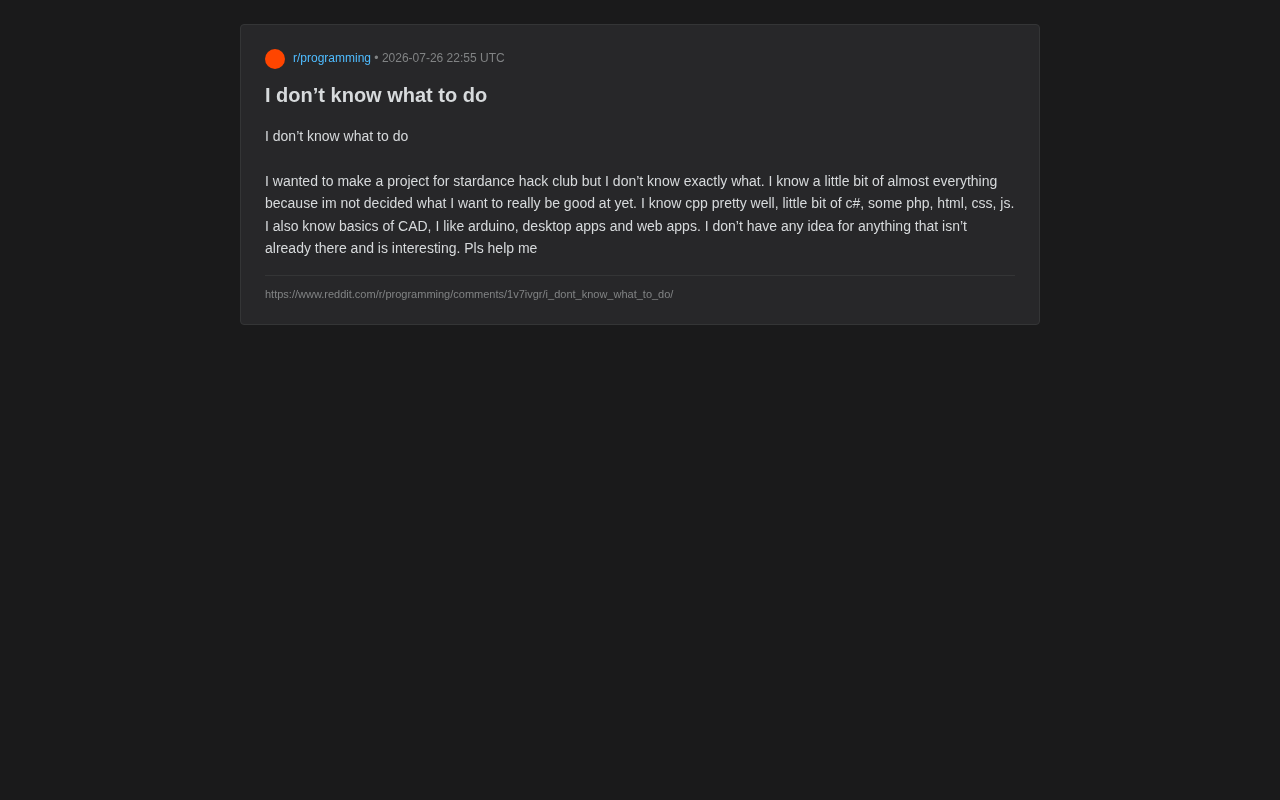
The question seems simple on the surface, but it touches on a core issue in tech learning: When you have multiple possibilities, how do you make a meaningful choice?
Why "Knowing Everything" Can Leave You Stuck
The Breadth vs. Depth Paradox
For beginners, "mastering multiple technologies" sounds like an advantage, but from a project-building perspective, it can create two hidden problems.
The first is excessive decision costs. When you only know web development, the answer to "what project should I build" is obvious. But when Arduino, desktop apps, web apps, and CAD are all on the table, every direction needs to be evaluated, which actually raises the psychological barrier to getting started.
This phenomenon is known in psychology as "Choice Overload," also called the "Paradox of Choice." Psychologist Barry Schwartz systematically articulated this concept in his book The Paradox of Choice: once the number of options exceeds a certain threshold, people's satisfaction actually decreases and decision anxiety skyrockets. Professor Sheena Iyengar of Columbia University validated this with her classic "jam experiment" — in a supermarket, a display of 24 varieties of jam attracted more people to stop and browse, but the ultimate purchase rate was only 3%, while a display of just 6 varieties achieved a 30% purchase rate. For programmers, the "options" in a tech stack are like jars of jam on a shelf — more choices aren't necessarily a good thing.
The second is the lack of a "depth anchor." Truly compelling project ideas are often born from deep exploration within a specific domain. When you've dug deep enough in one direction, you naturally discover "pain points with existing tools" — and that's exactly where good projects begin. A state of superficial dabbling rarely produces this kind of insight.
This relates to an important model in tech talent development — the T-shaped professional. The concept was originally proposed by McKinsey and later widely adopted by companies like IDEO and Google. The horizontal bar of the T represents broad cross-domain knowledge, while the vertical bar represents deep expertise in a specific area. A person's competitive edge doesn't lie in how long the horizontal bar is, but in how deep the vertical bar goes — with depth, breadth can then serve its purpose in making connections and driving innovation. This Reddit developer's current state is more like a long horizontal bar without a vertical bar — an "I-shaped" talent, so to speak — and a hackathon is precisely a great opportunity to pick a direction and start digging deeper.
"Originality Anxiety" Is a False Problem
The developer mentioned "not being able to think of anything that hasn't already been done and is interesting enough." This is actually a common misconception among many creators — an excessive pursuit of absolute originality.
In reality, the vast majority of successful projects are not "unprecedented." They're either improvements on existing ideas, combinations of different technologies, or simply reimplementations from a different angle. The value of a hackathon has never been about inventing entirely new concepts, but rather bringing an idea to life within a limited timeframe.
From a tech history perspective, this pattern is repeatedly confirmed. Google wasn't the first search engine (AltaVista and Lycos came before it), the iPhone wasn't the first smartphone (Palm and BlackBerry preceded it), and even Linux wasn't the first Unix-like operating system. These products succeeded because of execution quality and unique perspective, not because they were "unprecedented." Austin Kleon goes even further in his book Steal Like an Artist: all creative work builds on what came before, and the key is how you recombine existing elements and infuse them with your own understanding. For hackathon participants, building "your own version" of a weather app or to-do list is far more valuable than waiting around for an idea "no one has ever done before."
Project Ideas Starting from Your Skill Stack
Combining Arduino with Software
Since this developer has both hardware (Arduino, CAD) and software (C++, Web) capabilities, combining hardware and software is precisely their most unique sweet spot. Most pure software developers can't do hardware, and most hardware hobbyists can't build good interfaces.
Arduino is an open-source electronic prototyping platform created in 2005 by a team at the Interaction Design Institute Ivrea in Italy, originally designed to provide design students with a low-barrier entry point into hardware programming. At its core is a development board equipped with a microcontroller (typically ATmega series or newer ARM chips), paired with a C/C++-based programming environment. Arduino's revolutionary impact was in dramatically lowering the barrier to hardware development — you don't need to understand complex circuit design or low-level register operations to control sensors, motors, and LEDs with just a few lines of code. A massive ecosystem has formed around Arduino, including thousands of compatible sensor modules (temperature/humidity, accelerometers, GPS, ultrasonic rangefinders, etc.), motor driver boards, and communication modules (Wi-Fi, Bluetooth, LoRa). When Arduino's hardware capabilities are combined with web technologies or desktop applications, you can create a "bridge between the physical world and the digital world" — this is the core idea behind the Internet of Things (IoT).
Some viable directions:
- Use Arduino to collect environmental data (temperature, humidity, light levels) and build a real-time visualization dashboard with a web app. The Arduino side can push data to a server via Wi-Fi modules like ESP8266/ESP32, while the front end renders it in real time using libraries like Chart.js or D3.js. Building this entire data pipeline is itself a comprehensive full-stack exercise.
- Create a physical interactive device: design the enclosure with CAD, 3D print it, and use C++ for the control logic. CAD (Computer-Aided Design) software like Fusion 360, SolidWorks, or the open-source OpenSCAD can precisely design hardware enclosures, export them as STL files, and 3D print them directly — completing the full loop from digital design to physical product.
- Desktop app + hardware combinations, such as a custom macro keyboard or gesture controller.
These types of projects tend to stand out at hackathons because demos you can "physically touch" are inherently persuasive. Hackathon judges and audiences see web pages and apps every day, but a physical device that actually does something will immediately catch their attention — this is what's known as the "demo effect."
Use Web Tech to Solve Small Real-Life Pain Points
If time is tight, web apps are the fastest route to tangible results. The key is to start from your own real needs: What inconveniences have you encountered in your studies or daily life?
- A small tool for managing learning progress
- A dashboard that aggregates and displays a certain type of information
- A script or interface that automates repetitive tasks
"Solving your own problem" is the most reliable source of creative ideas because you're both the developer and the first user, so you can immediately validate whether the solution actually works. This approach has a specific term in software development — "dogfooding" — first popularized by Microsoft in 1988. Many well-known open-source projects and startups originated from founders solving their own pain points: Ruby on Rails was born out of the Basecamp team building their own project management tool, and Notion started as founder Ivan Zhao's alternative to note-taking tools he was dissatisfied with. "Your own needs" are reliable because you have the most genuine understanding of the problem and the most intuitive judgment of the solution's quality.
Practical Methods to Break Through Decision Paralysis
Define the Direction First, Then the Project
Instead of agonizing over "what project to build," answer a more fundamental question first: What skill do I want to practice or demonstrate this time? Do you want to go deeper into C++? Try hardware-software integration? Or polish your front-end experience? Once you've identified the learning objective, you naturally have criteria for filtering project ideas.
Impose Constraints on Yourself
Unlimited possibilities lead to paralysis. Deliberately adding constraints actually sparks creativity. For example:
- Limit yourself to only using the Arduino + Web tech stack
- Limit the scope to something completable within 48 hours
- Limit the goal to solving a specific problem for a specific person (like your roommate)
The more specific the constraints, the easier it is to start taking action.
This principle has extensive empirical support in creative fields. A 2015 study published in Organizational Behavior and Human Decision Processes found that moderate constraints actually improve the quality of creative output — because constraints force the brain to abandon the inefficient mode of "infinite divergence" and instead explore more deeply within a limited space. In practice, this principle is widely applied: Twitter's original 140-character limit gave rise to a unique short-text culture; Game Jams in game development typically impose thematic constraints (like "only one button" or "time loop"), and it's precisely these seemingly restrictive conditions that inspire ingenious designs. For programmers, "I can build anything" is the worst possible starting point, while "I need to solve a problem for my roommate in 48 hours using Arduino and JavaScript" is a clear, actionable starting line.
Done Is Better Than Perfect
For hackathon participants, the most important advice is this: Pick a "good enough" idea and start building, rather than waiting for the "perfect" idea to appear. A project's value becomes clearer as you make progress, and many great ideas only emerge while you're writing code. Standing still and thinking about "what would be most interesting" is never as meaningful as actually building something "decent."
Behind this is a principle repeatedly validated in software engineering: iteration beats waterfall. The traditional "waterfall model" requires exhaustive requirements analysis and design before any coding begins, while Agile development advocates building a Minimum Viable Product (MVP) first, then continuously adjusting based on usage and feedback. Reid Hoffman (co-founder of LinkedIn) has a widely quoted saying: "If you're not embarrassed by the first version of your product, you've launched too late." For hackathon participants, this can be rephrased: if you already think your idea is perfect before you've written a single line of code, you're probably overthinking it.
Final Thoughts
This Reddit developer's confusion is not fundamentally a capability problem — it's a lack of direction. The breadth of their skills is an asset, but turning it into results requires focus, not further expansion.
For all learners at a similar stage, the answer is perhaps quite simple: Stop waiting for inspiration. Start from the skills you already have and the real needs you actually face, pick a small project you can finish within your deadline, and write the first line of code. Confusion dissolves through action, and direction often reveals itself, little by little, in the process of doing.
Related articles

Disaster and Glory of the Apollo Program: The History We Must Revisit Before Returning to the Moon
From the fatal Apollo 1 fire to Apollo 8's daring lunar orbit to Apollo 11's successful landing—revisiting the disasters, fears, and compromises of the Apollo program and their lessons for today's return to the Moon.
Netflix Trust Exercise Turns Into Firing Trap: Where Are the Boundaries of Corporate Trust?
A Netflix employee was fired after sharing private info in a trust exercise. We analyze the risks of corporate trust exercises and how employees can protect themselves.

AMD CDNA5 Architecture Deep Dive: Technical Evolution and the AI Computing Competition Landscape
Deep analysis of AMD's CDNA5 architecture covering Chiplet packaging upgrades, HBM memory evolution, and low-precision compute optimization, examining how AMD challenges NVIDIA's AI chip dominance.