Tech Giants Pour $92 Million: The Political-Business Game Behind the White House Ballroom Project

Six tech giants donated $92 million to the White House ballroom project, reflecting a shift in tech's political engagement and its potential impact on AI regulation and industry competition.
The Washington Post revealed that Nvidia, Apple, Google, Microsoft, Amazon, and Meta together donated $92 million to the White House ballroom project. This donation comes at a critical window when the tech industry faces multiple regulatory pressures including antitrust and AI safety reviews, making it hard to view as purely charitable. The article argues this marks a shift in tech companies' political engagement from indirect lobbying to direct, high-profile donations, exacerbating the public trust deficit. The donations could influence AI regulatory frameworks, create hidden competitive advantages for large tech companies, and reshape the industry landscape. The core question is how to maintain transparency and hold the line while participating in politics.
An Unusual "Renovation Bill"
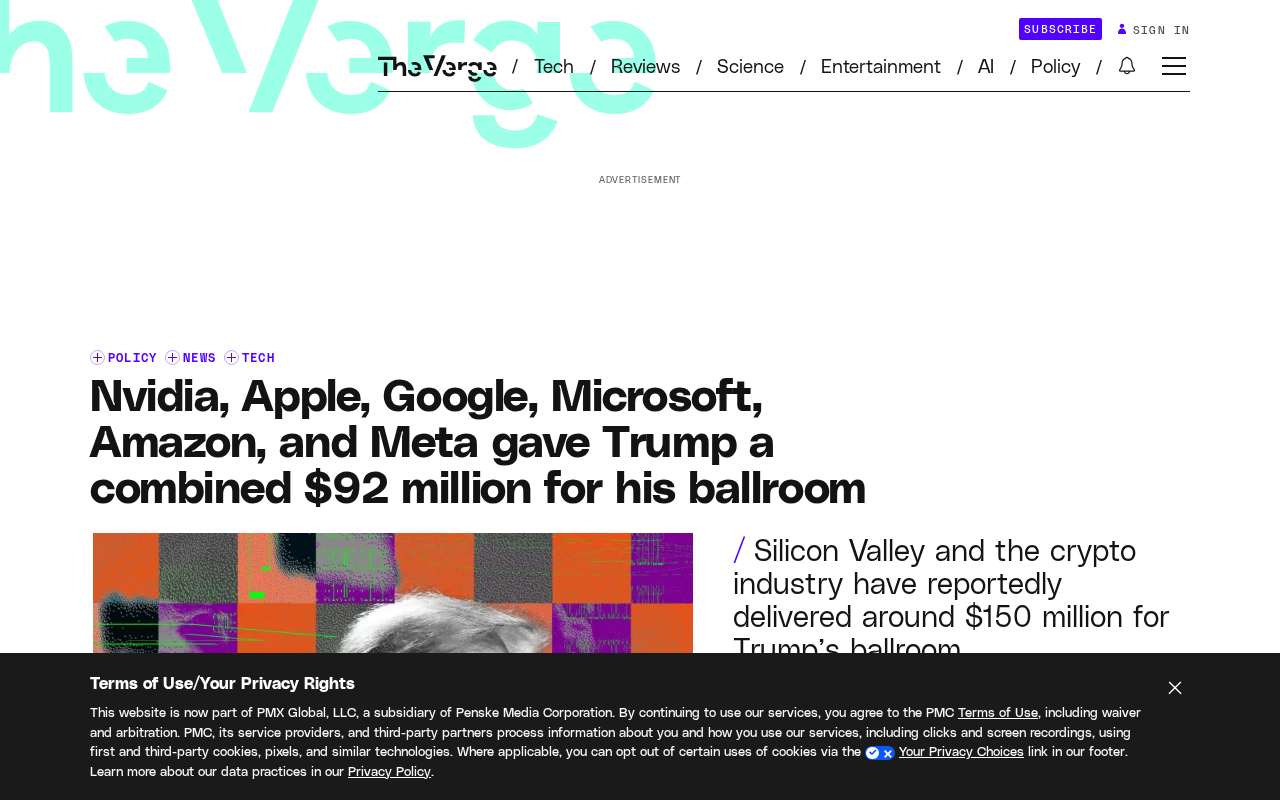
When The Washington Post published the donor list for the White House ballroom project, the scale of the tech industry's political contributions once again reshaped public perception. Six tech giants—Nvidia, Apple, Google, Microsoft, Amazon, and Meta—together contributed $92 million to support this White House facility construction project.
What makes this figure striking is not just its absolute scale, but the delicate timing it reveals: tech companies are facing unprecedented regulatory pressure, from antitrust lawsuits to AI safety reviews, and every policy could reshape the industry landscape. At this critical juncture, such a large-scale "donation" is hard to interpret as a purely charitable act.
Each Company's Calculations
The Chip Giant's Special Predicament
Nvidia's involvement is particularly intriguing. As the absolute dominant player in the AI chip market, Nvidia's export control policies, antitrust investigations, and AI computing power regulations all directly relate to its core business. On Washington's policy chessboard, Nvidia needs to ensure its voice is heard.
By contrast, Apple faces ongoing scrutiny of its App Store ecosystem and global questions about its closed ecosystem. Google and Meta have long been at the center of antitrust storms, with their advertising business models repeatedly challenged. While Microsoft and Amazon compete fiercely in cloud computing, they share common interests in AI regulation and government procurement.
The "New Normal" of Political Donations
This $92 million donation is, in fact, a microcosm of the shift in the tech industry's political engagement model. In the past, tech companies preferred to influence policy indirectly through lobbying and industry associations; now they increasingly favor direct, high-profile political investment. Behind this shift is a fundamental change in the relationship between the tech industry and government—from "you mind your business, I'll mind mine" to "deep entanglement."
The legality of U.S. political donations is primarily established by the Federal Election Campaign Act of 1971 and subsequent amendments. The core framework prohibits corporations from donating directly to federal candidates, but allows influence through Political Action Committees (PACs), super PACs, and donations to specific non-campaign projects (such as inaugurations, party events, and naming rights for public facilities). The 2010 Supreme Court ruling in Citizens United v. FEC further removed limits on independent political spending by corporations and unions, spawning the proliferation of super PACs and dark money organizations. Unlike traditional lobbying, political donations lean more toward resource transfer and relationship maintenance, while lobbying focuses on information delivery and position statements. When donations target non-campaign projects like the White House ballroom, they are often not subject to strict disclosure requirements by the Federal Election Commission, making them more likely to become transparency blind spots—which precisely explains why media investigation has become the primary channel for public awareness.
The Paradox of Transparency and Public Trust
The Washington Post report brought this massive donation to light, but it also exposed a deeper problem: without media investigation, the public might never have known the specific investment these tech giants made in the White House project.
This "post-hoc exposure" model keeps tech companies' political donations perpetually shrouded in a gray area. On one hand, corporations have the right to participate in the political process; on the other hand, when such participation comes in such a concentrated form, the public has reason to question: is this money supporting public facility construction, or buying policy influence?
For the tech industry, the greater risk lies in a trust deficit. These companies are already heavily criticized on issues like data privacy, content moderation, and market monopolization. The exposure of massive political donations only intensifies public suspicion of their motives.
Potential Impact on AI Regulation
The timing of this donation highly coincides with a critical window for AI regulation. Currently, governments worldwide are racing to establish AI governance frameworks, from model transparency to computing power exports, and every rule could affect tech giants' competitive advantages.
Against this backdrop, the political capital tech companies build through donations may translate into influence in the policy-making process. This is not a conspiracy theory, but the basic logic of political operation. The question is: when the relationship between policymakers and fund providers becomes too close, how can the independence and fairness of regulation be guaranteed?
Global AI regulation is currently fragmented. The EU's AI Act sets obligations by risk tiers, China has issued generative AI management measures, and the U.S. remains at the stage of executive orders and voluntary industry commitments. Federal-level AI legislation in the U.S. has been slow to materialize, with states (such as Colorado and California) advancing on their own, giving tech giants strong incentives to push for looser, more unified rules at the federal level to avoid compounding compliance costs across states. At the same time, policy tools such as export controls, computing power procurement, and government procurement contracts also directly affect AI companies' revenue expectations. In this window period, the policy capital brought by political donations is particularly critical: it may manifest as gentle questioning at hearings, subtle adjustments to key wording in legislative drafts, or grace periods for transitional rules. Regulatory capture theory points out that when dense exchanges of personnel, finances, and information form between the regulated and the regulators, the scales of rule-making tip. For tech giants, donations don't directly buy rules, but they do pave the way for more friendly dialogue channels.
The Hidden Reshaping of Industry Competition
More subtle effects may occur at the level of competition among tech companies. When Nvidia, Apple, Google, Microsoft, Amazon, and Meta appear together on a donation list, it's not just collective action—it may also be a signal: in Washington's policy game, these companies have both competition and common interests.
This "co-opetition" relationship could reshape the competitive landscape of AI and the tech industry. When regulation becomes a key competitive variable, whoever better manages their relationship with the government may gain a hidden advantage. For small and medium-sized tech companies and startups, this undoubtedly increases competitive inequality.
Conclusion: The Eternal Proposition of Money and Policy
The $92 million ballroom donation, on the surface, is tech giants' support for a White House project; in essence, it is a landmark event in the deepening of the tech industry's political engagement. In this era where AI reshapes everything, the entanglement of technology and politics will only grow tighter. The real question is not "should tech companies participate in politics," but "how to maintain transparency in participation and hold the line in influence."
For those who follow the tech industry, the significance of this donation far exceeds its numerical value. It reminds us that when evaluating AI regulation, antitrust policy, or even technical standards, we need to see the invisible hands—those forces that influence rule-making through political donations, lobbying, and policy participation.
One-line Summary
Six tech giants donated $92 million to the White House ballroom project, reflecting a shift in the tech industry's political engagement model and its potential impact on AI regulation and industry competition.
Paragraph Summary
The Washington Post revealed that six tech giants—Nvidia, Apple, Google, Microsoft, Amazon, and Meta—together donated $92 million to the White House ballroom project. This donation comes at a critical window when the tech industry faces multiple regulatory pressures including antitrust and AI safety reviews, making it hard to view as purely charitable. The article argues this marks a shift in tech companies' political engagement from indirect lobbying to direct, high-profile donations, exacerbating the public trust deficit. The donations could influence the formulation of AI regulatory frameworks, create hidden competitive advantages for large tech companies, and reshape the industry competitive landscape. The core question is how to maintain transparency and hold the line while participating in politics.
Related articles

OpenAI Partners with Shield: How the Astra Agent Revolutionizes IT Troubleshooting
OpenAI and Shield launch the Astra agent, which autonomously logs into computers and legacy systems to fix IT issues in real time, 35-40% faster than traditional models, with humans involved only when judgment is needed.

iPhone Duo Battery Life Tested: One Charge a Day Is Unavoidable, and the Large Screen Is the Culprit
iPhone Duo battery test: heavy use needs at least one charge a day, and about 30% remains after 6.5 hours of screen-on time. How often the large screen is unfolded is key; a MagSafe battery pack helps, and long-term degradation is also worth watching.

Kimi K3.1 Pro Open-Sourced: 2.8 Trillion Parameters Close In on Opus
Moonshot releases the open-source MoE model Kimi K3.1 Pro, with 2.8T total parameters and 104B activated, trailing Opus 5.5 by under 1 point on Terminal Bench 4.0.