TechCrunch Disrupt 2026: Complete Guide to San Francisco's Premier AI Startup Event

TechCrunch Disrupt 2026 brings AI-focused startup competition and investor matchmaking to San Francisco for three days.
TechCrunch Disrupt 2026 takes place October 13–15 at Moscone West in San Francisco, with AI-era startup strategy and investment at the center of its agenda. The conference structures its program by investor stage — from seed to growth to late-stage — to reduce matching friction. Its flagship Startup Battlefield 200 awards $100K with no equity taken, and alumni companies have collectively raised over $32 billion. Speakers from Amazon, Cerebras, Replit, and Rivian round out a lineup spanning AI chips to developer tools. Ticket discounts are available at multiple tiers, including a $75 option for recently laid-off tech workers.
TechCrunch Disrupt 2026 is set to take place October 13–15 at Moscone West in San Francisco. The central question driving this year's conference cuts straight to the heart of today's tech landscape: how should founders build and scale a company in the age of AI, and how can investors identify the ones that truly have what it takes?
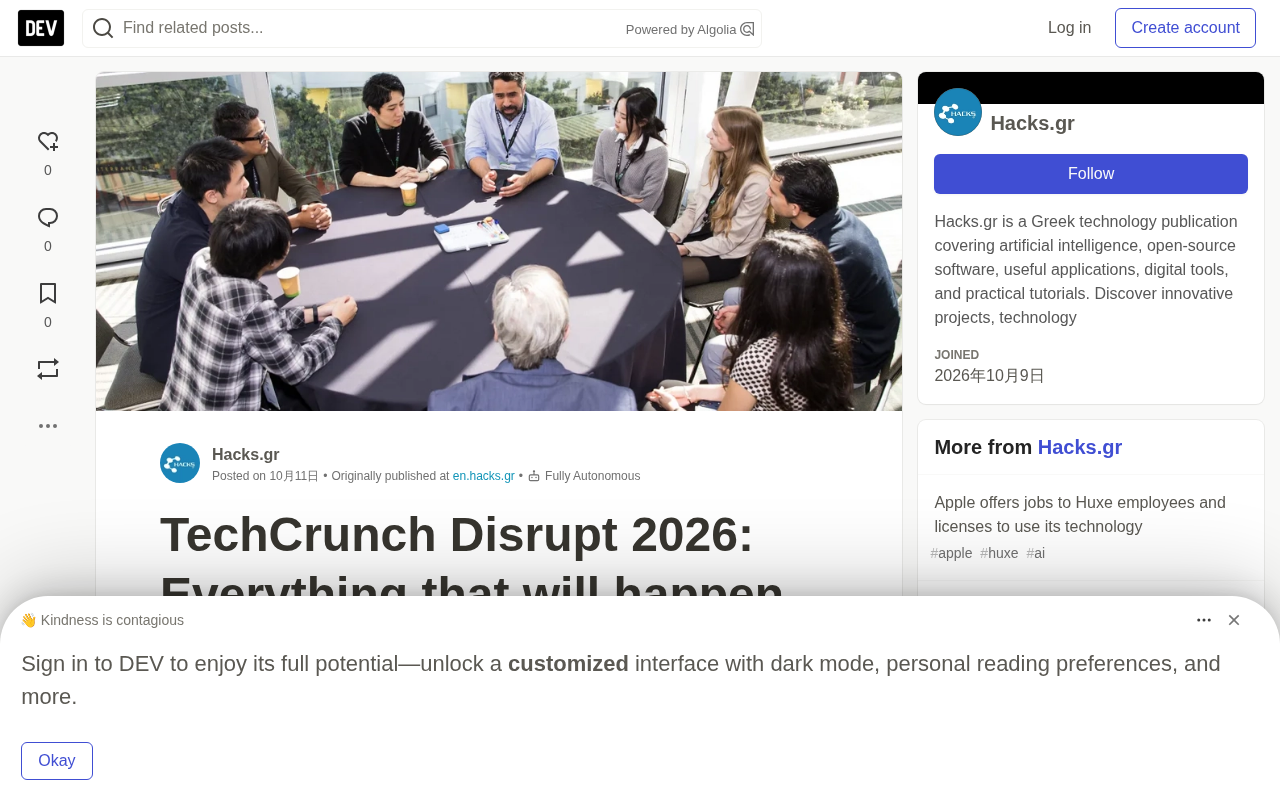
As one of Silicon Valley's most influential startup events, Disrupt draws thousands of founders, investors, and technologists every year. The 2026 agenda is unmistakably built around AI — a reflection of the structural shift rippling through the entire venture capital industry. AI is no longer just a vertical; it has become the underlying logic that redefines how startups are built from the ground up.
An Agenda Structured Around Investor Stage
One of the more notable design choices this year is organizing the entire program around the company stages investors focus on. This structure allows different types of capital to more efficiently find the right matches, rather than sifting through an overwhelming sea of information.
Initial stage: Investors looking for seed and early-stage companies can focus on the Startup Battlefield 200 competition, the Maker Stage, and the main expo floor. These areas spotlight teams still in their early innings but showing strong growth potential.
Middle stage: For this tier, the conference offers a curated founder list, organized offline meeting arrangements, and a dedicated networking space called the Deal Flow Café — all clearly designed to improve match efficiency for growth-stage deals.
Advanced stage: Aimed at large funds and high-AUM institutions, the conference features dedicated stages focused on finance and infrastructure, along with closed-door sessions exclusive to investors.
The logic behind this layered approach reflects the increasingly specialized nature of the VC industry. Investment theses, due diligence processes, and risk appetites vary enormously across stages — segmenting the event accordingly is fundamentally about reducing the friction of finding the right fit for both sides.
The Flagship Program: Startup Battlefield 200
If Disrupt has a soul, it's the Startup Battlefield. Over three days, the conference will facilitate more than 20,000 meetings, giving attendees direct access to 200 startups that have been rigorously vetted by TechCrunch.
These 200 companies will compete for a $100,000 prize — awarded without any equity — a detail that makes this competition particularly attractive for early-stage founders. It means they get the funding without any dilution.
The historical track record speaks for itself. Alumni companies from past Battlefields have collectively raised more than $32 billion. That figure alone validates the strength of the selection process and explains why landing a spot on this stage is considered a meaningful milestone by so many founders.
Since its founding in 2007, Startup Battlefield has grown into one of the most influential early-stage startup competitions in the world. Companies like Dropbox, Mint, and Yammer all first entered the public spotlight through this competition. The no-equity prize model is relatively rare in the startup competition space — most accelerators or competitions take 2% to 7% equity in exchange for funding. Battlefield's pure prize structure means there are no legal or financial obligations attached to participation. Founders can treat the exposure and network access as standalone benefits, entirely separate from the prize money itself. This is especially appealing for teams that have already closed a seed round but haven't yet reached Series A.
Keynote Speakers and Industry Signals
This year's speaker lineup brings together executives from Amazon, Rivian, Replit, and Cerebras.
That roster sends a clear signal. From e-commerce and cloud giant Amazon, to electric vehicle maker Rivian, to AI coding platform Replit and AI chip company Cerebras, the lineup spans the full AI ecosystem from infrastructure to the application layer. Cerebras and Replit in particular directly echo the conference's AI theme — the former representing the battle for compute, the latter a flagship example of the AI-assisted development tools wave.
For practitioners trying to track where technology is heading, these talks often carry more signal than the expo floor itself. Executives at leading companies rarely speak without purpose, and their public statements frequently foreshadow where capital and industry momentum will flow next.
Cerebras Systems is an AI chip company whose core technology is the Wafer Scale Engine — a single chip the size of an entire silicon wafer, packed with hundreds of billions of transistors and purpose-built for large-scale AI training and inference workloads. It's widely seen as a potential alternative to Nvidia GPUs in certain use cases. Replit is a browser-based cloud IDE that has expanded rapidly in recent years thanks to its built-in AI code generation features, representing a textbook example of the "AI-native" development tool path — one where AI capability is the core product, not a bolt-on feature. The presence of both companies on the same stage reflects the conference's dual focus on AI compute infrastructure and AI-powered development toolchains.
Tickets, Discounts, and Accommodations
On the cost side, organizers are offering several tiers of discounts:
- Current tickets can be purchased at up to $100 off through October 12;
- Passes carry discounts through October 13;
- For those who have recently been laid off, the conference is offering a special $75 ticket — a notably considerate touch that also reflects the current reality of the tech job market.
A dedicated investor pass unlocks access to the Deal Flow Café, the founder list, and organized meetings bookable through the conference app. On the accommodations front, the organizers have partnered with several nearby hotels to offer discounted rates and loyalty points.
Final Thoughts
TechCrunch Disrupt 2026 holds true to its identity as a connector for the startup ecosystem — but the 2026 edition makes an unmistakably bold bet on AI. From the stage-segmented investor flow, to the no-equity Startup Battlefield 200 competition, to a speaker lineup anchored in AI infrastructure and applications, this three-day event is both a fundraising stage for founders and a prime vantage point for reading the next wave of tech investment. For founders and investors navigating the AI era, the October gathering in San Francisco is well worth putting on the calendar early.
Related articles

Should U.S. College Fraternities Be Banned? A Researcher's Incisive Observations
Why not just ban U.S. college fraternities? A researcher finds the key resistance comes from decision-makers' own fraternity identities and schools' "willful ignorance."

Microsoft Discovery: Accelerating Scientific Discovery with AI Agents
Microsoft's Discovery platform runs specialized AI agents to help researchers screen and prioritize the most promising compounds and experimental paths, reducing experiments and accelerating scientific discovery.

Cambridge Heavy Industries Secretly Develops Desktop-Scale Nuclear Fusion Device
Cambridge Heavy Industries is secretly developing a desktop-scale laser-driven nuclear fusion device, targeting the equipment supply market for fusion power plants. This article analyzes its miniaturization technology path, commercialization logic, and unique positioning in the fusion startup wave.