Teenage Engineering EP-35 Multi-Function Guitar Amp Launched: Built-in Effects and Phantom Power

Teenage Engineering launches the battery-powered multi-input EP-35 amp with built-in effects, positioned as a portable rehearsal station.
Teenage Engineering officially unveils the EP-35 battery-powered amp, featuring multiple inputs and built-in effects. It offers line-in, 1/4-inch guitar input, and XLR microphone input with phantom power, allowing multiple sound sources to be connected simultaneously. Phantom power—rare in portable amps—enables small vocal performances or podcast recording. The company claims extensive built-in effects but has not disclosed specific types or parameter depth. Battery power continues the brand's portable DNA, suiting outdoor and mobile rehearsal, but key data such as amplifier power, speaker specs, wireless audio protocol, and battery life are still missing. Competitors include the Boss Katana Air and Yamaha THR series; the EP-35 differentiates through comprehensive connectivity and design language, and buyers are advised to wait for full specs and hands-on reviews.
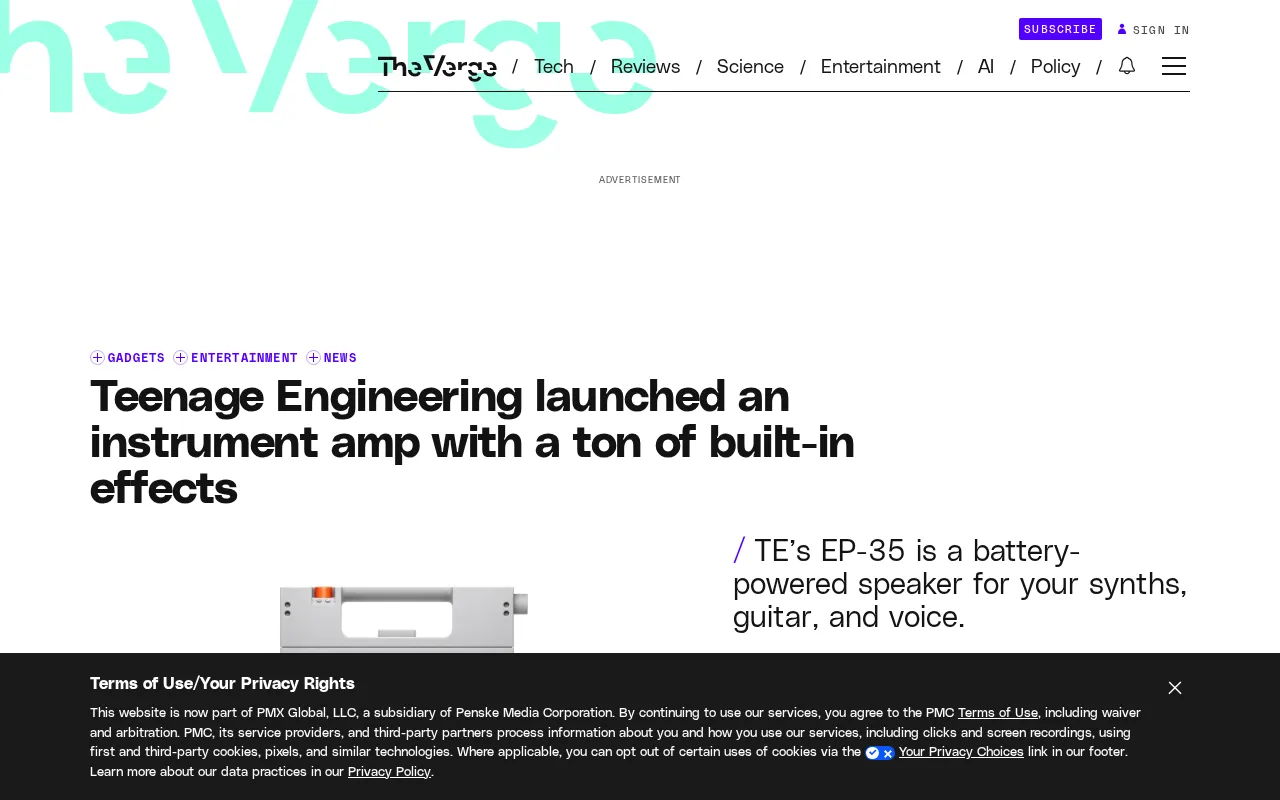
Teenage Engineering is no longer content with just making synthesizers and portable recording devices—it has set its sights on the instrument amplifier market. The previously leaked EP-35 has officially arrived: a battery-powered amp with multiple inputs, multi-instrument compatibility, and a fairly rich set of built-in effects. For musicians who like to jam at their desk or outdoors, it attempts to solve three stages—signal input, effects processing, and amplification—in a single box.
Multi-Input Design: Guitars, Microphones, and Line Signals All Covered
The rear interface layout of the EP-35 is the core of what sets it apart from ordinary practice amps. A line-in port handles line-level devices, a 1/4-inch guitar input serves electric guitars or basses, and an XLR input is dedicated to microphones—supporting condenser mics that require phantom power. This means it's not just a toy for guitarists; it can also handle small vocal performances or podcast recording scenarios.
Official information also mentions that the EP-35 supports audio streaming, but the specific protocol and latency performance have not been disclosed. Judging from the product positioning, Teenage Engineering clearly wants users to plug in multiple sound sources simultaneously rather than swapping cables one at a time. Multiple inputs are uncommon in portable amps, and the addition of phantom power pushes it one step closer toward a small mixer.
Phantom Power is the DC power supply method required for condenser microphones to operate, typically +48V, transmitted through the same pair of pins on an XLR cable, so no additional power cable is needed. Condenser microphones contain impedance conversion circuitry that requires power, while dynamic microphones do not. When a portable amp or small mixer is labeled as supporting phantom power, it means it can directly drive professional condenser mics without needing an external standalone preamp. It's worth noting that the actual power delivery capability of phantom power (whether current is sufficient and voltage is stable) directly affects the performance of high-sensitivity condenser mics—this is also a metric that professional users will focus on in real-world testing.
Built-in Effects: An Amp or an Effects Chain?
Teenage Engineering emphasized in its press release that the EP-35 features "a large number of built-in effects" but did not list them individually. Given the brand's consistent product logic—from the OP-1 to the TX-6—effects are often tied to the playfulness of the interface rather than pursuing studio-grade parameter depth. It's reasonable to assume that the EP-35's effects modules will be presented with intuitive knobs and buttons, suitable for quick switching during live performance.
For guitarists, built-in effects eliminate the hassle of external pedals, especially in portable scenarios. However, the specific types of effects, whether presets can be stored, and whether they can be expanded via firmware updates are all currently unknown. These details will directly affect its competitive comparison against traditional guitar amps.
Signal Chain refers to the processing order that an audio signal passes through from input to speaker, typically: preamp → compression/distortion → modulation effects (chorus, phaser) → delay → reverb → power amp. An amp with built-in effects is essentially multiple stompbox effects integrated into one box, but the processing order is usually fixed—though some products allow adjustment. What professional guitarists care about is whether the signal chain is editable, whether certain effects can be placed before the preamp (such as adding compression before distortion), and whether parallel processing is supported. If the EP-35 wants to compete with pedalboards, the flexibility of the signal chain and effects quality are key.
Battery Power and Portable Positioning
The EP-35 is battery-powered, continuing the "take it anywhere" DNA of Teenage Engineering's product line. Compared to rehearsal amps that require mains power, the battery solution makes it more practical for street performances, camping sing-alongs, rooftop jams, and similar scenarios. The combination of multiple inputs and battery power also suggests it may have been designed as a small mobile rehearsal station: one person on guitar, another on microphone, outputting simultaneously.
The trade-off is power and SPL. Portable amps are limited by battery and size, so bass response and maximum volume typically cannot compete with mains-powered amps at the same price point. Teenage Engineering has not published the EP-35's amplifier power or speaker specifications, which will be key data for evaluating its practical usability.
SPL (Sound Pressure Level) is a metric for measuring an amp's actual loudness, in decibels (dB). Portable amps are limited by battery power and speaker size, so SPL is typically lower—especially noticeable in open outdoor environments. Every 3dB increase in SPL requires double the power. Bass response is limited by cabinet volume and speaker diameter, and small drivers struggle to reproduce low-frequency extension. Therefore, when evaluating battery-powered amps, amplifier power (watts) and sensitivity (dB/W/m) are more useful references than battery capacity alone, which only determines runtime, not loudness.
Market Position and Open Questions
Teenage Engineering is known for design-driven products with premium positioning, and the EP-35 is unlikely to take a low-price route. Its direct competitors include desktop multi-function amps like the Boss Katana Air and Yamaha THR series, which have accumulated years of experience in effects count and app control. The EP-35's differentiation lies in its comprehensive connectivity and brand design language, but effects quality, wireless audio latency, and firmware ecosystem remain unknown.
From leak to official launch, the information release pace for the EP-35 has been fast, but key specifications are still scarce. For potential buyers, it's advisable to wait for the full spec sheet and first hands-on reviews before making a judgment—especially regarding the actual phantom power delivery performance and battery life data.
One-line Summary
Teenage Engineering launches the battery-powered multi-input EP-35 amp with built-in effects, positioned as a portable rehearsal station.
Paragraph Summary
Teenage Engineering officially unveils the EP-35 battery-powered amp, featuring multiple inputs and built-in effects. It offers line-in, 1/4-inch guitar input, and XLR microphone input with phantom power, allowing multiple sound sources to be connected simultaneously. Phantom power—rare in portable amps—enables small vocal performances or podcast recording. The company claims extensive built-in effects but has not disclosed specific types or parameter depth. Battery power continues the brand's portable DNA, suiting outdoor and mobile rehearsal, but key data such as amplifier power, speaker specs, wireless audio protocol, and battery life are still missing. Competitors include the Boss Katana Air and Yamaha THR series; the EP-35 differentiates through comprehensive connectivity and design language, and buyers are advised to wait for full specs and hands-on reviews.
Related articles

Nothing CMF Buds 2A Drops to $17.89 on Black Friday: A New Low for ANC Earbuds
Nothing CMF Buds 2A wireless earbuds Black Friday deal: just $17.89 on Amazon, about $11 off retail and a record low. ANC earbuds at an entry-level price.

When AI Creation Gets Accused of "Spitting": Hacker News Heats Up Over the Glaude Controversy
A Hacker News post, "Spitting in the Face of Glaude," sparks debate on AI creation transparency and attribution ethics. This analysis examines the blurred creator identity behind the controversy and offers practical advice for AI content production.

Akai Embraces Custom Firmware: MPC Sample 1.4 Lets Users AI-Program Their Sampler
Akai embraces the modding community with MPC Sample 1.4 firmware, supporting vibe-coded custom firmware and effects. We analyze the impact of this open strategy on music hardware and AI-assisted programming.