Teenage Engineering's First CD Player: Putting the Spinning Disc on Display

Teenage Engineering releases its first CD player, the EP/BC-1, whose exposed-disc slab design attracts attention.
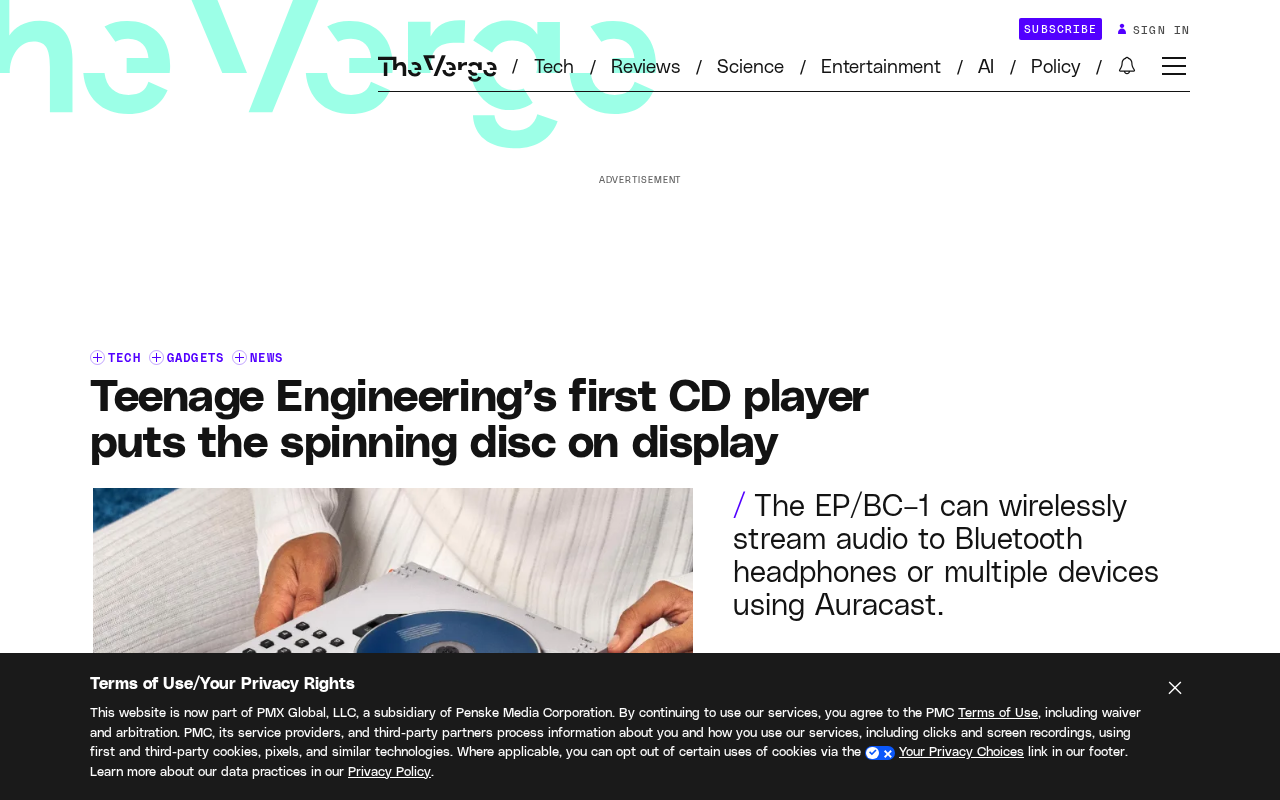
Teenage Engineering has launched its first CD player, the EP/BC-1, featuring a slab-like structure with the disc directly exposed and spinning during playback, abandoning traditional top-cover, slot-loading, or drawer-style trays. It is the first product in the company's new official "broadcast series," a name that suggests it may target content-creation scenarios such as podcasts and radio. The company calls it "a modern interpretation of the classic CD player," but has not announced pricing, release date, or technical specifications. At a time of slight CD revival, this design continues the brand's consistent language of making mechanical structures visible, while also raising practical questions about dust protection, scratch resistance, and how the body accommodates the disc-reading mechanism. For now, it looks more like a design manifesto led by concept.
Teenage Engineering is once again challenging conventional wisdom through design. The Swedish company, known for its minimalist aesthetic and modular synthesizers, has just released its first CD player, the EP/BC-1. Its most eye-catching feature is that the spinning disc is directly exposed—no top cover, no drawer; the disc itself is the visual centerpiece.
A Record Player on a "Slab"
The official description of the EP/BC-1 is "a modern interpretation of the classic CD player." According to the description, the unit uses a slab-like structure, with the disc placed out in the open so that its rotation is directly visible during playback. This is completely different from traditional CD players, which either use a top-loading lid or a slot-loading or drawer-style tray.
Exposing mechanical structures is a consistent part of Teenage Engineering's product language. From the OP-1 synthesizer to the TP-7 recorder, the company is used to letting users see "the machine at work." The EP/BC-1 continues this approach: the CD is no longer a hidden medium, but part of the device itself.
The Red Book Standard and the Basic Principles of CD Playback
The digital audio specification for CDs (Compact Discs) originates from the "Red Book" standard jointly established by Sony and Philips in 1980. It specifies a sampling rate of 44.1 kHz, 16-bit quantization, two-channel PCM encoding, and reading of the pit sequence on the disc surface with a 780 nm infrared laser. During playback, the laser pickup tracks along a spiral track from the inner ring to the outer ring, while the servo system corrects focus and tracking errors in real time. At the same time, the disc rotates at constant linear velocity—higher rotational speed at the inner ring and lower at the outer ring—to ensure a constant data rate. The reason traditional CD players generally use enclosed drawer or top-cover structures is that dust, fingerprints, and scratches scatter the laser, causing bit errors or even skipping, and an exposed design must compensate with stronger error-correction algorithms (CIRC) and mechanical stability. Understanding this principle is necessary to judge just how much risk the EP/BC-1's exposed-disc design actually takes.
The First Product in the New "broadcast" Series
The EP/BC-1 is officially described as the first member of a new "broadcast series." The naming hints at the product positioning—possibly aimed at podcasts, radio, content creation, and similar scenarios, rather than being purely nostalgic consumer electronics.
Interestingly, Teenage Engineering did not disclose the EP/BC-1's price, release date, or detailed technical specifications in the announcement. At present, only the design form and series affiliation can be confirmed. To the outside world, this product looks more like a design manifesto: in the streaming era, in what way can physical discs still be reexamined?
Teenage Engineering's Product Lineage and the "broadcast" Positioning
Teenage Engineering was founded in 2005 and is headquartered in Stockholm. It initially established its brand DNA of "transparent mechanical feel + minimalist industrial design" with the OP-1 portable synthesizer, and later launched the Pocket Operator series, the OB-4 Bluetooth speaker, the TP-7 field recorder, and the CM-15 microphone, among others. Among these, the TP-7 and CM-15 already clearly lean toward content-creation scenarios such as podcasts and field recording, and the "broadcast" series can be seen as the formal naming and extension of that product line. Incorporating a CD player into a "broadcast" context suggests that it may do more than play back music; it may also be connected to workflows such as sampling, transcription, and radio program production—which also explains why the official emphasis is on series affiliation rather than mere nostalgic selling points.
An Unconventional Attempt in the CD Revival Wave
In recent years, CDs have seen a slight recovery in the music consumption market, but most manufacturers have chosen to recreate classic appearances or focus on portability. Teenage Engineering has taken another path: rather than imitating the old era, it redesigns CD playback itself.
The risks of this strategy are also obvious. An exposed disc means that dust protection and scratch resistance require extra consideration, and it is still unclear how the slab-shaped body accommodates the disc-reading mechanism. Before these details are announced, the EP/BC-1 looks more like a product led by concept.
For people accustomed to streaming, it may be just a beautiful ornament; for users who still collect CDs, it offers a rare sense of ritual. Teenage Engineering is clearly betting on the latter and is willing to pay a practical price for design.
One-line Summary
Teenage Engineering releases its first CD player, the EP/BC-1, whose slab design with an exposed disc attracts attention.
Paragraph Summary
Teenage Engineering has launched its first CD player, the EP/BC-1, featuring a slab-like structure with the disc directly exposed and spinning during playback, abandoning the traditional top cover, slot-loading, or drawer-style tray. The unit is the first product in the company's new official "broadcast series," a name that suggests it may target content-creation scenarios such as podcasts and radio. The company calls it "a modern interpretation of the classic CD player," but has not announced pricing, release date, or technical specifications. At a time when CDs are seeing a slight revival, this design continues the brand's consistent language of making mechanical structures visible, while also raising practical questions about dust protection, scratch resistance, and how the body accommodates the disc-reading mechanism. For now, it looks more like a design manifesto led by concept.
Related articles

Nothing CMF Buds 2A Drops to $17.89 on Black Friday: A New Low for ANC Earbuds
Nothing CMF Buds 2A wireless earbuds Black Friday deal: just $17.89 on Amazon, about $11 off retail and a record low. ANC earbuds at an entry-level price.

When AI Creation Gets Accused of "Spitting": Hacker News Heats Up Over the Glaude Controversy
A Hacker News post, "Spitting in the Face of Glaude," sparks debate on AI creation transparency and attribution ethics. This analysis examines the blurred creator identity behind the controversy and offers practical advice for AI content production.

Akai Embraces Custom Firmware: MPC Sample 1.4 Lets Users AI-Program Their Sampler
Akai embraces the modding community with MPC Sample 1.4 firmware, supporting vibe-coded custom firmware and effects. We analyze the impact of this open strategy on music hardware and AI-assisted programming.