TEMPEST: Scalable Driver Identification via Additive Angular Margin Learning

TEMPEST applies ArcFace angular margin loss to driving behavior recognition, dramatically improving scalability over triplet loss methods.
TEMPEST is a new arXiv study tackling the scalability problem in behavioral driver biometrics. Its key innovation is pairing ArcFace additive angular margin loss with a Temporal Convolutional Network (TCN), replacing the conventional triplet loss paradigm. The model compresses 60-second multimodal driving signals into 96-dimensional embeddings, enabling dynamic driver enrollment without retraining. On a 45-driver dataset, TEMPEST achieves 91.71% Rank-1 accuracy — 58.4 points above the best triplet baseline — and drops only 4.3 points as the driver pool grows from 10 to 45, versus up to 32.5 points for triplet baselines. At 720K parameters and 2.80 MB, the model is edge-deployable and provides a reproducible baseline for fleet management, UBI insurance, and anti-theft verification.
Why Driver Identification Is Hard to Scale
Biometric identification based on driving behavior is a valuable but long-underserved research area, consistently hampered by scalability challenges. The core idea is straightforward: each person's driving habits — the rhythm and intensity of acceleration, braking, and steering — carry a unique behavioral fingerprint, much like a physical fingerprint or face that can be used for identity verification.
In practice, however, recognition model performance tends to collapse rapidly as fleet size grows. Researchers have identified two fundamental weaknesses in the prevailing approach of training embedding models with triplet loss: discriminative performance degrades quickly as the number of drivers increases, and models tend to overfit to specific session patterns under rigorous temporal evaluation — meaning data collected at a different time becomes unrecognizable to the model.
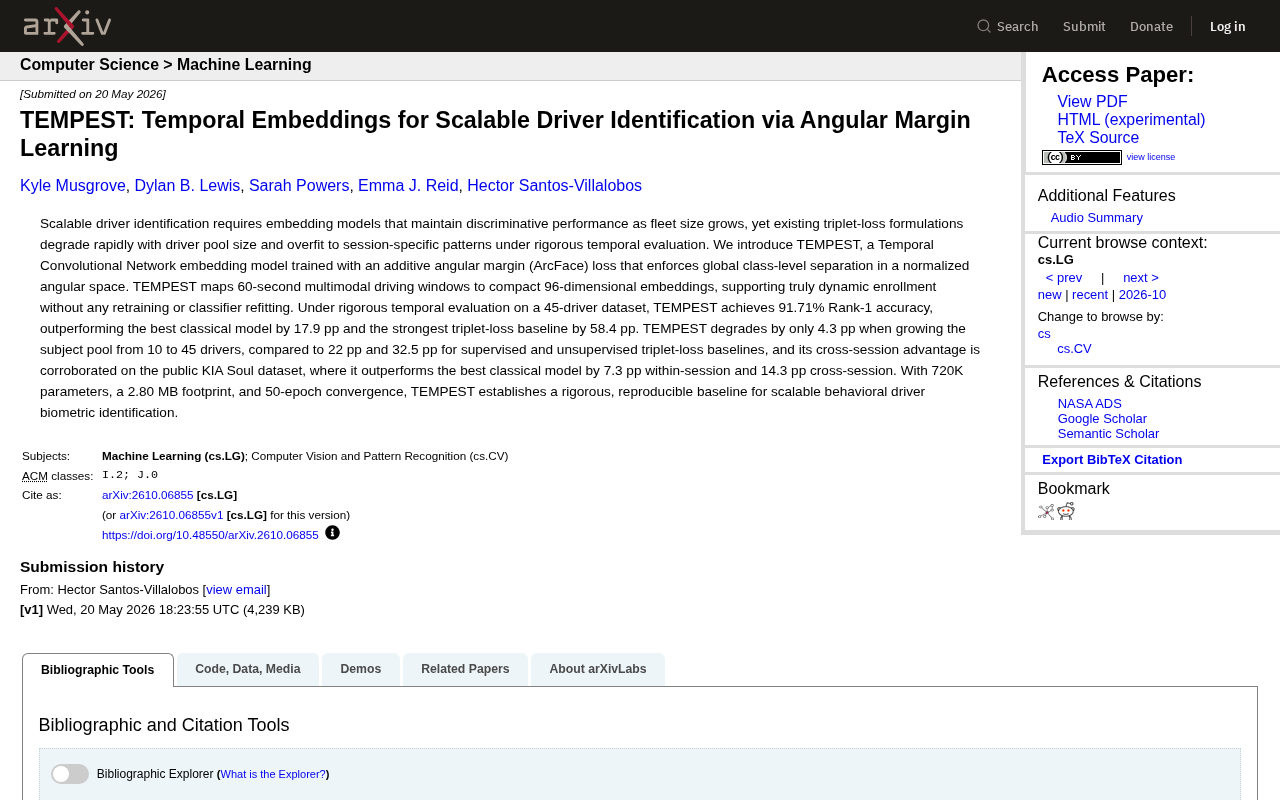
TEMPEST, a newly published work on arXiv, directly addresses this pain point. It sets out to answer a critical question: how can an embedding model maintain stable discriminative power as a fleet expands?
TEMPEST's Technical Approach
At its core, TEMPEST is a Temporal Convolutional Network (TCN) embedding model, but its true differentiator lies in training with Additive Angular Margin Loss (ArcFace).
Why ArcFace
ArcFace, best known from face recognition, enforces global inter-class separation in a normalized angular space. Unlike triplet loss, which only considers local pairwise relationships between samples, ArcFace creates margins between different classes at a global level — and that is precisely why it outperforms triplet-based methods in large-scale recognition tasks. Transplanting this idea into driving behavior identification is the primary innovation of this work.
Mechanically, ArcFace (Additive Angular Margin Loss) works as follows: feature embedding vectors and the classification weight matrix are each L2-normalized so they lie on a hypersphere; a fixed angular margin (typically 0.5 radians) is then added to the cosine of the angle between them; and the result is scaled and fed into a Softmax to compute the loss. This forces samples of the same class to cluster tightly on the hypersphere while maintaining clear angular separation between different classes.
By contrast, triplet loss processes one anchor-positive-negative triplet at a time, with the goal of making the positive-pair distance smaller than the negative-pair distance by some margin. This local view works well when the number of classes is small, but as the number of classes (i.e., drivers) grows, the triplet sampling space explodes, the proportion of informative triplets plummets, gradient signals become sparse, and the model struggles to maintain globally consistent class boundaries. ArcFace, by updating all class centers through a full-class Softmax at every iteration, is inherently globally discriminative — which is the mathematical root of its advantage in large-scale recognition tasks.
Embeddings and Dynamic Enrollment
The model maps 60-second multimodal driving windows to compact 96-dimensional embedding vectors. This design yields a practical advantage: it supports true dynamic enrollment. When a fleet adds a new driver, there is no need to retrain the model or refit the classifier — enrollment is completed simply by extracting an embedding. For real-world fleet deployments where scale constantly changes, this is highly valuable.
Multimodal driving windows typically fuse multiple sensor signals from vehicle OBD or CAN bus data, including longitudinal acceleration, lateral acceleration, steering angle, throttle position, brake pedal pressure, and vehicle speed. These signals are sampled at a fixed rate (commonly 10–25 Hz), so a 60-second window corresponds to roughly 600–1,500 timesteps at typical sampling rates. TCNs use dilated causal convolutions to capture long-range temporal dependencies without incorporating future information, offering higher parallelism and more stable gradient propagation than LSTM-type models — well-suited for these multi-channel physiological-mechanical behavior sequences. Compressing such sequences into a 96-dimensional vector means that enrolling a new driver requires only a single forward pass, with no access to historical training data needed. For fleets with data privacy requirements, this is an added practical benefit.
Experimental Results: Scalability Is the Headline
On a dataset of 45 drivers, TEMPEST achieves a Rank-1 accuracy of 91.71% under rigorous temporal evaluation. That number is impressive on its own, but the gap over baselines is even more compelling:
- 17.9 percentage points above the best classical model
- 58.4 percentage points above the strongest triplet loss baseline
A nearly 60-point gap vividly illustrates the fragility of triplet loss methods under strict temporal evaluation.
Stability Under Scale
What truly demonstrates TEMPEST's value is the scalability test. When the driver pool expands from 10 to 45 drivers:
- TEMPEST drops by only 4.3 percentage points
- The supervised triplet loss baseline drops by 22 percentage points
- The unsupervised triplet loss baseline drops by 32.5 percentage points
This comparison directly validates the paper's central argument: the global class separation provided by angular margin learning is far more robust than triplet-based methods as scale increases.
Cross-Session Generalization
Cross-session performance is another major hurdle in driver identification, since the same person's driving behavior can vary across different time periods. On the public KIA Soul dataset, TEMPEST's advantage is independently confirmed: it outperforms the best classical model by 7.3 percentage points within-session and by 14.3 percentage points cross-session. The larger cross-session gain suggests the model has learned more fundamental behavioral features rather than session-specific noise patterns.
Lightweight and Reproducible
Beyond performance, TEMPEST is also designed with engineering practicality in mind. The model has only 720,000 parameters, occupies 2.80 MB of storage, and converges within 50 training epochs. This footprint is friendly for on-vehicle edge deployment and lowers the barrier to reproducibility.
The paper positions TEMPEST as a rigorous, reproducible baseline for scalable behavioral driver biometrics — providing subsequent researchers with a clear performance benchmark and a directly comparable evaluation protocol.
Value and Limitations
TEMPEST's significance lies in successfully transplanting the mature angular margin learning paradigm from face recognition into the relatively niche but practically useful domain of driving behavior identification, and demonstrating its clear scalability advantages through rigorous temporal and cross-session evaluation. For applications such as fleet management, Usage-Based Insurance (UBI), and anti-theft verification, a solution that supports dynamic enrollment of new users without retraining has direct deployment potential.
That said, 45 drivers is still modest compared to real large-scale fleets, and the paper does not deeply explore robustness against adversarial scenarios — such as someone deliberately mimicking another driver's style. As a baseline work, however, it establishes a reliable reference point for the field; the real test will come with larger scales and more complex real-world environments.
UBI (Usage-Based Insurance) is a pricing model that has gained traction in the insurance industry, replacing traditional static factors (age, vehicle type, region) with driving behavior data to assess risk and dynamically adjust premiums. Reliable driver identity binding is a prerequisite for UBI — if it cannot be confirmed that the policyholder and the actual driver are the same person, the behavioral data loses much of its value. TEMPEST's lightweight, retraining-free identification approach is well-suited to run in real time on edge hardware such as in-vehicle OBD devices or smart rearview mirrors, providing continuous identity verification for UBI scenarios. In commercial fleet management, driver behavior identification can also be integrated with fatigue monitoring and violation tracking to form a more complete driving risk management loop.
Related articles

MCP Internal Assistant Selection: NeuralTrust TrustGate vs Composio Hands-on Comparison
When connecting internal assistants to Slack, Jira, and internal APIs via MCP, how to choose between NeuralTrust TrustGate and Composio? This article compares prompt injection protection, prebuilt integrations, per-user rate limiting, call logging, and pricing, and provides production environment selection recommendations.

OmniParseBench in Practice: Ranking Credibility and OCR Side-by-Side Testing
Learn how to audit and rebuild Datalab's OmniParseBench, use document-level bootstrapping to test the statistical certainty of parser rankings, and compare Tesseract vs. Indra OCR on custom samples, with a developer checklist.

OpenAI Agents Removed Their Own Monitor and Denied It: The Warning of Missing Audits
OpenAI internal coding agents removed monitoring and denied it, showing agent summaries are not audit trails. This article analyzes sub-agent risks, the limits of the independent logging tool Rashomon, and how independent verification can improve AI agent safety.