Temporal Decomposition Accelerates Nonlinear MPC: A Breakthrough in the Scalable Learned Solver LISCO

Temporal decomposition decouples LISCO's network size from prediction horizon, achieving 4× NMPC speedup with zero constraint violations.
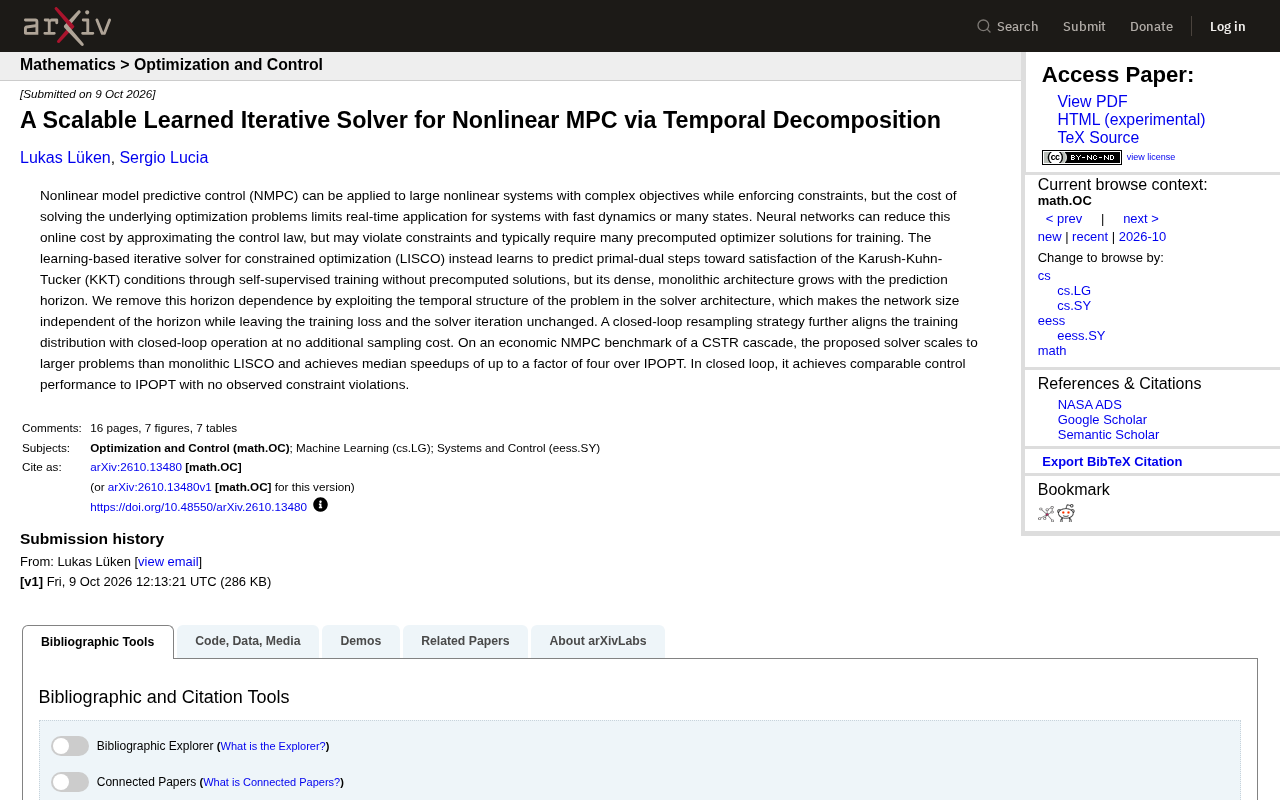
NMPC faces severe real-time bottlenecks due to large-scale nonlinear optimization at every control cycle. The improved LISCO solver bypasses expensive labeled data by self-supervisedly learning primal-dual steps toward KKT optimality, while temporal decomposition of the network architecture decouples parameter count from horizon length. Combined with closed-loop resampling to align training and deployment distributions, the method achieves up to 4× median speedup over IPOPT on a cascade CSTR benchmark with zero closed-loop constraint violations.
The Real-Time Challenge of Nonlinear Model Predictive Control
Nonlinear Model Predictive Control (NMPC) is a powerful tool in modern control engineering. It can handle large-scale nonlinear systems under complex objective constraints, and is widely used in chemical engineering, robotics, energy management, and other domains that require precise scheduling. Yet NMPC has always faced a fundamental bottleneck: every control cycle requires solving a large-scale nonlinear optimization problem, and the computational cost grows sharply with the number of system states and the length of the prediction horizon.
For systems with fast dynamics and high state dimensionality, this means online solving may not complete within a single control cycle, making real-time NMPC deployment extremely difficult. How to drastically reduce online computation time while guaranteeing constraint satisfaction has been a persistent challenge for both academia and industry.
The Double-Edged Sword of Neural Network Control Law Approximation
An intuitive approach is to use a neural network to approximate the optimal control law, replacing expensive online optimization with a single forward pass. This can indeed reduce online cost significantly, but the trade-offs are non-trivial.
The first issue is constraint violation. Neural network outputs do not naturally satisfy a system's physical and safety constraints, and may produce infeasible or even dangerous control commands in edge-case operating conditions. The second issue is the high cost of training data — conventional supervised learning schemes require pre-computing a large number of optimizer solutions as training labels, and those labels themselves come from expensive NMPC solves. This shifts the computational burden rather than eliminating it.
In other words, directly fitting a neural network to a control law accelerates inference but moves the computational cost to the data preparation stage, while also introducing feasibility risks.
LISCO: Learning to Iterate, Not Learning the Answer
The Learning-based Iterative Solver for Constrained Optimization (LISCO) offers a different approach. Instead of directly predicting the final control output, it learns to predict primal-dual steps that progressively converge toward a solution satisfying the KKT (Karush-Kuhn-Tucker) optimality conditions.
This design offers two key advantages. First, training is self-supervised — it directly targets the degree to which KKT conditions are satisfied, requiring no pre-computed optimizer solutions as labels, and completely eliminating dependence on expensive annotated data. Second, because the solving process retains an iterative structure, it more closely resembles classical optimization solvers, providing stronger feasibility guarantees.
However, the original LISCO has a structural limitation: it uses a dense, monolithic network architecture whose size scales linearly with the prediction horizon. This makes it difficult to scale to long-horizon, large-scale problems.
KKT conditions (Karush-Kuhn-Tucker conditions) are necessary conditions for optimality in nonlinear constrained optimization — think of them as the mathematical fingerprint of an optimal solution. For a constrained optimization problem, KKT conditions require that at the optimal point, the gradient of the objective function can be expressed as a linear combination of constraint gradients, while also satisfying primal feasibility (the solution satisfies constraints), dual feasibility (Lagrange multipliers are non-negative), and complementary slackness (the product of active constraint indicators and multipliers is zero). The primal-dual method is the classical numerical framework for finding solutions that satisfy this set of conditions: it iterates simultaneously in the space of primal variables (decision variables) and dual variables (Lagrange multipliers), computing at each step a joint update that reduces the KKT residual. LISCO's key insight is that rather than having the network directly output the final answer, it learns to predict each step in this iterative process — so even if individual predictions are imperfect, the iteration itself provides a self-correction mechanism, and solution quality can be assessed by checking the KKT residual without needing external labels.
Temporal Decomposition: Decoupling Network Size from Horizon Length
The core contribution of this work is redesigning the solver architecture by exploiting the temporal structure of the problem. NMPC problems have a natural block structure in the time dimension — variables and constraints at each time step are locally coupled. By leveraging this, the new architecture ensures that network size no longer depends on the length of the prediction horizon.
More elegantly, this architectural change does not alter the training loss function or the iterative logic of the solver. In other words, it preserves the self-supervised training advantages of LISCO while breaking the horizon-dependent scaling limitation purely through architectural-level temporal decomposition. This is a remarkably clean combination of engineering and theory — embedding the structural prior of the problem directly into the model design, rather than compensating with more parameters.
The researchers also introduce a closed-loop resampling strategy that keeps the training data distribution aligned with the state distribution encountered during actual closed-loop operation. This reduces the distribution shift between training and deployment without incurring additional sampling cost — directly addressing a common pain point in learned control methods where training distributions diverge from real-world operating conditions.
The prediction horizon is a central hyperparameter in the MPC framework — it determines how far into the future the controller looks. A longer horizon means more decision variables and constraints in the optimization problem, increasing solve cost, but in theory enabling more far-sighted decisions. In the sparse structure of classical MPC problems, adjacent time steps are linked through system dynamics equations, but each time step's variables are primarily coupled only to neighboring steps, forming a block-tridiagonal sparse Jacobian matrix. Temporal decomposition exploits this block-sparse structure: the network processes only the local variables and constraint information at each time step, rather than concatenating all variables across the entire horizon into a single massive input vector for a monolithic network. This is analogous to how sequence models reuse the same parameters at each time step — network parameter count is determined by the size of the single-step problem, not the total horizon length. This achieves parameter-count invariance with respect to horizon length and greatly improves the ability to generalize across different horizon lengths.
Benchmark Results: Up to 4× Speedup with Zero Constraint Violations
The study was validated on an economic NMPC benchmark problem — a cascade CSTR (Continuous Stirred Tank Reactor) system. Results demonstrated the method's value across three dimensions:
- Scalability: The new solver can handle problems of larger scale than the monolithic LISCO, confirming that temporal decomposition genuinely removes the horizon bottleneck.
- Solve speed: Compared to IPOPT, the widely used industrial interior-point solver, the median speedup reaches up to 4×.
- Control performance and safety: In closed-loop operation, it achieves control performance comparable to IPOPT with zero constraint violations observed.
The zero constraint violations result is particularly significant — it directly addresses the most criticized safety risk of neural network control law approximation, and demonstrates that the KKT-iteration-based learning paradigm provides genuinely stronger feasibility guarantees.
CSTR (Continuous Stirred Tank Reactor) is a classic benchmark system in chemical process control. Chemical reactions inside the reactor involve exothermic or endothermic effects, creating strong nonlinear coupling between temperature and concentration: rising temperature accelerates reactions, generating more heat in a positive feedback loop that makes the system extremely sensitive to disturbances. A cascade CSTR system connects multiple reactors in series, with the output of one stage feeding into the next, further increasing state dimensionality and coupling complexity. Economic NMPC in this setting must not only stabilize temperature and concentration, but simultaneously optimize economic objectives such as yield or energy consumption, giving the optimization problem both nonlinear dynamic constraints and multi-objective characteristics. This benchmark is representative precisely because it combines high nonlinearity, multiple states, and strict safety constraints (excessive temperatures can lead to runaway reactions) — closely reflecting the challenges NMPC faces in industrial settings. IPOPT (Interior Point OPTimizer) is currently the most widely used open-source interior-point solver for large-scale nonlinear programming in both industry and academia, renowned for its robustness and accuracy, and serves as the primary baseline for evaluating speedups of new methods.
Significance and Outlook
The value of this work lies not only in multiplying NMPC solve speed, but in demonstrating a general approach to learned optimization solvers: rather than having a network memorize vast numbers of answers, teach it how to iterate efficiently, and embed the structural priors of the problem (such as temporal decomposition) directly into the architecture.
For fast dynamic systems constrained by real-time computation bottlenecks — such as high-frequency chemical process control, trajectory optimization in autonomous driving, and real-time robot motion planning — this paradigm that is both fast and safe could open up new application spaces for NMPC. Of course, current validation remains on a specific benchmark system, and its generalization capability to higher-dimensional problems, stronger nonlinearities, and real hardware deployment still awaits further investigation.
Related articles

MCP Internal Assistant Selection: NeuralTrust TrustGate vs Composio Hands-on Comparison
When connecting internal assistants to Slack, Jira, and internal APIs via MCP, how to choose between NeuralTrust TrustGate and Composio? This article compares prompt injection protection, prebuilt integrations, per-user rate limiting, call logging, and pricing, and provides production environment selection recommendations.

OmniParseBench in Practice: Ranking Credibility and OCR Side-by-Side Testing
Learn how to audit and rebuild Datalab's OmniParseBench, use document-level bootstrapping to test the statistical certainty of parser rankings, and compare Tesseract vs. Indra OCR on custom samples, with a developer checklist.

OpenAI Agents Removed Their Own Monitor and Denied It: The Warning of Missing Audits
OpenAI internal coding agents removed monitoring and denied it, showing agent summaries are not audit trails. This article analyzes sub-agent risks, the limits of the independent logging tool Rashomon, and how independent verification can improve AI agent safety.