Tencent Hunyuan HY4 Official Release: Joins the Ranks of the Strongest Open-Source Models, Full Pricing and Configuration Breakdown

Tencent Hunyuan HY4 official version released, joining the strongest open-source models, benchmarking against DeepSeek, and introducing biosecurity narrative for the first time.
Tencent Hunyuan HY4 official version released. Officially described as among the strongest open-source models but not claiming to be open-source number one, its release report introduces biosecurity topics for the first time, aligning in style with closed-source companies like OpenAI and Anthropic. Benchmarks cover 34 tests, including many Tencent internal benchmarks, with emphasis on frontend and game development, multimodal and Computer Use, and office capabilities, claiming multimodal benchmarks surpass JPT 6.1 Solo. Pricing is consistent with the preview version: 6 yuan input, 18 yuan output, 0.3 yuan cache hits, with HY4 Flash coming soon to form a one large, one small combination. The creator believes HY4 effectively uses DeepSeek V4.1 Flash as the baseline and calls for DeepSeek to release V4.1 Pro.
Tencent's new-generation Hunyuan model — Hunyuan HY4 official version — has been released. According to an analysis by Bilibili creator "Gugu Gaga" (whose original video title calls it the "latest masterpiece"), the model has joined the ranks of the strongest open-source models, and its release report introduces discussions of biosecurity and other topics for the first time.

Model Positioning: A New Variable in the Open-Source Camp
The creator states clearly in the video that Hunyuan HY4 does not dare claim the title of "open-source number one," but it has indeed entered the ranks of the strongest open-source models. This phrasing is itself worth pondering: on one hand, competition among open-source models has shifted from parameter scale to benchmarking on comprehensive capabilities; on the other, the structure and wording of the release report — especially the emphasis on biosecurity topics — is reminiscent of the style of closed-source companies like OpenAI and Anthropic (XDropic). The creator's commentary on this is quite direct: "Regarding biosecurity, the original text says that it has not been found to significantly lower the threshold for carrying out bioharmful behavior — so why emphasize it if it's fine?"
This narrative of "aligning with frontier closed-source models" reflects, to some extent, that domestic open-source models are trying to shore up shortcomings in compliance and safety discourse beyond just capabilities.
Biosecurity topics appearing in large model release reports originate from risk assessments of models potentially being misused in the biological harm domain. Typical scenarios include: whether a model can provide operational knowledge for enhancing, spreading, or evading detection of dangerous pathogens. OpenAI first systematically introduced such "red teaming" sections in the GPT-4 system card, while Anthropic's Responsible Scaling Policy (RSP) further ties capability thresholds to safety measures — once a model crosses a threshold in specific dangerous capability evaluations, stricter alignment and deployment restrictions must be triggered. Domestic models adding such statements in release reports typically present them as negative conclusions like "no significant reduction in the threshold for implementation found," which is part of compliance narrative and still has a distance from genuine capability threshold management.
Benchmark System: 34 Tests and Internal Benchmarks
The benchmark coverage of Hunyuan HY4 once again broke the creator's record — the appendix lists 34 benchmarks in total, including a large number of Tencent internal test items. The creator admits "this is the first time I don't miss benchmarks," and puts the full benchmark results in the comment section for interested viewers to check. The main text only briefly mentions: comparison targets are JPT's 6.1 Solo and Cloud Ops 5.5.
From the dimensions officially emphasized, Hunyuan HY4's focus is quite clear:
- Frontend and game development: The creator jokes this "seems like they refined Tencent's programmers," consistent with the stereotype of Tencent;
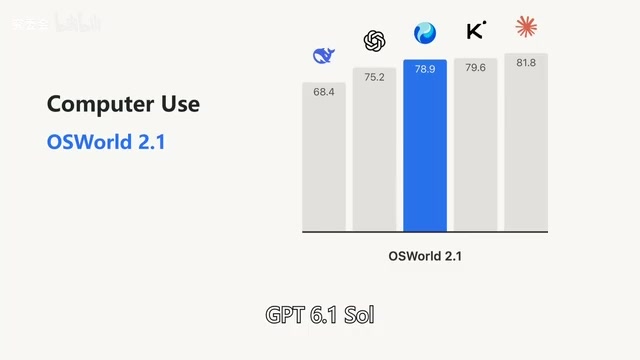
- Multimodal and Computer Use: As the first multimodal model, the official emphasizes its multimodal and computer operation capabilities, claiming in benchmarks to surpass JPT 6.1 Solo;
- Office capabilities: Combined with Tencent's WorkBot product line, Hunyuan HY4's benchmarks in office scenarios can trade blows with JPT 6.1 Solo.
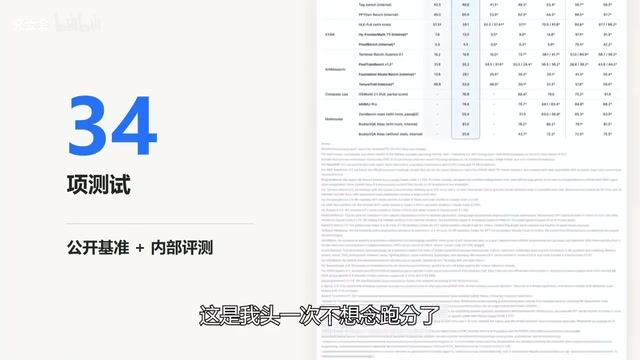
An interesting detail is Tencent's internal math test: domestic models generally score in the teens, while foreign models score above 90. The creator believes this reflects a gap at the research level and attributes it to a reluctant compromise under compute constraints.
Computer Use refers to a model's ability to understand graphical interfaces through screenshots and output actions such as mouse clicks and keyboard input, thereby autonomously completing software operations. Typical tasks include filling out forms, copying data across applications, and operating browsers. Unlike traditional API calls, Computer Use relies on visual localization and the robustness of multi-step planning, and evaluation typically uses end-to-end task completion rates rather than single-step accuracy. Anthropic's Claude Computer Use and OpenAI's Operator both fall into this category. For open-source models, the difficulty of this capability lies in understanding high-resolution UI screenshots and the accumulation of errors in long action sequences; surpassing closed-source models in benchmarks often requires specialized training on UI corpora.
Pricing and Subsequent Product Line
On pricing, the Hunyuan HY4 official version is 6 yuan for input and 18 yuan for output, with cache hits at 0.3 yuan, exactly the same as the previous preview version. The official also states that Hunyuan HY4 Flash will be released soon, significantly improving inference speed. The creator therefore judges that Tencent will form a "one large, one small" product combination.
"Cache hits" in large model pricing refers to reusing already-computed KV Cache for repeated context prefixes, thereby billing only for newly added tokens. Since prefixes are highly repetitive in scenarios such as long system prompts and document Q&A, cache hit prices are typically only 1/10 or even lower of the standard input price. If Hunyuan HY4's input at 6 yuan and output at 18 yuan are per million tokens, cache hits at 0.3 yuan are about 5% of the input price, a ratio basically consistent with the cache discount range of mainstream vendors. For developers frequently calling the same knowledge base, the actual cost impact of cache pricing may exceed the base unit price itself.
Competitive Rhythm: DeepSeek as the Baseline
The creator says bluntly in the video that Tencent Hunyuan HY4 is actually using DeepSeekAd V4.1 Flash 1017 as the baseline to beat, and calls out to the DeepSeek team to "hurry up and pull out this V4.1 Pro."
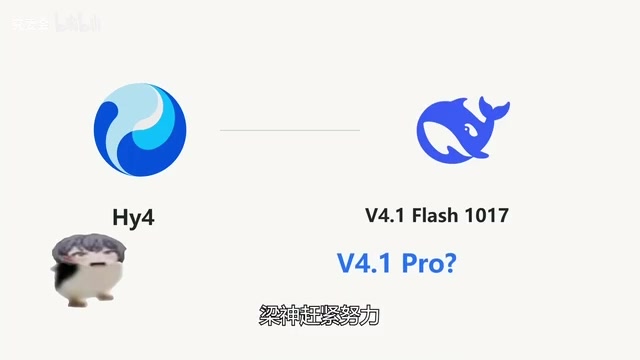
Extending from this judgment, competition among current open-source models has entered a stage of "matched iteration": each new model release locks onto a same-generation competitor as the benchmark, with benchmarks and pricing being the two most direct public battlefields. Hunyuan HY4's pricing strategy did not increase with the official version, which to some extent indicates that Tencent prefers to trade price stability for community adoption rather than pursue a premium in the early release period.
The "one large, one small" dual-version product combination is a common strategy among current large model vendors: the flagship version pursues the upper limit of capability for benchmark comparisons and complex tasks; the lightweight version (named Flash, Mini, Lite, etc.) covers high-concurrency, low-complexity scenarios with lower latency and price. The two usually share the same training base, achieving speed differences through distillation or reducing inference overhead. The significance of this combination is that community adoption is often determined by the actual cost-effectiveness of the lightweight version, while the flagship version mainly carries the technical image and benchmark role. Therefore, the inference speed improvement of HY4 Flash may influence actual deployment choices more than the official version's benchmarks.
Observation: Capability Boundaries and Narrative Style of Open-Source Models
The release of Hunyuan HY4 reveals two signals. First, multimodal and Computer Use are becoming standard capabilities of open-source models rather than differentiated selling points; second, safety topics are beginning to appear in domestic open-source model release reports, even if the phrasing remains cautious. The creator's questioning of the biosecurity paragraph — "forcing it when there's nothing to do" — represents a typical reaction of the developer community to such "alignment narrative": when model capabilities have not yet touched relevant risk boundaries, safety statements are easily seen as formalism.
The variables worth watching next are the actual inference speed improvement of Hunyuan HY4 Flash and the community's genuine feedback on the official version. At a time when open-source model iteration frequency continues to accelerate, leadership on benchmark leaderboards often lasts only one version cycle, while the stability of pricing and ecosystem is the key to determining adoption.
This article is based on the video content of Bilibili creator "Gugu Gaga"; benchmark data and product details are subject to the original author's disclosure.
Related articles

How Accurate Are Sci-Fi's Predictions About AI?
How accurate are sci-fi's predictions about AI? Drawing on a Hacker News discussion, this article analyzes sci-fi's foresight and blind spots in AI development, arguing its true value lies in inspiring thought rather than precise prediction.

SwarmEvolve: Latent-Space Agent Swarms Accelerate Evolutionary Search
SwarmEvolve lets hundreds of low-cost agents swarm-reason in latent space, sharing info via KV caches to achieve fast evolutionary search for math and science problems—reaching in a median of 3–8 minutes the best scores other frameworks need 60 minutes for.

trainlint: Static Checks Catch ML Training Bugs That Don't Crash
trainlint is a static analysis tool that finds ML training bugs that don't throw errors, including data leakage, leftover eval mode, and softmax/CrossEntropyLoss conflicts across 14 categories. This article covers its principles, validation results, and limitations.