Tencent Hy4 Flash Lands on AI Gateway: 50% Off and a Million-Token Context
Tencent Hy4 Flash lands on AI Gateway, keeping Hy4's full capabilities at roughly one-tenth the price, with a limited-time 50% discount.
Tencent's Hy4 Flash model is now on AI Gateway with a limited-time 50% discount on input, cached input, and output tokens through November 29, 2026. Positioned as the low-cost member of the Hy4 family, it retains the full feature set—reasoning, tool calling, structured output, prompt caching, and image input—with a 1M-token context window, at roughly one-tenth of Hy4's per-token price. Reasoning can be disabled for requests that don't need it. Developers access it via the fixed model name tencent/hy4-flash through AI SDK, Chat Completions, and more. AI Gateway offers a unified API, usage tracking, retries, and failover, priced at provider rates with no markup.
Tencent's Hy4 Flash model is now available on AI Gateway, offered to developers at a 50% introductory discount. According to the official announcement, the discount covers input, cached input, and output tokens and runs through November 29, 2026.
A low-cost heir to flagship capabilities
Hy4 Flash is the newest, lower-cost member of the Hy4 family. Its key selling point: it retains Hy4's full feature set while pushing the per-token price down to roughly one-tenth. Those features include reasoning that preserves its thinking across turns, tool calling, structured output, prompt caching, and image input, all while maintaining the same 1-million-token context window.
That means developers don't have to make major capability compromises to save money. For teams that need long context and multi-turn reasoning but are cost-sensitive, the positioning is quite straightforward.
Reasoning you can turn off
One notable design choice: Hy4 Flash's reasoning can be disabled for requests that don't need it. This leaves room to further cut cost and latency for high-frequency, low-complexity tasks, and the official guidance explicitly calls out high-concurrency coding, agent, and document-processing workloads as a good fit.
In other words, the same model can switch between "thinking on" and "thinking off" depending on task type, rather than forcing you to pay reasoning costs on every call.
「Disableable reasoning」 corresponds to the hybrid reasoning mechanism now widely adopted by mainstream large models: before generating a final answer, the model first emits a chain-of-thought to decompose, verify, and self-correct, then produces the result. Enabling reasoning significantly improves accuracy on complex tasks but consumes a large number of extra tokens and increases time-to-first-token. Disabling reasoning is equivalent to letting the model answer directly, which suits retrieval-augmented generation, format conversion, simple classification, and other scenarios that don't require multi-step derivation. The common industry approach is to control the thinking budget through request parameters (such as reasoning effort or thinking budget) rather than maintaining two separate models—this is precisely the technical meaning behind the article's emphasis on "the same model switching by task type," and it downgrades cost and latency tuning from model selection to parameter tuning.
Integration: a unified model name and CLI setup
On AI Gateway, calling Hy4 Flash uses the fixed model name tencent/hy4-flash. The official docs provide a minimal AI SDK example: pass the model name and prompt to streamText, then read the textStream output chunk by chunk.
Beyond the AI SDK, the page also lists calling methods such as Chat Completions, indicating it isn't tied to a single SDK.
For developers who want to use the model in coding agents like Claude Code, Codex, or Cursor, the official recommendation is to install the latest Vercel CLI and run npx vercel ai-gateway setup, then select tencent/hy4-flash in the agent. A model playground is also provided for trying it out directly.
AI SDK is an open-source TypeScript library from Vercel for calling different model providers through a unified interface. Its core abstraction is the provider—each provider offers a mapping from model name to a specific API—while streamText issues streaming requests and the returned textStream is an asynchronously iterable stream of text increments, making it easy to render as generation proceeds. Alongside it, Chat Completions is the de facto standard interface format established by OpenAI, and many providers are compatible with that protocol to lower migration costs. The significance of a "unified model name" here is that the model identifier uses a provider/model namespace format, so callers only need to change a string to switch the underlying model while the SDK, retry, and streaming logic stay the same—this is also the key design by which an aggregation gateway reduces the complexity of managing multiple models.
What AI Gateway is for: a unified API with no markup
To understand the significance of this launch, it helps to first look at what AI Gateway itself does. Per the official description, it provides a unified API for calling models, handles usage and cost tracking, and can configure retries, failover, and performance optimization in exchange for higher availability than a single provider.
It also bundles custom reporting, Zero Data Retention support, API key budget controls, routing rules, and more.
On pricing, AI Gateway explicitly states that it reflects provider prices as-is, with no markup and no platform fees on inference, including for bring-your-own-key (BYOK) requests. For teams already doing cost accounting across multiple clouds and models, this reduces the extra uncertainty introduced by a middle layer.
Zero Data Retention (ZDR) means the gateway or provider promises not to persistently store request and response content, discarding it after completing inference in memory only; it is usually offered as a contractual term or configuration switch and is a hard requirement for selection in regulated industries such as finance, healthcare, and legal. Failover, meanwhile, automatically reroutes requests to a backup provider or model when the primary provider times out, rate-limits, or errors, working with retry and timeout policies to improve end-to-end availability. BYOK (Bring Your Own Key) means developers connect to the gateway using their own provider API key, in which case the gateway only handles routing and metering and takes no share of billing. Together these capabilities form the value of the aggregation layer: pulling availability, compliance, and cost governance out of business code and handling them centrally.
What this signals
From a product cadence perspective, the launch of Hy4 Flash continues a main thread in today's large-model market: while keeping context length and the tooling ecosystem consistent, significantly lowering unit price through smaller models or lower inference overhead.
For developers, the practical decision points come down to two. First, task fit—complex agent tasks that need to preserve reasoning across turns can be treated differently from batch document processing that just needs fast throughput, using the reasoning switch. Second, migration cost—a unified model name plus an aggregation gateway means you don't have to rewrite the entire calling logic when switching providers.
The 50% discount is time-limited, but it's more of an entry point for developers to drop Hy4 Flash into their existing evaluation pipelines at a lower barrier. Whether to adopt it long-term still depends on how it performs under real workloads.
One-line Summary
Tencent Hy4 Flash is now on AI Gateway, retaining Hy4's full capabilities at roughly one-tenth the price, with a limited-time 50% discount.
Paragraph Summary
Tencent's Hy4 Flash model is now officially available on AI Gateway, with a limited-time 50% discount on input, cached input, and output tokens through November 29, 2026. Positioned as the low-cost member of the Hy4 family, Hy4 Flash retains the full feature set—reasoning, tool calling, structured output, prompt caching, and image input—along with a 1-million-token context window, while costing roughly one-tenth of Hy4 per token. Its reasoning can be disabled for requests that don't need it, further cutting cost and latency for high-frequency, low-complexity tasks. Developers access it via the fixed model name tencent/hy4-flash, with support for AI SDK, Chat Completions, and other methods, and can configure it in coding agents. AI Gateway itself provides a unified API, usage tracking, retries, and failover, and prices at provider rates with no markup.
Related articles

Inside Honey Trap Training: Emotional Dissociation and Anchoring Techniques
How are spies trained for honey trap missions? A trainee reveals emotional dissociation, perfume and keyword anchoring, and target photo binding—psychological techniques that condition reflexes for intelligence work.

Frontier AI Risk Management: Full-Pipeline Practices from Training to Deployment
OpenAI outlines a frontier AI risk management framework: from training-stage model alignment to deployment-stage sandboxing and blocking safeguards, plus post-deployment monitoring—a layered risk control system across the model lifecycle.
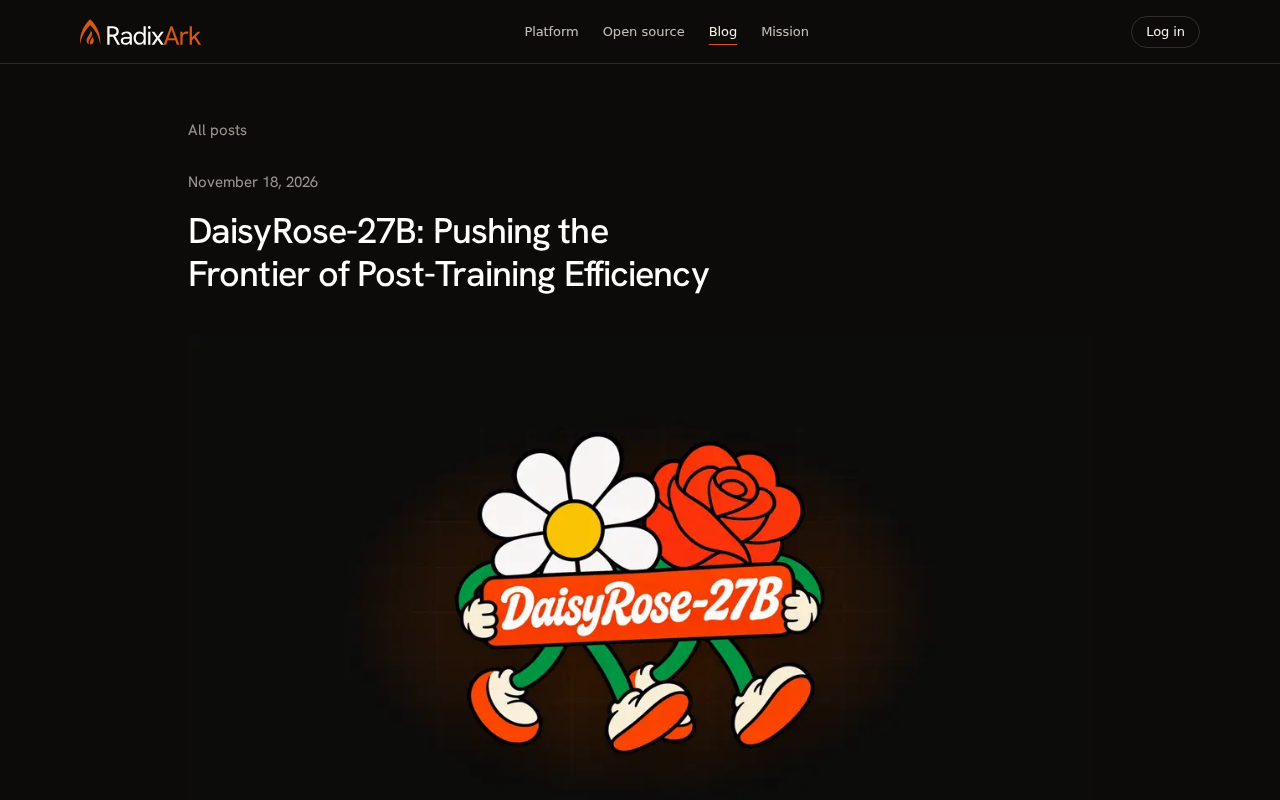
DaisyRose-27B: 1,200-Task RL Boosts Qwen3.8 from 5.6% to 12% on Terminal-Bench 4.1
DaisyRose-27B uses RL training on 1,200 tasks to boost Qwen3.8's Terminal-Bench 4.1 score from 5.6% to 12%, showing lightweight RL can more than double terminal task performance.