Tencent Open-Sources Agent Memory: A Fully Local AI Long-Term Memory Solution with Zero External Dependencies

Tencent's open-source TencentDB Agent Memory delivers fully local, zero-dependency long-term memory for AI Agents.
TencentDB Agent Memory is Tencent Cloud's open-source solution for AI Agent long-term memory, featuring a 4-tier progressive pipeline that handles everything locally with no external API dependencies. Written in TypeScript, it addresses data privacy and cost concerns for industries like finance and healthcare, and has already earned over 8,100 GitHub Stars.
The AI Agent Memory Problem
Building truly production-ready AI Agents comes down to one central challenge: giving Agents persistent, reliable long-term memory. Most existing solutions rely on external vector databases or third-party APIs, which introduce data privacy risks, increase system complexity, and drive up operational costs.
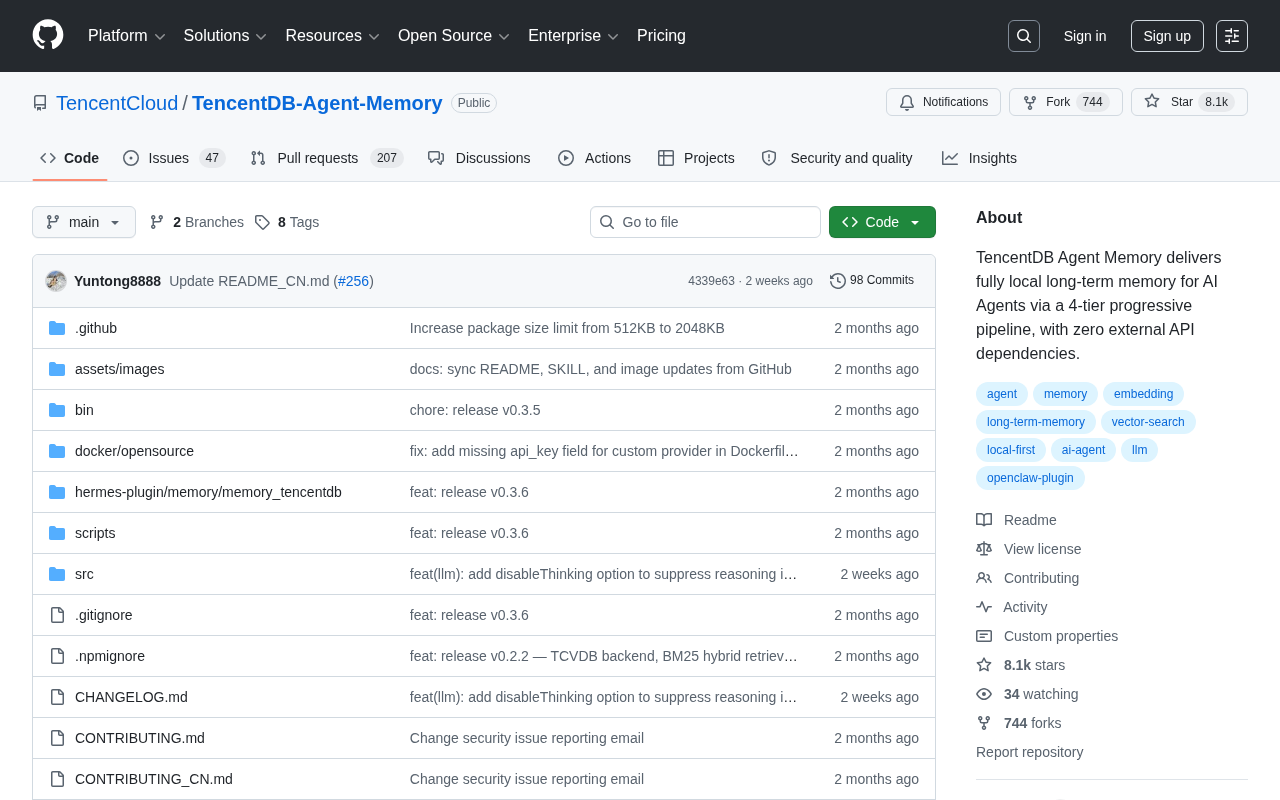
Tencent Cloud's recently open-sourced TencentDB Agent Memory was built specifically to address this pain point. The project quickly gained traction on GitHub, amassing over 8,100 Stars and 744 Forks, with as many as 134 new Stars in a single day — making it one of the hottest projects in the AI infrastructure space. Its core promise is straightforward: deliver fully local long-term memory for AI Agents via a 4-tier progressive pipeline, with zero external API dependencies.
Core Design: The 4-Tier Progressive Memory Pipeline
Limitations of Traditional Approaches
Conventional Agent memory solutions typically rely on a single "vectorize-and-retrieve" pattern — embedding conversation content and storing it in a vector database, then using similarity search to recall relevant context.
Vector databases and embedding technology are the backbone of this approach. Embedding models use neural networks to map unstructured data like text and images into hundreds or thousands of floating-point dimensions, with semantically similar content clustering closer together in vector space — making semantic retrieval possible. OpenAI's text-embedding-ada-002, for instance, maps text into 1,536-dimensional vectors; open-source alternatives like BGE (BAAI General Embedding) and E5 offer local options that require no API calls. Vector databases such as Pinecone, Weaviate, and Milvus are purpose-built for storing and querying high-dimensional vectors, leveraging approximate nearest neighbor (ANN) algorithms like HNSW (Hierarchical Navigable Small World) or IVF (Inverted File Index) to achieve millisecond-level similarity retrieval across millions of vectors. However, this approach has clear weaknesses: memory cannot be managed in layers; retrieval accuracy is constrained by embedding quality; high-dimensional vectors are inherently poorly suited for exact matching and time-ordered structural queries; accumulating information over long time spans becomes unwieldy; and dependence on external APIs, data transfer risks, and pay-per-use pricing all create systemic bottlenecks in privacy-sensitive scenarios.
It's also worth noting that Retrieval-Augmented Generation (RAG) and Agent memory systems differ significantly in architecture — though they're often conflated. RAG is designed for one-shot retrieval from static knowledge bases and typically doesn't involve writes or updates. Agent memory systems require continuous writes, version management, and selective forgetting — a workload much closer to database read/write operations. TencentDB Agent Memory's 4-tier pipeline essentially layers dynamic updates, hierarchical compression, and long-term consolidation on top of RAG's retrieval capabilities, representing an engineering evolution from RAG toward truly stateful Agents — a distinction that matters greatly when making architectural decisions.
How the Progressive Pipeline Solves These Problems
TencentDB Agent Memory's 4-tier progressive pipeline breaks memory processing into distinct stages: from raw information capture and structured processing, to semantic compression and long-term consolidation. Each tier processes information at a different level of granularity, allowing Agents to quickly access recent context while efficiently retrieving long-term historical memory.
More specifically, the four tiers divide responsibilities as follows: Tier 1 captures the raw conversation stream, preserving complete interaction context; Tier 2 performs structured extraction on raw content — identifying entities, relationships, and key events, transforming unstructured text into queryable structured data; Tier 3 generates summary memories through semantic compression, retaining core semantic information at a fraction of the storage cost and avoiding the redundant accumulation of raw dialogue; Tier 4 consolidates stable, frequently accessed knowledge into long-term storage, forming the foundation of the Agent's "knowledge base." This layered processing design strikes a balance between storage efficiency, retrieval speed, and information completeness — rather than simply dumping all conversation content into a single vector index.
Notably, TencentDB Agent Memory builds its memory storage on top of Tencent Cloud's proprietary database engines. The TencentDB family covers relational (TDSQL), document, time-series, and other storage engines, refined through years of handling Tencent's massive internal workloads. Deeply integrating an Agent memory system with mature database capabilities means directly reusing engineering infrastructure like transaction processing, persistence guarantees, and index optimization — rather than relying on lightweight file systems or in-memory caches. This is a core advantage in engineering reliability over many lightweight memory solutions.
This layered design echoes human memory mechanisms. Neuroscience divides human memory into sensory memory (~0.5 seconds), working memory (short-term, ~20 seconds), and long-term memory. The hippocampus handles memory consolidation — converting short-term memories into long-term ones through neural replay during sleep, gradually encoding information into the cortex. AI Agent memory architectures draw on this same layered thinking: the context window corresponds to working memory, external storage corresponds to long-term memory, and Tier 3's semantic compression precisely mirrors the information refinement process in memory consolidation — actively managing the "forgetting curve" by applying differentiated retention strategies based on importance and access frequency, rather than passively accumulating all raw information. While modern LLM context windows have expanded to hundreds of thousands of tokens (e.g., Claude's 200K, Gemini's 1M), they still face information loss and retrieval inefficiency in ultra-long conversations and cross-session scenarios. Layered management is designed to compensate for this structural gap — storing and retrieving memories differentially based on importance and recency, providing more precise informational support within the limited context window.
Core Advantages: Local Deployment and Zero External Dependencies
Data Privacy and Security
"Fully local" is the project's most defining characteristic. All memory data — storage, processing, and retrieval — happens entirely within the local environment, without sending sensitive conversation data to external servers. For industries with stringent data privacy requirements, such as finance, healthcare, and government, this capability is especially critical.
From a regulatory compliance perspective, China's Data Security Law, Personal Information Protection Law, and Data Export Security Assessment Measures — enacted between 2021 and 2022 — establish a strict data localization framework. Processing important data and personal information overseas requires a security assessment, with additional sector-specific compliance requirements layered on top for finance, healthcare, and government. The EU's GDPR similarly imposes strict controls on where personal data is processed. Agent systems that rely on overseas vector database services (such as Pinecone's US nodes) face potential cross-border data compliance scrutiny when handling conversations containing personal information. Local deployment eliminates this legal uncertainty at the architectural level — keeping all memory data flows entirely within an organization's own data governance boundary, with no additional compliance assessment procedures required.
Lower Cost and Operational Complexity
Zero external API dependencies deliver significant engineering advantages: no additional fees for vector database services or embedding API calls, and no concerns about third-party service availability, rate limiting, or latency. The entire memory system integrates into existing Agent applications as a self-contained module, dramatically lowering the bar for deployment and maintenance.
To put costs in perspective: Pinecone's standard plan charges by the number of stored vectors and queries — in high-frequency conversation scenarios, monthly costs can rapidly climb to hundreds of dollars. OpenAI's embedding API similarly charges by token count. For applications needing to provide persistent memory for large numbers of users, these marginal costs scale linearly with user growth, creating significant commercial pressure. A local solution converts these variable costs into fixed hardware resource consumption, offering a clear economic advantage at scale.
TypeScript Stack and MCP Protocol Compatibility
The project is written in TypeScript — Microsoft's statically typed superset of JavaScript that significantly improves maintainability for large codebases. In AI application development, the TypeScript/Node.js ecosystem is growing rapidly, with mature tools like the Vercel AI SDK, LangChain.js, and the OpenAI Node SDK making it an important stack for building AI applications. Compared to Python's dominance in AI research, TypeScript has natural advantages for frontend integration, real-time interactive interfaces, and full-stack web applications — fitting seamlessly into today's mainstream JavaScript/TypeScript ecosystem. It's particularly well-suited for AI applications and Agent frameworks built on Node.js, is developer-friendly for frontend and full-stack engineers, and signals a project orientation toward production engineering and deployment.
On interoperability: Anthropic's Model Context Protocol (MCP), introduced in late 2024, aims to establish a standardized communication protocol between LLMs and external tools and data sources — including memory storage backends. The TypeScript stack gives TencentDB Agent Memory natural compatibility with MCP interfaces. If MCP support is added in future iterations, it could be directly invoked by MCP-compatible clients like Claude Desktop and Cursor, significantly expanding its ecosystem reach. This is an evolution direction the community should keep a close eye on.
AI Agent Architecture Context
Understanding the value of TencentDB Agent Memory requires understanding the broader AI Agent architecture. AI Agents are intelligent systems capable of perceiving their environment, planning actions, and autonomously executing tasks — typically using a large language model (LLM) as the core reasoning engine, combined with tool use, a planning module, and a memory system to form a complete architecture. Major Agent frameworks include LangChain, LlamaIndex, AutoGen, and CrewAI.
Among an Agent's four core modules, the memory system is often the most underappreciated in engineering implementation. The perception module handles external inputs (text, images, tool return values, etc.); the planning module relies on the LLM for task decomposition and action decisions — the ReAct (Reasoning + Acting) framework significantly improves task completion rates by alternating between reasoning and acting steps, while Tree-of-Thought addresses complex planning through multi-path search; the tool use module has become standard in mainstream LLMs since GPT-4 introduced Function Calling, allowing models to invoke external APIs, databases, and code execution environments via structured JSON; and the memory system handles state persistence, directly affecting an Agent's coherence and reliability across multi-turn conversations and cross-session task collaboration. An Agent without effective memory management is essentially stateless — starting from scratch with every interaction — which severely limits the ability to handle complex tasks. The absence of robust memory capability is one of the core reasons many Agents perform inconsistently in real-world deployments.
Use Cases
TencentDB Agent Memory is well-suited for AI Agent applications that require persistent memory:
- Personal assistant applications: Remembering user preferences, interaction history, and long-term goals
- Customer service bots: Maintaining customer information and issue context across sessions
- Enterprise intranet Agents: Running securely in local environments without leaking business data
- Edge computing scenarios: Maintaining memory capability in environments without stable network connectivity
An Industry Signal from Big Tech Open Source
Tencent Cloud's decision to open-source this project reflects the continued investment that China's tech giants are making at the AI infrastructure layer. As Agent technology moves from concept to production deployment, memory capability has become critical infrastructure for building practical intelligent systems. The growing availability of open-source tools like this will further lower the bar for developers building high-quality AI Agents and accelerate maturation of the entire ecosystem.
From a broader perspective, this is also a snapshot of Chinese tech companies competing for developer ecosystems at the AI infrastructure layer. Following Alibaba Cloud's open-sourcing of the Qwen model series and Baidu's continued iteration on PaddlePaddle, Tencent Cloud's open-source investment in Agent memory infrastructure reflects how major players are shifting their competitive focus from model capabilities down to engineering toolchains. Whoever can help developers build production-grade Agent applications faster and at lower cost stands to occupy a central position in the ecosystem when the next wave of AI applications takes off.
Conclusion
TencentDB Agent Memory centers its value proposition on "local deployment" and "zero external dependencies" — directly addressing two major pain points in AI Agent development: data privacy and cost control. The 4-tier progressive memory pipeline design draws on human memory layering mechanisms and neuroscientific memory consolidation theory, reflecting deeper thinking about Agent memory management. At the same time, the project's technology stack choices give it the potential to adapt to emerging protocol standards like MCP, making its ecosystem expansion potential worth watching.
As an open-source project still in rapid development, its real-world performance at scale remains to be validated by developers. But a community response of over 8,000 Stars signals that this direction genuinely resonates with a broad developer audience. For teams actively building AI Agents, TencentDB Agent Memory is worth including in your technical evaluation.
Key Takeaways
Related articles

Transformer²: Achieving Co-Design of Robot Morphology and Control with a Unified Architecture
Deep dive into how Transformer² uses a unified Transformer architecture to integrate robot morphology design and motion control into one model, enabling task-driven end-to-end co-design for embodied AI.

Tutorial: Installing Tailscale on a Jailbroken Kindle to Create a Private Network Node
Learn how to deploy Tailscale on a jailbroken Kindle, turning an idle e-reader into a private network node. Covers cross-compilation, power optimization, and risk considerations.
Tutorial: Installing Tailscale on a Jailbroken Kindle to Create a Private Network Node
Learn how to deploy Tailscale on a jailbroken Kindle to turn an idle e-reader into a private network node. Covers cross-compilation, power optimization, and risk considerations.