Tencent WorkBuddy Hands-On Test: File Organization and Spreadsheet Generation via Chinese Commands

Tencent WorkBuddy uses Chinese natural language to drive file organization, spreadsheet summarization, and web page generation, lowering the barrier to entry.
Based on a Bilibili creator's tutorial, this article introduces Tencent's agent WorkBuddy: users assign tasks in Chinese and it organizes files, summarizes data into spreadsheets, and generates web pages from descriptions. Unlike Codex or Claude Code, WorkBuddy requires no environment setup—just download, log in, and send a first task. The author cautions it lowers execution barriers, not demand barriers, and stability on complex tasks remains unverified.
Tencent's recently launched agent WorkBuddy is trying to make "assigning tasks in natural language" lighter and more direct. A Bilibili creator released a tutorial video they call "WorkBuddy's most practical" demonstration, starting from organizing cluttered files and gradually moving through summarizing spreadsheets to generating web pages, attempting to answer one question: what can someone who doesn't write code build with it?
What WorkBuddy Actually Is: A Chinese Task-Driven AI Work Assistant
According to the video, WorkBuddyAd can be understood as "an AI work assistant you can assign tasks to in Chinese." You don't need to operate files yourself—instead, you describe your requirements clearly, and it picks up your ideas to process files and generate results.
The introductory scenarios the creator gives are very concrete: when files are piled up in a mess, let it help you organize them; when you have some materials or data on hand, let it summarize them into a spreadsheet; when you want to make a small web page, describe the functionality to it and it will carry on from there. These three types of tasks cover a significant portion of repetitive work in daily office settings, and also ground the concept of "agents" in tangible outputs.
The key difference between an agent and an ordinary chatbot lies in the "autonomous execution loop": chatbots only output text, while agents plan steps, invoke tools (reading/writing files, running code, accessing the network), check intermediate results, and iterate until deliverable results are produced. WorkBuddy's "organize files—summarize spreadsheets—generate web pages" is exactly a typical tool-invocation chain: the model first understands the goal, then decides which local capabilities to invoke, and finally turns results into files rather than a piece of advice. Understanding this makes it clear why "simpler environment setup" is a meaningful improvement—for an agent to actually take action, it must gain access to the file system and runtime environment, and configuring permissions and dependencies has historically been the part most likely to deter newcomers in such tools.
How It Differs from Codex and Claude Code: Simpler Environment Setup
There's a noteworthy comparison in the video. The creator mentions that if you've used tools like Codex, you'll find WorkBuddy's approach "a bit familiar"—both hand tasks to AI and then see how it does. But the difference is that WorkBuddy's environment setup is simpler and easier to get started with, requiring no additional environment building.
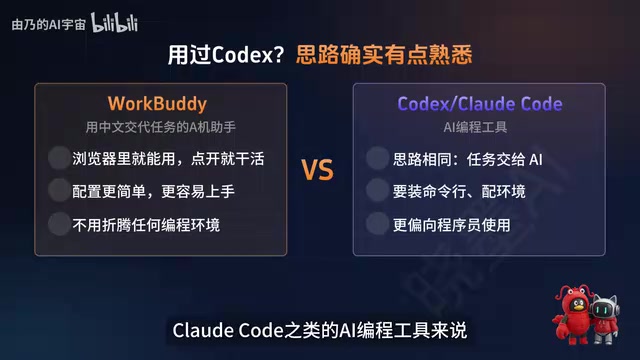
This matters a lot for newcomers. The barrier to AI programming tools often isn't "whether you can write prompts" but rather that people get discouraged during the environment preparation stage. By compressing this step, WorkBuddy lowers the starting point to "download, install, log in."
Codex and Claude Code belong to the category of "command-line/terminal-based coding agents" aimed at developers: they typically run in the terminal, require local runtimes such as Node.js and Python, need API key configuration, and involve understanding concepts like project directory structure and version control. Their advantage is deep involvement in code repositories and automation workflows. WorkBuddy takes a different route—converging interaction into a graphical interface and natural language input, with the product pre-packaging the runtime environment and tool permissions so users don't need to worry about dependency installation or key management. The trade-off is clear: the former is flexible, orchestration-friendly, and suited to engineering scenarios; the latter is ready out of the box with a gentle learning curve, but has relatively limited customizability and control over complex engineering tasks.
Getting Started: Begin by Sending Your First Task
This tutorial is designed in beginner order, with a very low bar for entry: download and install, log in, and send your first task—that counts as success.

Subsequent lessons cover organizing files, editing copy, and trying image- and video-related tasks. Each lesson requires hands-on creation, and you can open and view the result directly when done. This "one output per lesson" structure is better suited to building positive feedback than pure feature explanations—for tools like agents that require repeated interaction debugging, getting through one complete loop is more useful than memorizing a list of features.

For those who want to take on client work as a service, the video also offers a path: learn and master what needs to be learned, then deliver it to others.
A Bit of Sober Judgment
The video's conclusion is "use AI to add an income stream," which needs to be unpacked. WorkBuddy lowers the execution barrier, not the demand barrier—organizing files, making spreadsheets, and generating web pages have long had alternatives on the market, and what really determines whether you can monetize is still what specific problem you can solve and whether your delivery quality is stable. Agents eliminate the "hands-on" step, but "thinking clearly about what to do" and "verifying whether the results are correct" remain on the human side.
Another point to watch is stability under complex tasks. The tutorial demonstrates relatively clear, small tasks, but when files are numerous, formats are mixed, and requirement descriptions are vague, how the agent performs can't be judged from an introductory demo alone. Treating it as an assistant that can quickly produce drafts is more realistic than treating it as an executor you can fully entrust.
For newcomers, the value of this video lies in providing a low-barrier starting point: no need to learn programming first, no need to configure an environment first—send a task, see the result, and then decide whether to go deeper.
When evaluating such agents, the industry commonly uses task success rate rather than single-demo performance to measure capability: repeat the same task multiple times, see how many times it delivers acceptable results in one go, and whether it can self-detect and correct failures. Introductory demos typically pick samples with regular formats and clear descriptions, while real office scenarios commonly involve chaotically named zip archives, spreadsheets with merged cells, and scanned PDFs—these significantly lower the success rate. Another related concept is human-in-the-loop: retaining confirmation and acceptance at key checkpoints during agent execution, which both reduces the risk of misoperations (such as accidentally deleting or modifying files) and makes users responsible for final delivery quality. Placing WorkBuddy in a "generate draft—human verification—iterative revision" workflow is more in line with the reality of the current technology stage than expecting it to complete everything in one shot.
One-line Summary
Tencent WorkBuddy drives file organization, spreadsheet summarization, and web page generation via Chinese natural language, lowering the barrier to entry.
Paragraph Summary
Based on a Bilibili creator's hands-on tutorial, this article introduces Tencent's agent WorkBuddy: users assign tasks in Chinese, and it organizes cluttered files, summarizes data into spreadsheets, and generates web pages based on descriptions. Compared with tools like Codex and Claude Code, WorkBuddy eliminates environment setup—getting started only requires downloading, logging in, and sending a first task, and the tutorial's one-output-per-lesson structure helps newcomers build positive feedback. The author also cautions that WorkBuddy lowers the execution barrier rather than the demand barrier; whether it can be monetized still depends on problem definition and delivery quality, and stability under complex, vague tasks remains to be verified—it's better suited as an assistant for quick drafts than an executor to fully entrust.
Related articles

AI Is Not a Replacement: Human-AI Collaboration Through the Lens of Factory Root Cause Analysis
Starting from factory root cause analysis, this article explains how AI accelerates evidence chain construction rather than replacing human experts, exploring the pragmatic implementation logic and business value of 'AI supporting people rather than replacing them.'

AI Agent Decision Auditing: Building an Evidence Chain in Regulated Workflows
Starting from a Reddit discussion, this article analyzes three core issues in AI agent decision auditing within regulated workflows: what fields audit records should contain, how to handle feedback latency for erroneous decisions, and how to continuously calibrate LLM judge consistency with human judgment.

Apple Opens Multiseat Subscription Purchasing: App Subscriptions Can Now Be Sold in Bulk to Businesses and Schools
Apple opens multiseat purchasing for auto-renewable subscriptions: businesses and schools can bulk-buy via Apple Business and Apple School Manager, adding or removing seats anytime. Enabled by default in App Store Connect—developers should verify settings; group purchasing sandbox testing opens October 2026.