TensorFlow: An In-Depth Look at the Open-Source Machine Learning Framework for Everyone

TensorFlow is Google's open-source ML framework with 200K+ Stars and a full end-to-end deployment ecosystem.
TensorFlow is an open-source machine learning framework led by Google, with over 200,000 GitHub Stars and nearly 79,000 Forks reflecting its community influence. Built on a C++ core for performance with friendly Python APIs on top, TensorFlow 2.0 introduced Eager Execution and deep Keras integration to improve developer experience. Sub-projects like TensorFlow Lite, TensorFlow Serving, and TFX cover everything from mobile inference to production deployment, while co-optimization with Google TPUs gives it a unique hardware advantage in large-scale industrial workloads.
An Open-Source Project Still Defining Industry Standards
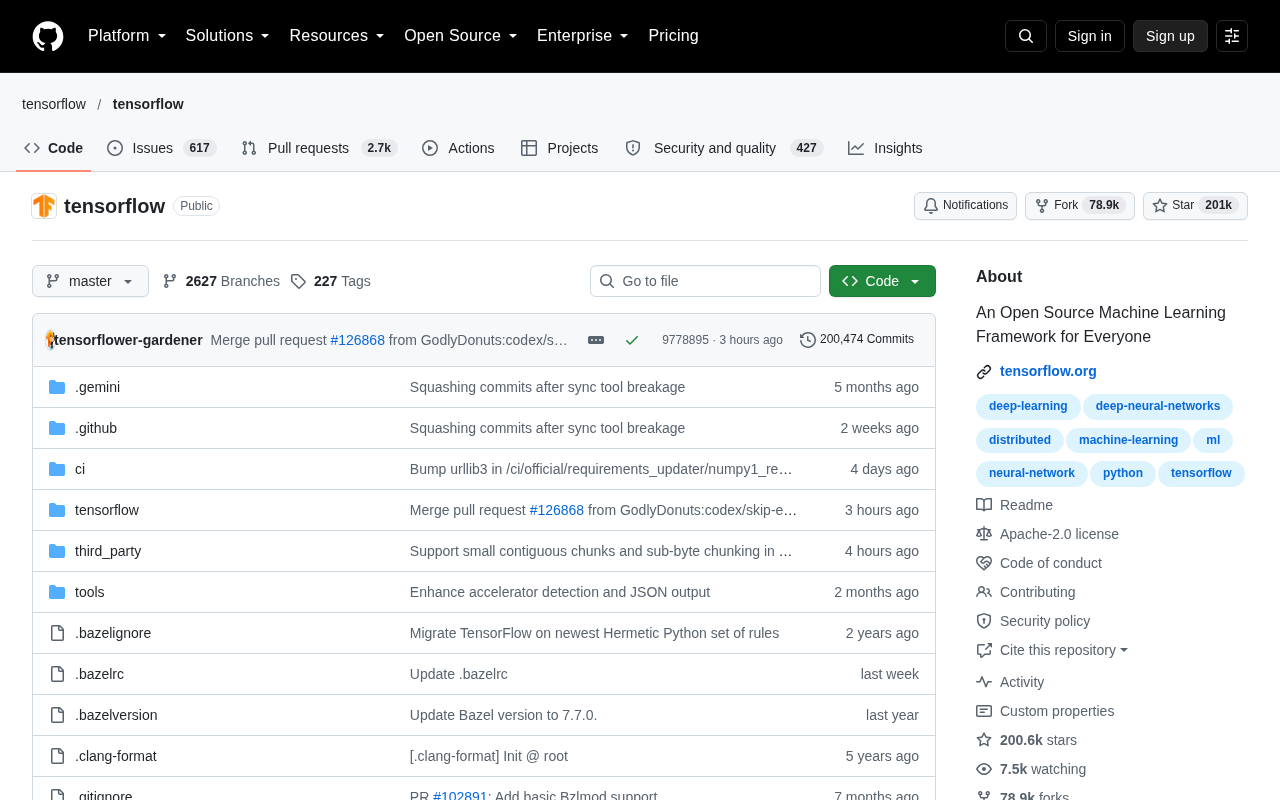
TensorFlow is an open-source machine learning framework primarily developed by Google. Its GitHub repository has accumulated over 200,000 Stars (200,585) and nearly 79,000 Forks (78,872), with 24 new Stars added in a single day. These numbers reflect the central role TensorFlow has long occupied within the broader machine learning ecosystem.
As a framework built primarily in C++, TensorFlow has a clear mission — "machine learning for everyone." It serves cutting-edge researchers conducting experimental modeling while also supporting enterprises deploying models to production environments at scale. This end-to-end coverage, from research to real-world deployment, is the key reason it has maintained such high visibility over the long term.
Why 200,000 Stars Matters
In the open-source world, Star count is a direct indicator of community recognition. TensorFlow's ability to accumulate over 200,000 Stars signals that it hasn't just been widely adopted as a tool — it has become the default entry point for many developers learning machine learning.
Nearly 79,000 Forks convey a different but equally important message: a large number of developers and organizations aren't merely "bookmarking" the project — they're actively building on it, customizing it, and conducting research on top of it. The roughly 1:2.5 ratio of Forks to Stars is a healthy engagement rate for a large open-source project, indicating a genuine base of contributors rather than passive interest.
What Sustained Daily Growth Signals
The "24 stars today" figure may seem modest, but for a mature project that has already amassed 200,000 Stars, maintaining consistent daily growth is a meaningful signal — it means TensorFlow is still attracting new users. The biggest challenge for mature projects is rarely the initial explosive growth; it's sustaining community vitality in the middle of the project's lifecycle. TensorFlow's continued growth curve confirms it has yet to be marginalized.
C++ Core and a Multi-Language Ecosystem
TensorFlow's core is built in C++, a carefully considered engineering decision. Using C++ at the foundation maximizes runtime performance and fully leverages the computational power of CPUs, GPUs, and specialized accelerator hardware — all of which is critical for training large-scale models.
At the same time, TensorFlow exposes a developer-friendly Python interface, allowing researchers and engineers to build and train models with a relatively low learning curve. This layered architecture — high performance at the bottom, ease of use at the top — is a common design philosophy among modern deep learning frameworks, and TensorFlow is one of the earliest projects to have engineered it at scale.
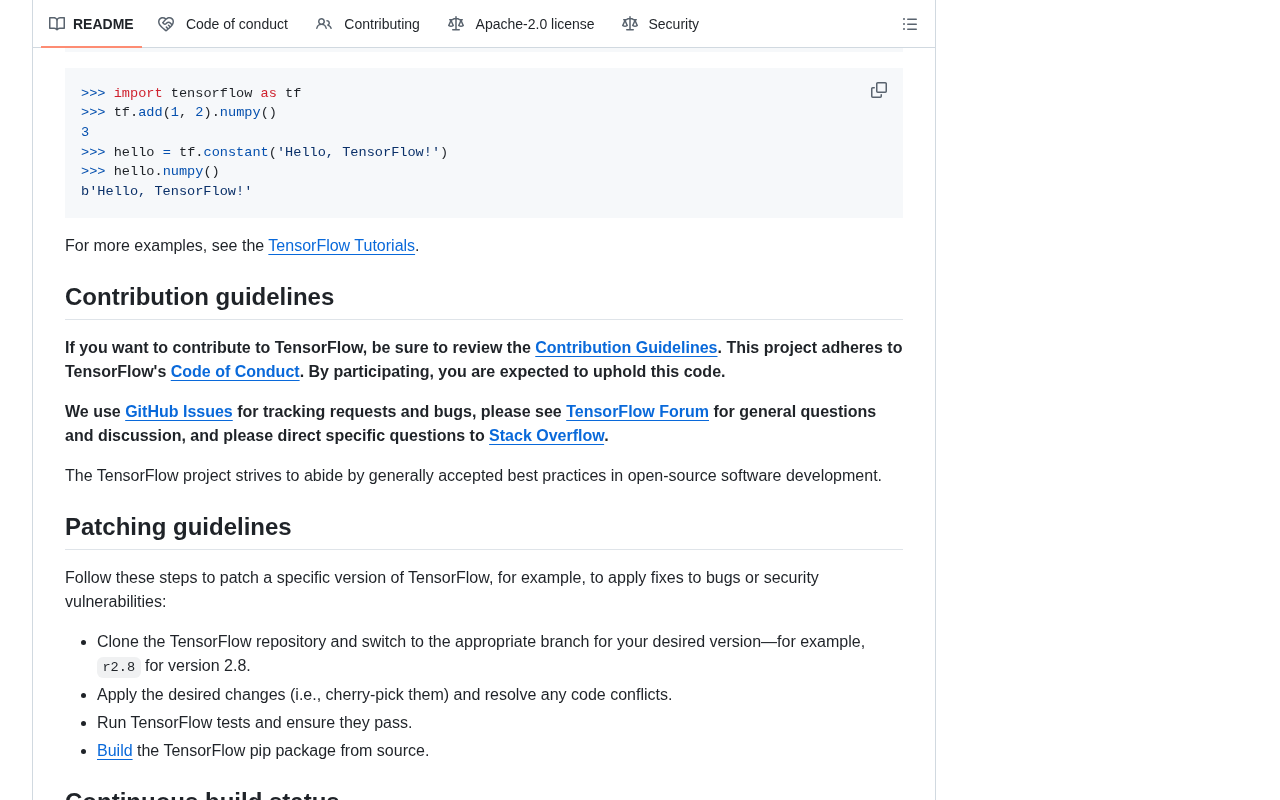
TensorFlow's multi-language support extends well beyond Python. Official bindings are available for JavaScript (TensorFlow.js), Swift, Java, Go, and more. TensorFlow.js, in particular, enables models to run directly in the browser or in Node.js environments, dramatically expanding deployment scenarios. It's also worth noting that following the release of TensorFlow 2.0 in 2019, Keras was deeply integrated as the official default high-level API, and Eager Execution (dynamic computation graphs) was enabled by default. This addressed the debugging challenges of the 1.x "define-then-run" static graph model. The architectural shift was widely seen as TensorFlow's direct response to PyTorch's dynamic graph approach, and it marked a pivotal moment in extending the framework's longevity.
TensorFlow's Role in the Machine Learning Ecosystem
After years of development, TensorFlow has evolved far beyond a single library into a comprehensive ecosystem. It provides toolchains covering the full pipeline — from model building and training, to deployment on mobile and edge devices, to serving models in production environments. This end-to-end coverage gives it a distinct advantage in industrial settings, particularly in scenarios requiring large-scale deployment.
For beginners, the vast community, extensive documentation, and abundance of tutorials mean answers to problems are almost always within reach. For enterprises, Google's continued investment and mature deployment solutions provide assurance of long-term reliability.
TensorFlow's end-to-end ecosystem capabilities are supported by several key sub-projects: TensorFlow Lite focuses on model inference for mobile and embedded devices, significantly reducing package size and latency through quantization and operator simplification; TensorFlow Serving is a production-grade model serving framework with support for version management and canary deployments; and TensorFlow Extended (TFX) provides a complete MLOps pipeline covering data validation, feature engineering, training, and monitoring. Additionally, Google's in-house TPU (Tensor Processing Unit) hardware is deeply co-optimized with TensorFlow, giving it hardware-level acceleration advantages on Google Cloud that other frameworks find difficult to replicate. This vertically integrated software-hardware ecosystem is the core competitive moat that sets TensorFlow apart from its competitors in industrial deployment scenarios.
Practical Advice for Developers
If you're considering entering the machine learning field, TensorFlow remains one of the frameworks worth prioritizing. Its broad ecosystem and community scale mean that the knowledge gained from learning it carries strong transferability and practical value.
For engineers with more experience, the recommendation is to evaluate based on the specific requirements of your project: if your goal is rapid prototyping and research experimentation, focus on the high-level APIs; if your goal is production deployment, dive deeper into its full serving and optimization toolchain. Either way, this project with 200,000 Stars offers a thoroughly solid foundation to build on.
Related articles

Multi-Agent Voice Command Center in Practice: Deconstructing the VAPI + Supabase Architecture
Deconstructing the Load Bearing Empire multi-agent voice command center: VAPI voice pipeline, Supabase Edge Functions for Webhooks, 8 Postgres tables tracking agent state, and Vercel-managed frontend design.

Astro 7 Rewrote Every Page, So IndexNow Now Hashes What a Crawler Reads
NeuraGrowth documents how an Astro 7 upgrade caused 273 pages to be misjudged as updated, and switched IndexNow hashing from file bytes to crawler-readable content—text, links, title, meta, and JSON-LD only.

From Python to AI Agents: A Full-Stack Learning Path with 488 Lessons and 23 Projects
A Udemy course covering Python, machine learning, deep learning, LLMs, RAG, and AI Agents, with 488 lessons and 23 real-world projects. This article analyzes the logic of this full-stack AI learning path, who it suits, and self-study advice.