Terence Tao: Mathematics Has Changed — Time to Act
Terence Tao: Mathematics Has Changed —…
Terence Tao calls on the mathematics community to acknowledge structural change in the discipline and align institutions and behavior accordingly.
The article centers on Terence Tao's blog post 'Mathematics has changed. Let's act like it.' The Fields Medalist's core judgment is that the tools, collaboration patterns, and knowledge production chains of mathematical research have undergone structural change, while academia's evaluation systems, collaboration norms, and talent development remain stuck in the old paradigm. The post received 199 points and 210 comments on Hacker News, showing the discussion has spread beyond mathematics. The author analyzes why the mathematics community is naturally cautious about new paradigms and emphasizes that Tao is not rejecting rigor but arguing that the way rigor is achieved should adjust to the environment. The core tension is that tool iteration outpaces institutional updates—a 'tools first, norms later' gap that also offers lessons for broader tech fields.
A Mathematician's Moment to "Act"
Fields Medalist Terence Tao published an article on his blog titled "Mathematics has changed. Let's act like it," which sparked widespread discussion on social platforms—on Hacker News, the article received 199 points and 210 comments. The title itself is a declarative statement: mathematics as a discipline has undergone substantive change, yet the academic community's way of doing things has not kept up.
What's worth noting is that this blog post is not a vague call to action, but rather a top scholar working on the front lines of mathematical research observing changes in the discipline's ecosystem. For a foundational discipline known for its "slowness," publicly discussing the need to "act" speaks volumes about the urgency of the issue.
The Mode of Mathematical Production Is Being Reshaped
Tao's core argument can be summarized as follows: the tools, collaboration patterns, and knowledge production chains of mathematical research have all undergone structural changes, but academia's institutional arrangements for evaluation, training, and collaboration remain stuck in the old paradigm.
This change is not an improvement in any single link of the chain, but a simultaneous shift across multiple links. When research tools and collaboration methods change together, mathematicians no longer face a multiple-choice question of "whether to use new methods," but an obligatory question of "how to maintain rigor and efficiency under new modes of production." Tao closes with "Let's act like it," which is essentially a reminder to peers: acknowledging change is the first step, but adjusting behavior is the key.
Judging from the discussion intensity on HN, the reach of this topic has long extended beyond the mathematics community. The 210 comments mean that engineers, researchers, and educators have all found resonance—their respective fields face the same gap where tool upgrades outpace institutional updates.
Terence Tao is one of the most influential mathematicians of our time. He won the Fields Medal in 2006 and has long worked in harmonic analysis, number theory, partial differential equations, and other areas. He is known for consistently discussing mathematical research methods, AI tools, and the academic ecosystem publicly on his personal blog. His blog has rare cross-disciplinary influence in the mathematics world, reaching both professional peers and readers in engineering, computer science, and education. Because of this, his public statements are often regarded as a "bellwether" for the direction of the discipline from a frontline researcher rather than mere personal opinion.
Hacker News is a technology community under Y Combinator, known for link sharing and in-depth commentary. Its scores and comment counts are often used to gauge how heatedly an article is discussed among tech professionals. 199 points and 210 comments mean the article was not only widely read but also triggered sustained multi-party debate, rather than one-way dissemination.
Why "Acknowledging Change" Is Harder Than It Seems
Mathematics has long been regarded as one of the purest disciplines, least dependent on external tools. The correctness of a proof is determined by logic, not by the speed of computational tools. This disciplinary temperament makes the mathematics community naturally cautious about new paradigms, and makes the word "change" appear especially jarring in a mathematical context.
Tao's statement is powerful precisely because he himself is a beneficiary and representative figure of traditional mathematical training. He does not deny rigor, but argues that the way rigor is achieved can—and should—be adjusted to the environment. The subtlety of this position lies in shifting the focus of debate from "whether new methods are reliable" to "whether old institutions still fit."
This is also why the article sparked discussion across multiple platforms. The divergence in the HN comment section is, to some extent, a microcosm of this shift: some believe the change is underestimated, while others worry that moving too fast will damage the discipline's foundations. Both concerns point to the same fact—change has already occurred.
The mathematics community's peer review and publication process is key background for understanding "institutional lag." A mathematics paper often takes months or even years from submission to formal publication. Review relies on deep reading by a small number of experts, and the evaluation system is built around original proofs and journal hierarchy. The advantage of this mechanism is rigor; the cost is slow adjustment. When research tools, collaboration methods, and even paper output speeds change, review standards and publication rhythms are hard to update in sync—and the institutional gap emerges.
From "Individual Adaptation" to "Institutional Response"
If this blog post is understood merely as "mathematicians should learn some new tools," its significance is underestimated. Tao is talking about response mechanisms at the disciplinary level: evaluation systems, collaboration norms, and talent development pathways all need to align with the new research reality.
The difficulty of institutional response lies in its lag. Individuals can quickly try new methods, but a discipline's review standards, publication processes, and training curricula are often adjusted on a yearly basis. When the speed of tool iteration significantly outpaces institutional updates, the gap accumulates into a structural problem. Tao's call is essentially a hope to shorten this lag.
For broader tech professionals, this tension is familiar. Software engineering, data science, and even content production are all experiencing a similar "tools first, norms later" pattern. The reason the mathematics discussion is worth learning from is that it examines the problem in the purest setting: when even logical proofs begin to depend on new collaboration and tool environments, institutional lag in other fields will only be more pronounced.
Conclusion: Change Is Not a Threat, but a Starting Point for Recalibration
Tao does not give an answer in the title; he gives an attitude. "Mathematics has changed" is a statement of fact, and "Let's act like it" is a call to action. The space between the two is exactly what the entire discipline needs to fill together.
For those following AI and research paradigms, the value of this article is not in providing concrete solutions, but in offering a signal sent personally by a top scholar: the self-renewal of foundational disciplines has begun, and the focus of discussion should shift from "whether to change" to "how to change safely." This shift itself is part of the change.
Related articles

VERS: Editing Activation Explanations to Halve Reasoning Model Tokens
VERS guides reasoning models by editing activation explanations, cutting 45.8% of tokens on GSM8K with only a 0.82 pp accuracy drop and transferring to larger models, but losing accuracy on competition problems.

Finding Errors Is Not Enough: Selective Model Escalation for Entity-Targeted Sentiment Analysis
This study explores selective model escalation for entity-targeted sentiment analysis, comparing data collection ordering, uncertainty-driven re-examination, and model routing—finding that minority-class priority only helps at very small data volumes, the oracle upper bound far exceeds actual gains, and escalation must be tailored to each dataset.
WAS-PO: Using Whitened Advantages to Solve the Correlation Trap in Multi-Reward Reinforcement Learning
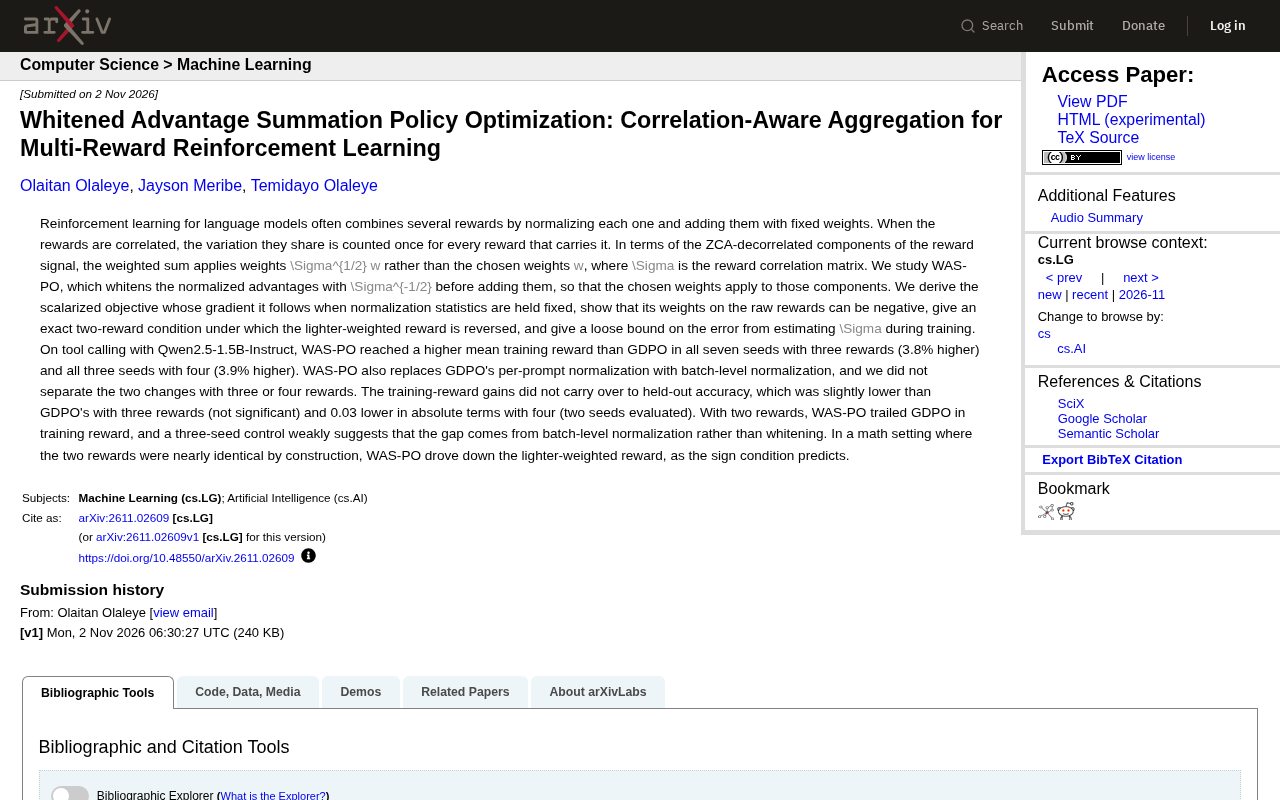
WAS-PO paper proposes whitening advantages to correct correlation bias in multi-reward RL: when rewards are correlated, naive weighted summation effectively applies Σ^{1/2}w instead of w. Experiments show training reward improves steadily, but held-out accuracy does not improve in sync, and under two rewards it actually falls behind.