Termy Review: Turning Game Videos into Immersive Language Learning Classrooms

Termy uses screen recognition to turn games, videos, and websites into immersive language learning material.
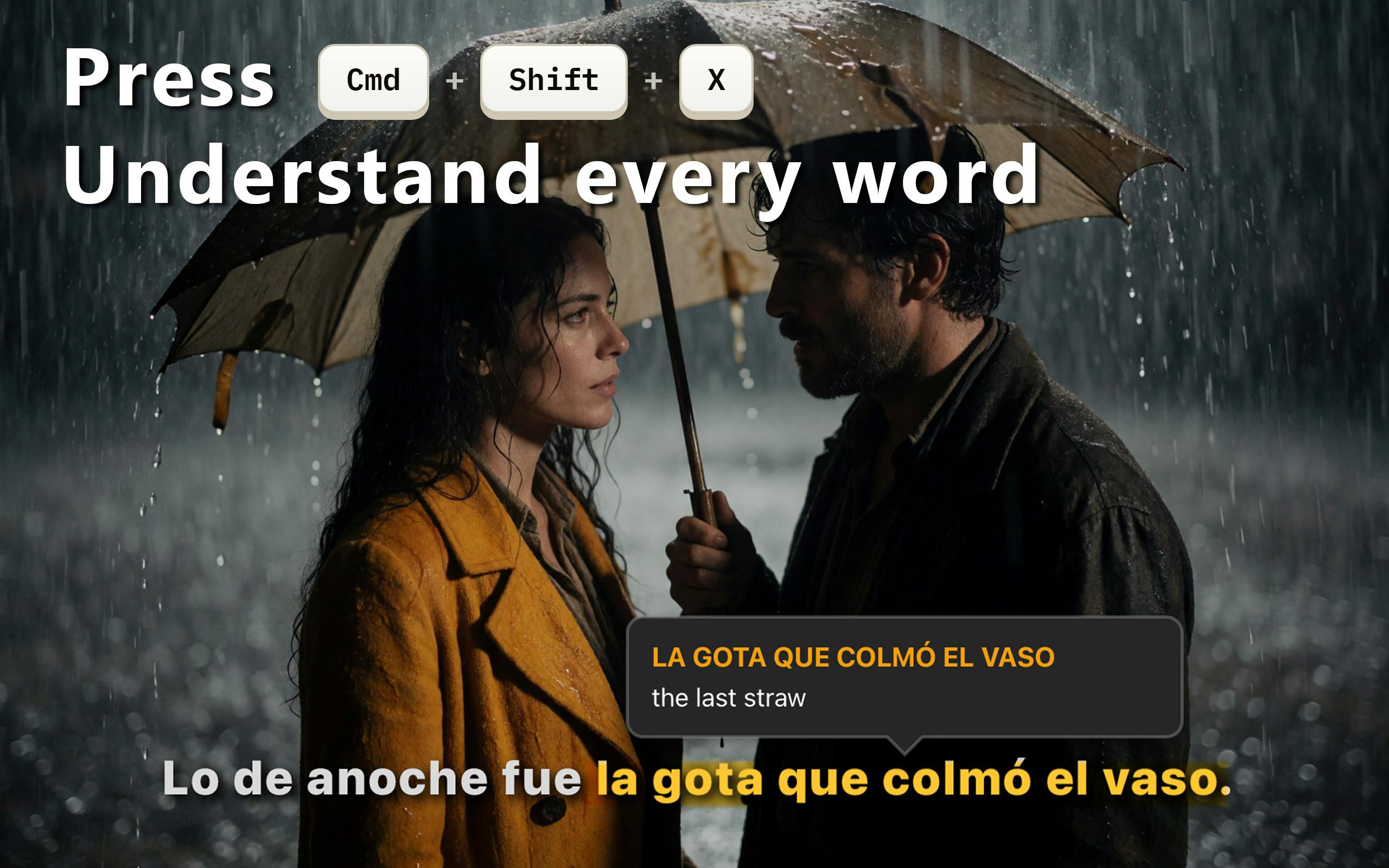
Termy is a desktop language learning tool that captures unfamiliar words directly from your screen while you play games, watch videos, or browse websites. Using a single hotkey, it identifies difficult words via OCR, explains them in context, and saves them with the exact moment of discovery. These contextual vocabulary entries then feed into an adaptive practice system. Supporting Windows, macOS, and 30 languages, Termy targets entertainment-driven learners who want to acquire languages naturally without breaking their flow.
A New Paradigm in Language Learning: From Content Consumption to Active Learning
Traditional language learning tools often face an awkward dilemma: learning content is severely disconnected from real-world usage scenarios. Users memorize thousands of words, yet still find themselves completely lost when watching foreign-language videos or playing foreign-language games. Termy, which recently debuted on Product Hunt, aims to break through this barrier — it transforms the games, videos, and websites users encounter daily into a direct source of language practice material.
According to its Product Hunt page, Termy was built by developer Mikhail Motyzhenkov. After launch, it received 84 upvotes, ranking 9th among products that day, spanning the categories of Education, Languages, and Gaming.
Core Philosophy: Completing Language Learning in a State of "Flow"
Termy's most noteworthy design philosophy is "not interrupting the user's flow." The concept of flow was first proposed in 1975 by Hungarian-American psychologist Mihaly Csikszentmihalyi, describing the optimal psychological state people experience when fully immersed in an activity — where the sense of time disappears, self-awareness diminishes, and action merges with consciousness. Flow requires a match between task difficulty and skill level, immediate feedback, and clear goals. In gaming and video consumption, flow is the core pursuit of user experience, and once interrupted (such as switching apps to look up a word), re-entry typically takes 15-25 minutes.
When you're playing a foreign-language game or watching a foreign-language video, encountering unfamiliar vocabulary usually means pausing, switching apps, and manually searching — a process that severely disrupts the immersive experience.
Termy's solution is a single hotkey — press it, and the tool automatically identifies difficult words on screen, explains them in context, and saves those words along with the "exact moment you discovered them." This "learn as you encounter" approach seamlessly embeds learning behavior into the content consumption process.
Termy's Technical Highlights: Screen Recognition and Contextual Memory
Real-Time Text Recognition Based on Screen Content
One of Termy's major technical features is its ability to recognize text anywhere on screen, without being limited to a specific application or browser plugin. This means whether it's dialogue in a game, subtitles in a video, or body text on a webpage, Termy can capture and analyze it. This cross-application versatility is what fundamentally distinguishes it from traditional browser translation plugins.
From a technical implementation perspective, screen OCR (Optical Character Recognition) converts text in images into editable text. Compared to traditional OCR for scanned documents, screen OCR faces more complex challenges: artistic fonts in games, dynamic backgrounds behind video subtitles, and character distortion from different resolutions and rendering methods. Modern screen OCR typically combines deep learning models (such as text detection and recognition networks based on CNN or Transformer architectures) to achieve high recognition accuracy in complex visual environments. Microsoft's Windows OCR API and Apple's Vision framework provide system-level support for desktop applications, but for special fonts and dynamic rendering in gaming scenarios, additional preprocessing and postprocessing algorithms are usually needed to improve accuracy.
Contextual Vocabulary Retention Mechanism
What's even more interesting is that Termy doesn't simply save words — it saves the complete context in which a word appeared, including that specific visual moment. Language learning research widely agrees that memorizing isolated words without context is extremely inefficient, while vocabulary anchored to emotional and situational contexts is far more likely to enter long-term memory. Termy capitalizes precisely on this cognitive principle.
This design has a solid foundation in cognitive science. The concept of Episodic Memory was proposed by Canadian cognitive psychologist Endel Tulving in 1972, referring to personal experience memories bound to specific times, places, and emotional states. In the field of language acquisition, Stephen Krashen's Input Hypothesis and Paul Nation's vocabulary learning research both emphasize that encountering vocabulary in meaningful contexts produces retention rates far higher than isolated memorization. Experimental data shows that vocabulary memory efficiency improves by 40%-60% when combined with contextual cues. This is why people often clearly remember expressions learned from a particular movie or game scene, yet quickly forget content mechanically memorized from word lists.
Adaptive Practice System Based on Personal Vocabulary
Those recorded "discovery moments" are subsequently transformed into adaptive exercises built around the user's personal vocabulary. In other words, your practice content comes entirely from material you've actually encountered, rather than cookie-cutter example sentences from generic textbooks. This level of personalization makes review more targeted and closer to actual usage needs.
Adaptive Learning is an educational technology approach that dynamically adjusts teaching content and pacing based on individual learner performance. Its core typically relies on Spaced Repetition System (SRS) algorithms, with the most classic implementation being the SM-2 algorithm (SuperMemo 2), later widely adopted by tools like Anki. This algorithm dynamically calculates the optimal time interval for the next review based on how difficult each learning item was to recall — well-remembered words get longer intervals, while poorly-remembered words are reviewed more frequently. More advanced adaptive systems also consider multidimensional factors such as semantic relationships between vocabulary, usage frequency, and the learner's individual forgetting curve parameters, using machine learning models for personalized scheduling to maximize memory benefits within limited study time.
Termy's Product Positioning and Usability Analysis
Supported Platforms and Language Coverage
According to official information, Termy currently supports both Windows and macOS desktop platforms, covering up to 30 languages. For cross-platform desktop users, this coverage is quite impressive. The product adopts a "Free to start" model, lowering the barrier for new users to try it out.
Target Audience: Entertainment-Driven Language Learners
Termy's positioning precisely targets a specific type of user: those who want to learn languages through everyday entertainment activities like watching shows, playing games, and browsing websites. This is a massive group that has long lacked suitable tool support. Compared to the tedium of vocabulary memorization apps and the high threshold of language courses, Termy offers a path of "learning through play."
The theoretical foundation of this approach traces back to the educational tradition of Immersive Language Learning. Linguist Stephen Krashen's "Acquisition-Learning Hypothesis" points out that natural language acquisition is more effective than deliberate language learning. Canada's French immersion education programs, running since 1965, have accumulated extensive empirical data proving that prolonged exposure to the target language in authentic contexts significantly improves language proficiency. Immersive learning in the digital age extends this concept: creating "virtual immersion" environments through digital content like games, films, and social media, allowing learners to receive abundant authentic language input without going abroad. Termy's product design is precisely the concrete implementation of this educational philosophy at the tool level.
Advantages and Potential Challenges of Using Termy
Precisely Addressing Real Language Learning Needs
From a product logic perspective, Termy addresses a real and high-frequency pain point in language learning — the need for fragmented, contextual, just-in-time learning. Deeply binding a learning tool to entertainment content aligns with current user attention habits and follows the widely recognized educational philosophy of "immersive learning."
Potential Challenges to Watch
Of course, as a tool that relies on screen recognition, Termy also faces some practical challenges: the accuracy of screen OCR recognition, compatibility with different game fonts, and how screen content is handled from a privacy perspective will all directly impact user experience. Particularly regarding privacy, a tool that needs to continuously "observe" users' screen content must be transparent about its data processing strategy — whether processing is local or cloud-based, whether data is encrypted in storage, and whether users can selectively exclude screen content from certain applications. These are all key factors users will consider when deciding whether to trust the tool.
Additionally, how to make "adaptive exercises" truly intelligent rather than mechanically repetitive is crucial for long-term user retention. If the spaced repetition algorithm is too simplistic, users will quickly find it tediously repetitive; if contextual understanding isn't precise enough, the quality of generated exercises will be significantly compromised.
Judging from the Product Hunt data of only 1 comment and 84 votes, Termy is still in its early stages, and market validation will take time. However, its product philosophy of "learning from content you love" undoubtedly offers a novel and noteworthy entry point for the crowded language learning space.
Conclusion: Is Termy Worth Trying?
Termy represents an evolutionary direction for language learning tools: no longer requiring users to study for the sake of studying, but letting learning naturally integrate into daily content consumption. When your games, videos, and websites can all become classrooms, the continuity and enjoyment of learning can truly be activated. For users seeking efficient immersive language learning, this desktop tool spanning Windows and macOS with support for 30 languages is worth a try.
Key Takeaways
Related articles

Why Does the Tesla Roadster Need to Fly? A Deep Dive into Musk's Wild Demo
Tesla's Roadster launch showed wall-climbing, upside-down driving, and flying stunts—but The Vergecast notes the demo car may lack a battery, the Rocket version is invite-only and not street-legal, and the website terms don't guarantee delivery. After nine years of delays, why does this car still need to exist?

AI Is Not a Replacement: Human-AI Collaboration Through the Lens of Factory Root Cause Analysis
Starting from factory root cause analysis, this article explains how AI accelerates evidence chain construction rather than replacing human experts, exploring the pragmatic implementation logic and business value of 'AI supporting people rather than replacing them.'

AI Agent Decision Auditing: Building an Evidence Chain in Regulated Workflows
Starting from a Reddit discussion, this article analyzes three core issues in AI agent decision auditing within regulated workflows: what fields audit records should contain, how to handle feedback latency for erroneous decisions, and how to continuously calibrate LLM judge consistency with human judgment.