Tesla FSD v15 Third-Person Reality View: AI-Generated in Real Time, No Game Engine

Tesla FSD v15 uses dual AI to generate third-person driving visuals in real time, no game engine.
Tesla FSD v15 introduces Reality View, showing the car's surroundings on the center display from a drone-like third-person angle—but the footage is entirely AI-generated, not from any camera. Two modules collaborate: a perception-decision AI shared with FSD driving understands the road, while a generative AI renders frames autoregressively via "previous frame plus blur, then refine." Musk stresses no game engine like Unity or Unreal is used, and only a fraction of vehicle compute is consumed. The leap from crude 3D blocks to near-AAA visuals is an extension of Tesla's end-to-end AI architecture—the same road-understanding model drives and draws, boosting transparency in human-machine co-driving.
Tesla's FSD v15 is rolling out a new "Reality View" that lets owners observe their vehicle's surroundings from a third-person perspective resembling a drone flyover. But that "drone" doesn't exist—the footage is entirely generated by AI in real time. Elon Musk confirmed that this is real-time AI video generation, not pre-rendered output or a traditional game engine.
What Is the Third-Person Reality View?
In FSD v15, the visualization on the center display has been upgraded from the crude 3D block models of the past to dynamic scenes approaching the quality of modern AAA games. Streets, buildings, vehicles, and pedestrians around the car are rendered as smooth video, with a viewpoint as if a drone were following behind the vehicle.
This perspective doesn't come from any external camera. Tesla vehicles don't carry hardware capable of capturing that angle—the "drone" in the frame is purely a digital fiction. What you're seeing isn't camera footage, but the vehicle's "brain" interpreting its surroundings.
Two AIs Working Together: Understanding and Rendering
According to Musk's explanation in the video, the system relies on two AI modules working in tandem:
- Perception and decision AI: This is the same "brain" responsible for FSD driving. It continuously analyzes camera input to understand road structure, obstacles, and drivable areas.
- Generative AI: After receiving the perception AI's output, the generation module references the previous frame, applies some fuzz, and then refines it into a clear image of the current moment—fast enough to produce video.
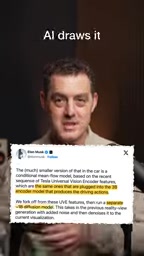
This "previous frame + blur + refine" pipeline is essentially an autoregressive video generation strategy, similar in concept to today's mainstream AI video generation models—but running in real time on in-vehicle compute, which is far more challenging.
Autoregressive video generation means the model generates each frame conditioned on previously generated frames (or their latent representations), producing continuous video frame by frame. Mainstream video generation models (such as diffusion-based or Transformer-based temporal models) often adopt this strategy to ensure temporal consistency between frames—if each frame were generated independently, the video would flicker and objects would jump discontinuously. Tesla's approach takes the previous frame as a reference, applies blur, and then has the generative model "denoise" it into the current frame, effectively using the previous frame to provide temporal context. The difficulty lies in error accumulation: deviations in early frames get amplified frame by frame; and with limited in-vehicle compute, single-frame inference must complete within tens of milliseconds to achieve video-level smoothness—far stricter constraints on model size and inference optimization than cloud-based generation.
No Game Engine, Only a Fraction of the Compute
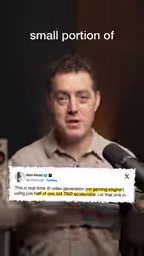
Musk emphasized that this reality view "uses no game engine at all." Traditional in-car 3D interfaces typically rely on game engines like Unity or Unreal for rendering, whereas Tesla chose to have AI generate video frames directly.
More importantly, all of this runs on just a fraction of the vehicle computer's compute. The FSD hardware platform must simultaneously handle driving decisions, perception, and cabin interaction—if generative visualization consumed too many resources, it would eat into compute for safety-critical tasks. Achieving real-time, video-level generation under limited resources indicates that Tesla has done substantial work in model compression and inference optimization.
Game engines (like Unity, Unreal) render 3D scenes through a pipeline where the scene is composed of pre-modeled geometry, materials, and lighting parameters; the engine projects 3D data into 2D images via rasterization or ray tracing, and shaders compute color and lighting. This approach requires assets to be built in advance by humans or tools, and the rendered output is deterministic and reproducible. Generative AI rendering, by contrast, doesn't rely on explicit 3D models—it has neural networks synthesize pixels directly from a "representation of understanding" of the environment, essentially "imagining" the image using learned priors. The key difference: game engine output is faithful to scene data, while AI-generated output may contain details that don't fully match real perception—which is why it's emphasized that the image reflects "the vehicle's understanding" rather than raw camera footage.
From 3D Blocks to Graphics Close to GTA 6
The video compared Tesla's screen interface from a few years ago: back then, only basic 3D geometric shapes surrounded the car, abstract and rough. Now v15's reality view can render lighting, materials, and dynamic details, with visuals being compared to GTA 6.
Behind this evolution is an extension of Tesla's end-to-end AI architecture—the same model that understands the road can not only drive, but also "draw" that understanding. Arrows in the scene show the vehicle's next turning or parking intent, and users can tap the screen to modify the planned route, blending visualization with interaction.
End-to-end AI architecture refers to a single neural network that maps raw sensor input directly to final outputs (such as steering and acceleration commands), without a manually designed modular pipeline in between. Traditional autonomous driving uses a modular architecture separating perception, prediction, and planning, with information passed between modules through hand-defined interfaces—errors accumulate at each stage. End-to-end models let the network learn intermediate representations on its own, theoretically reducing information loss. What's special about Tesla's reality view is that it reuses this architecture's intermediate representations: the driving model's internal understanding of road structure is passed directly to the generation module as a drawing condition. In other words, the visualization doesn't build a separate scene reconstruction pipeline—it "borrows" the world model already formed by the driving brain, which is a key reason it can run on limited compute.
What Does This Mean?
The third-person reality view is more than a technical showpiece. It gives passengers and drivers an intuitive basis for trusting the vehicle's perception—you can see what the car "thinks" the world around it looks like. When AI driving decisions are presented as video, transparency in human-machine co-driving improves markedly.
At the same time, it's a public demonstration of generative AI deployed in real time on the vehicle. Generating third-person video without a game engine and using only a small amount of compute showcases the potential boundaries of on-device AI inference. For those following AI applications and autonomous driving, this feature is worth continued observation.
One-line Summary
Tesla FSD v15 uses dual AI to generate third-person driving footage in real time, without a game engine.
Paragraph Summary
Tesla FSD v15 introduces "Reality View," presenting the vehicle's surroundings on the center display from a third-person, drone-flyover-like perspective—but no real camera captures this angle; the footage is entirely AI-generated in real time. The system relies on two modules working together: a perception-decision AI shared with FSD driving understands the road, while a generative AI renders video frames autoregressively via "previous frame plus blur, then refine." Musk emphasizes that no game engine like Unity or Unreal is used, and only a small fraction of the vehicle computer's compute is consumed. The visuals have evolved from crude 3D blocks a few years ago to near-AAA-game quality—essentially an extension of the end-to-end AI architecture, where the same road-understanding model can both drive and draw its understanding, improving transparency in human-machine co-driving.
Related articles

Nothing CMF Buds 2A Drops to $17.89 on Black Friday: A New Low for ANC Earbuds
Nothing CMF Buds 2A wireless earbuds Black Friday deal: just $17.89 on Amazon, about $11 off retail and a record low. ANC earbuds at an entry-level price.

When AI Creation Gets Accused of "Spitting": Hacker News Heats Up Over the Glaude Controversy
A Hacker News post, "Spitting in the Face of Glaude," sparks debate on AI creation transparency and attribution ethics. This analysis examines the blurred creator identity behind the controversy and offers practical advice for AI content production.

Akai Embraces Custom Firmware: MPC Sample 1.4 Lets Users AI-Program Their Sampler
Akai embraces the modding community with MPC Sample 1.4 firmware, supporting vibe-coded custom firmware and effects. We analyze the impact of this open strategy on music hardware and AI-assisted programming.