Tesla Optimus Begins Mass Production, But How Far Is It From True Usability?
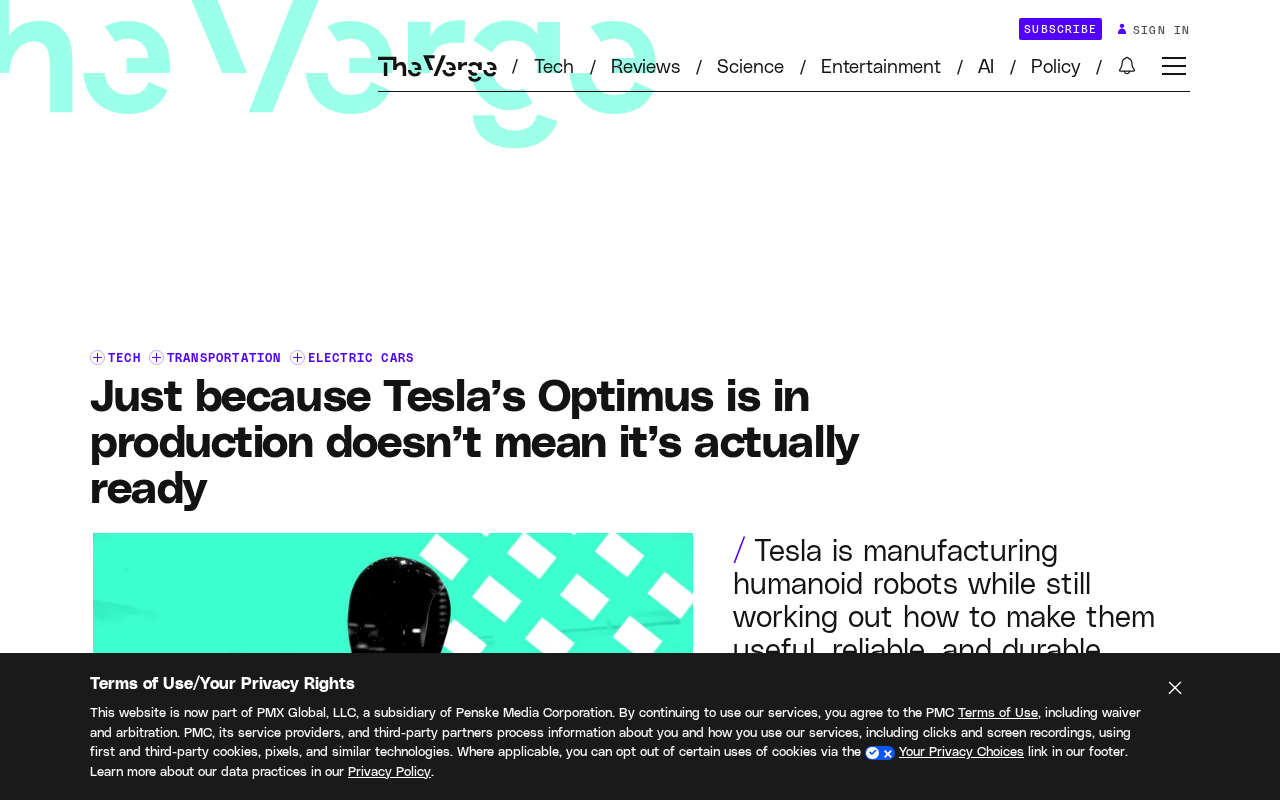
Tesla Optimus starts early production, but core issues like hands, safety, reliability, and AI remain; production does not equal usability.
Tesla CEO Musk announced that Optimus has begun early production at the Fremont factory, but admitted bottlenecks in hand dexterity, safety, reliability, and durability, with core AI still far from mature. The article argues that mass production is symbolic, and true usability still requires technical validation, safety certification, and scenario adaptation. Competition is intensifying, with cost control and AI key to adoption.
Title
Tesla Optimus Begins Mass Production, But How Far Is It From True Usability?
Meta Description
Tesla's Optimus humanoid robot has started early production at the Fremont factory, but Musk admits the hands, safety, reliability, and AI still need work. This article analyzes the gap between mass production and usability, and the real challenges facing the humanoid robot industry.
Article Content
Tesla CEO Elon Musk announced at the earnings call that the humanoid robot Optimus has begun early production on the high-volume production line in Fremont, California. However, Musk immediately listed a long series of unresolved issues: the robot's hands, safety, reliability and durability, as well as the artificial intelligence needed to make it an efficient tool.
This news came from an RSS feed, with a headline that bluntly stated "Just because Tesla's Optimus is in production doesn't mean it's actually ready." This article takes a deep dive into the real challenges behind Optimus mass production and what it means for the humanoid robot industry.
Mass Production Launch: A Symbolic Milestone
Musk said at the earnings call that Optimus has begun early production on the high-volume production line at the Fremont factory. This marks a key step for Tesla from prototype to mass production in robot manufacturing. But the term "early production" itself is subtle—it means the line is running, but large-scale commercial delivery is still a long way off.
For Tesla, Optimus means far more than just a new product. It carries Musk's vision of "letting robots do dangerous, repetitive, and boring work," and it is an important piece in Tesla's transformation from a carmaker into an AI and robotics company. However, the mass production launch is more of a symbolic milestone than a signal of technological maturity.
Technical Bottlenecks: Hands, Safety, and Reliability
Musk admitted at the call that Optimus still has multiple core technologies that need improvement. The first is the robot's hands—humanoid robot hands need sufficient dexterity and tactile feedback to perform fine operations. This is a widely recognized challenge in the industry, and Tesla is no exception.
Second is safety and reliability. Humanoid robots need to operate safely in human environments, and any failure could have serious consequences. Durability is equally critical, as the robot needs to maintain stable performance under high-intensity work. These engineering problems require extensive testing and iteration to solve.
The core challenge lies in artificial intelligence. Musk explicitly pointed out the need for "the AI to make it an efficient tool." Current humanoid robots are still far from the level needed to replace human workers in perception, decision-making, and execution. Tesla needs to build a powerful AI system that enables Optimus to understand its environment, plan tasks, and adapt to changes.
Dexterous hands and tactile feedback are key to enabling fine manipulation in humanoid robots. The human hand has about 20 degrees of freedom and can perform complex actions such as grasping and pinching, while robot hands typically have only 6-12 degrees of freedom and lack high-density tactile sensors. Tactile feedback allows the robot to perceive an object's hardness, shape, and slippage, thereby adjusting grip force to avoid crushing an egg or dropping a tool. Tesla Optimus's dexterous hand design draws on biomechanical principles, but achieving dexterity and durability close to that of a human hand while keeping costs controllable remains an engineering challenge. Currently, leading industry solutions such as Shadow Robot's hands cost tens of thousands of dollars, and Tesla needs to significantly reduce costs to meet its target price of $20,000.
The safety of humanoid robots involves functional safety standards such as ISO 13849 and IEC 61508. These standards require robots to enter a safe state when a fault occurs, such as emergency stop or limiting force output. Humanoid robots collaborating with humans in unstructured environments need collision detection, force limiting, and dynamic obstacle avoidance capabilities. Tesla's accumulated visual perception and neural network technologies from autonomous driving can be transferred to robots, but robots have higher safety requirements: car collisions are probabilistic events, while robots directly contact humans, and any mistake could cause personal injury. Therefore, Optimus needs to pass strict safety certification and extensive scenario testing before it can enter homes or factories.
Industry Background: Competition and Expectations in Humanoid Robots
Tesla Optimus is not fighting alone. Many companies around the world are investing heavily in the humanoid robot field, including Boston Dynamics, Figure AI, and several Chinese startups. Competition is focused on motion control, AI capabilities, and cost control.
Musk has said that Optimus's target cost is around $20,000. If this pricing can be achieved, it will greatly promote the popularization of humanoid robots. But low prices depend on mass production and a mature supply chain, and Optimus is still in the early production stage, so cost reduction will take time.
Market expectations for Optimus are high, but there is often a gap between expectations and reality. Tesla's AI experience in autonomous driving (such as visual perception and neural networks) may provide a technical foundation for Optimus, but the complexity of humanoid robots far exceeds that of autonomous driving.
Boston Dynamics is known for high-dynamic motion control driven by hydraulic and electric actuation. Its Atlas robot can perform parkour, backflips, and other highly difficult maneuvers, but the cost is extremely high and it has not been commercialized. Figure AI focuses on AI-driven humanoid robots and works with OpenAI to integrate large language models, with the goal of replacing manual labor in logistics and manufacturing scenarios. Chinese startups such as UBTECH, Unitree Robotics, and Xiaomi are also advancing humanoid robots, targeting low-cost and education/entertainment markets. Competition focuses on motion control (joint motors, reducers, and balance algorithms), AI capabilities (multimodal perception and task planning), and cost control (supply chain and mass production). Tesla's advantage lies in its manufacturing capabilities and AI infrastructure, but humanoid robots require an entirely new supply chain and engineering system.
Reality Check: Why "Production" Does Not Equal "Usability"
"Production" and "usability" are two completely different concepts. Production means the production line can assemble robots, while usability means the robot can work stably, safely, and efficiently in real scenarios. From production to usability, Tesla still needs to cross multiple thresholds, including technical validation, safety certification, and scenario adaptation.
Musk's candid statement actually increases credibility—he did not claim that Optimus is already perfect, but clearly pointed out areas for improvement. This pragmatic attitude may be more conducive to long-term development than overpromising. For readers following the humanoid robot industry, the start of Optimus mass production is a signal worth watching, but it should not be misunderstood as a sign of technological maturity.
In the coming years, whether Optimus can move from "rolling off the line" to "truly easy to use" will depend on Tesla's continued breakthroughs in AI, mechanical engineering, and the supply chain. We will wait and see.
One-line Summary
Tesla Optimus has started early production, but core issues such as hands, safety, reliability, and AI remain unresolved; production does not equal usability.
Paragraph Summary
Tesla CEO Musk announced that the humanoid robot Optimus has begun early production on the high-volume production line at the Fremont factory, but he immediately admitted that the robot still has bottlenecks in hand dexterity, safety, reliability, and durability, and that the core AI capability is far from mature. The article argues that the mass production launch is a symbolic milestone, and that moving from production to true usability still requires crossing multiple thresholds, including technical validation, safety certification, and scenario adaptation. Industry competition is intensifying, and cost control and AI capabilities are key to large-scale adoption. The market should view Optimus's progress rationally and should not mistake a running production line for technological maturity.
Related articles

OpenAI Partners with Shield: How the Astra Agent Revolutionizes IT Troubleshooting
OpenAI and Shield launch the Astra agent, which autonomously logs into computers and legacy systems to fix IT issues in real time, 35-40% faster than traditional models, with humans involved only when judgment is needed.

iPhone Duo Battery Life Tested: One Charge a Day Is Unavoidable, and the Large Screen Is the Culprit
iPhone Duo battery test: heavy use needs at least one charge a day, and about 30% remains after 6.5 hours of screen-on time. How often the large screen is unfolded is key; a MagSafe battery pack helps, and long-term degradation is also worth watching.

Kimi K3.1 Pro Open-Sourced: 2.8 Trillion Parameters Close In on Opus
Moonshot releases the open-source MoE model Kimi K3.1 Pro, with 2.8T total parameters and 104B activated, trailing Opus 5.5 by under 1 point on Terminal Bench 4.0.