Tesla Roadster: The Flying Hypercar That Goes Beyond Plaid

Tesla Roadster gets 122 Product Hunt upvotes, riding brand momentum rather than new product progress.
Tesla Roadster earned 122 upvotes and fourth place on Product Hunt with "The hypercar that flies," a result driven more by sustained brand momentum than a new product launch. The article examines the strategy behind bold phrases like "beyond Plaid" — deliberately withholding specs to preserve suspense and engineering flexibility — and notes that electric hypercars face inherent paradoxes around lightweighting, battery weight, thermal degradation, and handling. It also shows how Tesla's launch style increasingly mirrors consumer electronics, while the gap between hype and reality erodes early supporters' patience.
Tesla Roadster: The Flying Hypercar That Goes Beyond Plaid
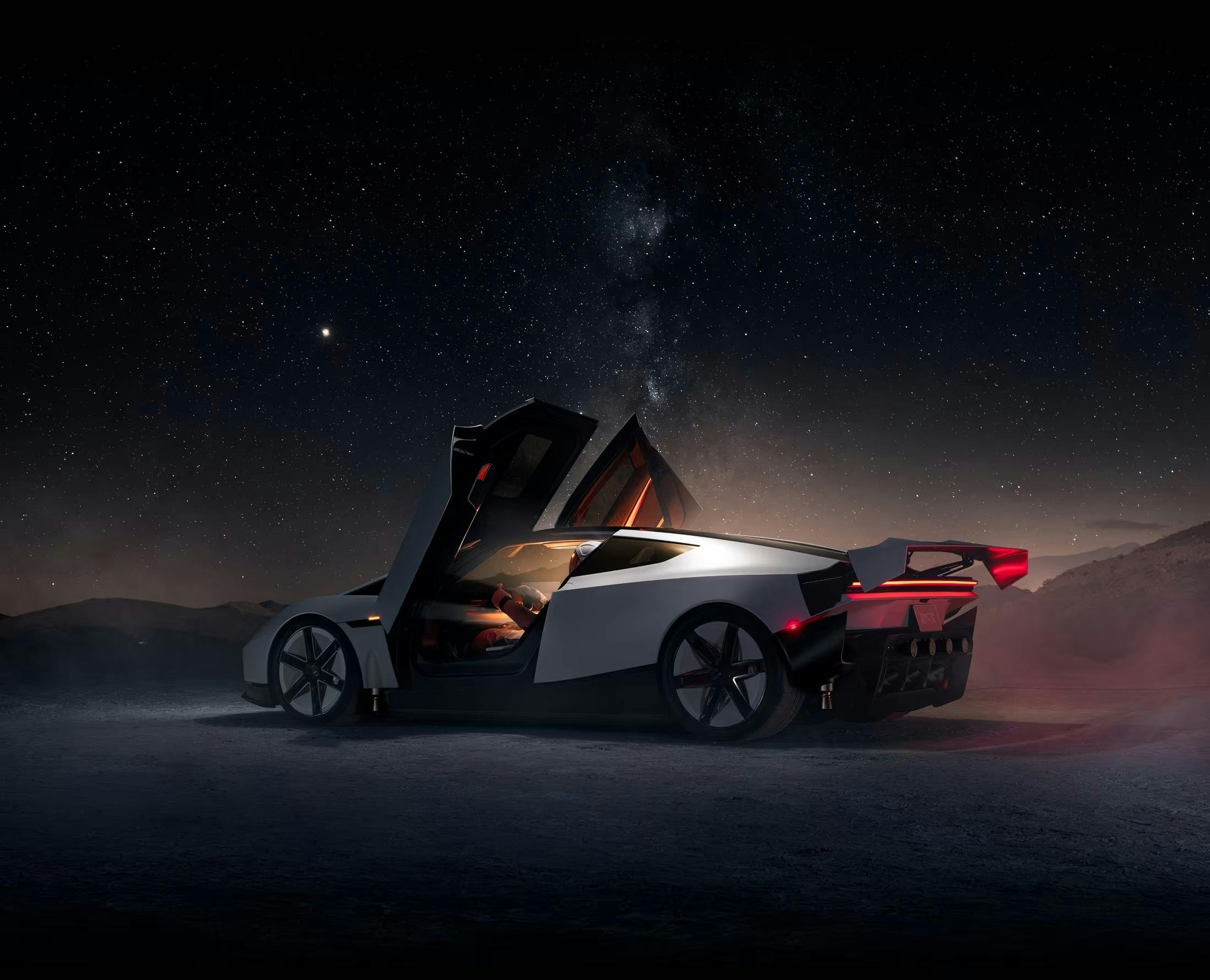
When an electric vehicle is branded with the word "flying," are we talking about marketing rhetoric or a genuine breakthrough at the boundaries of engineering? The Tesla Roadster drew attention on Product Hunt with the tagline "The hypercar that flies," quickly racking up 122 upvotes and landing at fourth place for the day. That result isn't exactly explosive for the EV category, but considering the Roadster isn't a new product launch so much as a continued release of brand momentum, the discussion value behind it far exceeds the numbers themselves.
The Definitional Debate Over a "Non-Earth" Hypercar
Tesla's description of the Roadster is aggressively worded — "extra-terrestrial vehicle," "beyond Plaid," "challenges the limits of design, engineering and physics." Stacked together, these phrases send a clear signal: the Roadster isn't a performance upgrade to the Model S Plaid, but a product in an entirely new dimension.
The question is, what exactly does "beyond Plaid" mean? Plaid is already the benchmark for acceleration performance among production EVs. For the Roadster to achieve a qualitative leap on that foundation, it's not just about stacking more motor power — it requires a systemic overhaul of battery discharge rates, thermal management systems, aerodynamic efficiency, and even tire grip. Tesla deliberately avoids specific specs in its description, a strategy that preserves suspense for the launch while also suggesting the vehicle's final form may still be under adjustment.
What is Plaid: Plaid is Tesla's highest-performance tri-motor powertrain version offered for the Model S and Model X, with deliveries beginning in 2021. It uses three independent motors to drive the front and rear axles separately (the rear dual-motor setup enables independent torque distribution between left and right wheels), producing a combined output of over 1,000 horsepower. The Model S Plaid accelerates from 0-100 km/h in approximately 2.1 seconds and has set production EV lap records at multiple tracks. So within Tesla's product language, Plaid isn't just a trim name — it's synonymous with "the current ceiling of production performance." When Tesla says the Roadster is "beyond Plaid," it's effectively declaring that the Roadster must cross a performance baseline that Tesla itself defined — and that baseline already represents the limits of motors, inverters, battery discharge, and thermal management working in concert.
Why specs are deliberately left blank: A hypercar's performance promises depend heavily on its final production form — any change to battery chemistry, cooling architecture, or even tire specifications could significantly rewrite acceleration and lap times. Publishing specs too early locks in engineering targets and becomes a PR burden if deliveries are delayed, so leaving them blank is both a marketing consideration and an engineering flexibility play.
Why a Hypercar Can Garner Attention on Product Hunt
Product Hunt's audience consists mainly of tech professionals, product managers, and early adopters — not traditional car buyers. The Roadster earning 122 upvotes on this platform shows its appeal has spilled beyond the automotive circle into a broader tech product discussion context.
Behind this phenomenon is a noteworthy trend: Tesla's product launches increasingly resemble tech product launches rather than automotive ones. From the Cybertruck to the Roadster, Tesla's exposure strategy on platforms like Product Hunt and X (formerly Twitter) closely mirrors that of consumer electronics brands — using minimalist product descriptions to create cognitive impact and replacing traditional advertising with community discussion.
However, the ratio of 6 comments to 122 upvotes also reveals something: most people are just "passing by and hitting like," with few engaging in substantive discussion. This may reflect the Roadster's long-undefined production timeline, which makes it difficult even for early adopters in tech communities to form meaningful discourse.
How Product Hunt works: Product Hunt is a product discovery community built around a "daily leaderboard," where users can upvote products launched that day, and the highest-voted products appear on the day's homepage rankings. Its audience is primarily Silicon Valley and global tech professionals, investors, and early adopters, and voting behavior is closer to "expressing approval" than purchase intent. Therefore, a product's performance on Product Hunt measures its topical penetration within tech circles, not market sales. This is precisely the logic behind Tesla choosing to release Roadster information on this platform: reaching the most influential opinion groups at extremely low cost and letting the discussion spread organically across social networks.
The Engineering Paradox of Hypercar Electrification
The category the Roadster represents — the pure electric hypercar — inherently faces a set of almost contradictory engineering requirements. Hypercars demand extreme lightweighting, yet large battery packs are precisely the heavyweight component; hypercars pursue sustained high-power output, yet thermal degradation under extreme discharge is a law of physics; hypercar buyers expect track-grade handling, yet the concentrated placement of battery packs alters the vehicle's center of gravity distribution.
Tesla claims the Roadster will "challenge the limits of physics," a statement worth deconstructing in an engineering context. What can truly be "challenged" is the wisdom of engineering trade-offs — how to find a previously deemed impossible balance between range, weight, power, and heat dissipation. If the Roadster's final production version can deliver convincing answers across these dimensions, its significance extends beyond being just a fast car — it would establish a new engineering paradigm for the entire high-performance EV category.
Battery discharge rate and thermal degradation: A battery's "discharge rate" is typically expressed in C-rate, meaning the multiple of discharge current relative to rated capacity. Ordinary EVs discharge continuously at around 1-3C, while hypercars need instantaneous rates of 10C or higher during full acceleration. High-rate discharge significantly increases internal resistance heating, and once cell temperatures exceed the safe range, the battery management system (BMS) actively limits output power to protect the cells — this is the so-called "thermal degradation," the root cause of a vehicle getting slower and slower after repeated full-throttle accelerations. Solutions include more aggressive cooling architectures (such as immersion cooling), lower internal resistance cell chemistries, and smarter power distribution strategies.
How battery placement affects center of gravity and handling: Combustion hypercars push weight toward the vehicle's center and lower the center of gravity through mid-engine or rear-engine layouts, while electric hypercars universally adopt a "skateboard" chassis, laying a flat battery pack beneath the floor between the front and rear axles. This layout naturally delivers a low center of gravity and near 50:50 front-to-rear weight distribution, but it also raises seating position, increases curb weight, and gives the vehicle excessive yaw inertia, making steering response less agile than lightweight combustion hypercars. Electric hypercars therefore often need wider tracks, stiffer suspension, and active torque vectoring to compensate.
Managing the Gap Between Expectation and Reality
Considerable time has passed since the Roadster first debuted, during which Tesla has repeatedly adjusted delivery expectations. This renewed attention on Product Hunt feels more like a resurgence of community sentiment than a substantive disclosure of product progress. For those who upvoted, what they're supporting is less a car that already exists and more the "possibility" that Tesla represents.
This kind of expectation management is a double-edged sword. On one hand, sustained topical heat maintains the Roadster's brand equity; on the other, each delay erodes the patience of early supporters. The competitive landscape of the hypercar market is also shifting — traditional hypercar brands are rolling out hybrid or pure electric models one after another, and the Roadster faces a competitive environment vastly different from when it first launched.
Whether the Tesla Roadster can ultimately truly "take off" depends on whether it can translate those thrilling descriptions into a deliverable, verifiable product experience. Until then, those 122 upvotes on Product Hunt are both anticipation and a checklist of promises yet to be fulfilled.
One-line Summary
Tesla Roadster gets 122 upvotes on Product Hunt, sustained by brand momentum rather than new product progress.
Paragraph Summary
Tesla Roadster earned 122 upvotes and fourth place on Product Hunt with "The hypercar that flies," a result stemming more from sustained brand momentum than a new product launch. The article analyzes the strategy behind official aggressive language like "beyond Plaid" and "extra-terrestrial vehicle" — deliberately avoiding specific specs to preserve suspense and engineering flexibility — and points out that pure electric hypercars inherently face engineering paradoxes: lightweighting vs. battery weight, sustained high power vs. thermal degradation, and handling vs. center of gravity distribution. Meanwhile, the Roadster's ability to attract tech community attention shows Tesla's launch approach has become highly similar to consumer electronics brands, but the imbalanced upvote-to-comment ratio and the long-undefined production timeline also expose how the gap between expectation and reality is eroding early supporters' patience.
Related articles

AgentCore in Practice: Connecting Custom Tools and MCP Servers to Agents
DebuggerCafe tutorial shows how to connect custom tools and MCP servers to Amazon Bedrock AgentCore agents, covering tool contract design, MCP reuse, and production concerns.

816B Parameters Scores Only 39? The Real Cost-Effectiveness of the Open-Source LLM Parameter Race
Meta's 816B Muse Spark Open scores just 39 on Artificial Analysis, while 180B Qwen3.8-Flash-Next scores 40. This article analyzes 11 open-weight models' parameters vs. scores, exploring the real impact of activated parameters, quantized size, and deployment cost.

Aerial Manipulators: The Next Step for Drones from 'Seeing' to 'Changing'
Starting from a Reddit discussion, this article analyzes the technical challenges, potential applications, and deployment bottlenecks of aerial manipulators, exploring the key challenges for drones moving from environmental perception to physical manipulation.