Tesla to Invest €3 Billion Expanding Berlin Factory, Cybercab's European Strategy Accelerates Across the Board

Tesla plans €3 billion Berlin factory expansion to pave the way for Cybercab European production and Robotaxi operations.
Tesla plans to invest €3 billion expanding Gigafactory Berlin, upgrading it from a Model Y production site to the European manufacturing hub for the Cybercab—marking Europe's shift from a sales market to an autonomous vehicle manufacturing base. The article analyzes Berlin's advantages in tariff avoidance, supply chain maturity, and talent, noting that the Cybercab as a steering-wheel-free autonomous vehicle depends far more on localized production and regulatory adaptation than ordinary passenger cars. Local manufacturing helps navigate European certification processes and respond to regional road conditions, while the Cybercab enters the Robotaxi segment with differentiated competition against the private vehicle market. However, implementation remains constrained by European regulatory approval and autonomous driving software progress, with no clear timeline yet.
Tesla is bringing Europe into its global roadmap for the Cybercab. According to RSS sources, Tesla plans to invest €3 billion in a large-scale expansion of Gigafactory Berlin to pave the way for European mass production of its dedicated autonomous taxi model.
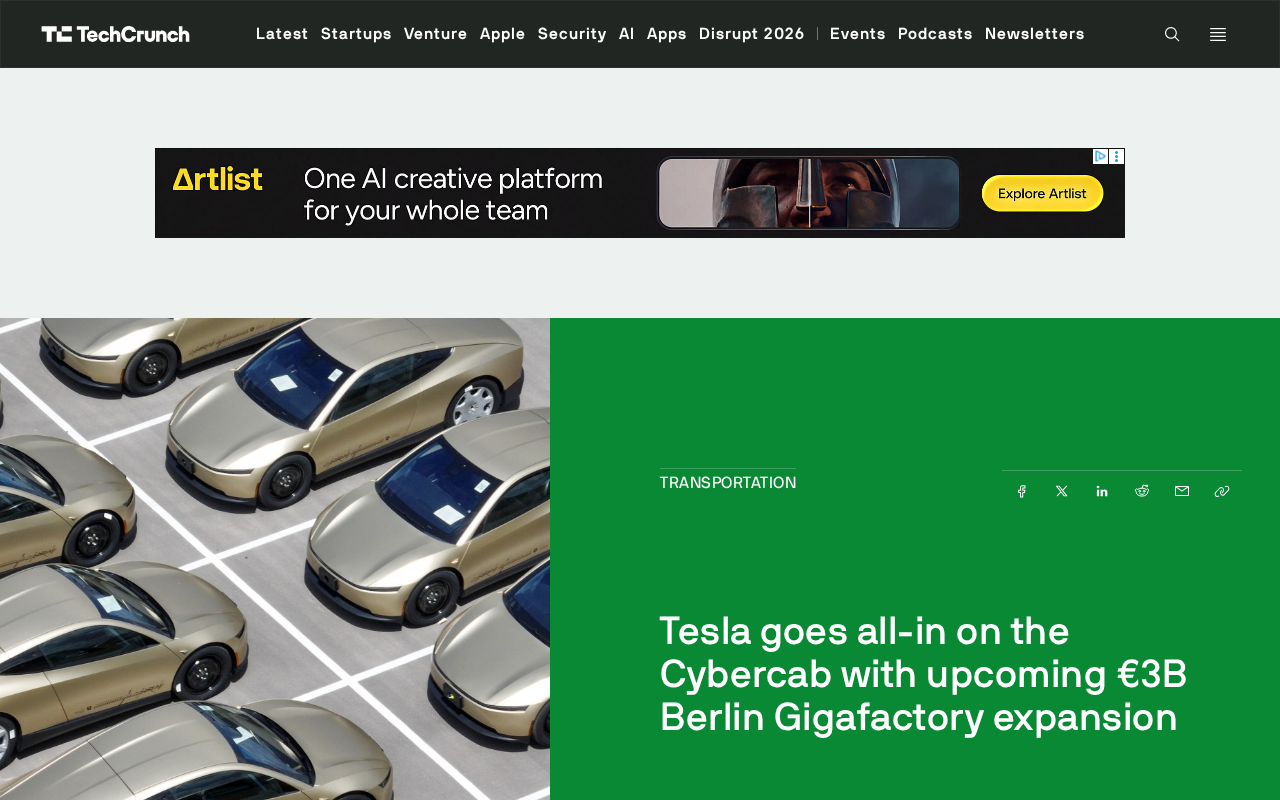
Berlin Factory Expansion: A Key Move in Cybercab's European Strategy
Tesla's €3 billion investment is a heavyweight move in its European manufacturing footprint. Gigafactory Berlin originally handled primarily Model Y production, but the expansion is squarely aimed at the Cybercab—a vehicle designed from the ground up for fully autonomous driving scenarios. This means Tesla is upgrading Europe from a "sales market" to an "autonomous vehicle manufacturing base."
In terms of site selection logic, the Berlin factory offers several advantages: it sits within the European customs zone, avoiding import barriers for finished vehicles; the surrounding supply chain has matured over several years of operation; and Germany's local engineering talent pool supports autonomous-driving-related production lines. Tesla choosing to expand in Berlin rather than build a new factory is essentially "layering capabilities" onto existing infrastructure rather than replicating from scratch—a more rational approach in terms of capital efficiency.
Why the Cybercab Needs a European Manufacturing Foothold
The Cybercab's product positioning differs from any previous Tesla model—it has no steering wheel or pedals and is designed specifically for driverless operation scenarios. Mass production and deployment of such a vehicle depend far more on localized manufacturing and regulatory adaptation than ordinary passenger cars.
European countries are moving at different paces on autonomous driving legislation, but the overall regulatory framework is gradually taking shape. Manufacturing the Cybercab locally allows Tesla to more flexibly navigate different countries' certification processes and shorten the cycle from production to road deployment. At the same time, Europe's narrow urban roads and high-density traffic environments impose different requirements on sensor suites and decision algorithms compared to North America, and local production helps respond to regional needs more quickly.
Where the €3 Billion Goes
Although the original information did not disclose specific production line details, the Cybercab's product characteristics suggest the funding will likely focus on several areas: retrofitting assembly lines for steering-wheel-free vehicles, localizing integration capabilities for autonomous driving sensor suites, and supporting battery and electric drive capacity. Tesla has been pushing manufacturing process simplification in recent years, and the Cybercab itself emphasizes a "rapidly replicable" production philosophy—the Berlin expansion will most likely continue this approach.
Cybercab is Tesla's dedicated autonomous taxi model unveiled in October 2024. Its design completely eliminates traditional driving controls such as the steering wheel, brake pedal, and rearview mirrors, relying entirely on Tesla's FSD (Full Self-Driving) software for driverless operation. The vehicle features a two-seat layout with butterfly doors and targets operating costs of approximately $0.2 per mile. Because it has no manual driving capability, the Cybercab's market launch and operation depend heavily on regulatory approval for L4 fully autonomous vehicles in each country—which is the core reason Tesla chose to manufacture locally in target markets to accelerate regulatory alignment.
Impact on Tesla's European Competitive Landscape
Tesla faces considerable pressure in Europe. Traditional automakers are accelerating their electrification transitions, and Chinese automakers are rapidly penetrating the European market with cost-effective offerings. The Cybercab represents a differentiated path—not competing in the private vehicle market's price war, but entering the emerging Robotaxi operating network segment.
Placing Cybercab manufacturing capability on European soil means Tesla can build a "production-to-operation" closed loop in its second-largest market outside North America. If this plan materializes smoothly, Europe will become an important testing ground for Tesla's autonomous driving commercialization, not merely a destination for vehicle exports.
Robotaxi refers to the business model of providing on-demand mobility services using driverless vehicles, viewed as the next structural transformation of the mobility industry. Unlike the private vehicle market, the Robotaxi segment competes on fleet operating efficiency, per-mile costs, and software algorithm capabilities—not brand premium or dealer networks. Waymo has achieved scaled commercial operations in multiple U.S. cities, Baidu's Apollo Go has accumulated substantial orders in China, and the European market remains in its early stages due to fragmented regulations. Tesla's entry into this segment with the Cybercab is essentially leveraging manufacturing cost advantages to compete on operating-side economies of scale—but the prerequisite is that FSD software's safety record can pass scrutiny by European regulators.
Variables Remain for Implementation
A note here: the pace of the €3 billion expansion plan still depends on multiple external factors—European regulatory approval for vehicles without steering wheels, the licensing framework for Robotaxi operations, and Tesla's own progress on autonomous driving software. The original information did not provide a definitive timeline for completing the expansion, and there is no official word yet on the actual deployment pace of the Cybercab in Europe.
What is certain is that Tesla is putting real money behind its confidence in the Cybercab path. This expansion investment in the Berlin factory is a concrete projection of that conviction onto the European market—from "selling cars" to "building autonomous mobility capacity," Tesla's European story is being told in a new way.
Related articles

Jensen Huang Returns to Nvidia: The Power Game Behind an "Aggro Reset"
Nvidia's board reappointed Jensen Huang as CEO less than two weeks after his scandal-driven resignation. This analysis explores the board's decision-making, Trump's political intervention, media power failure, and market reaction behind the dramatic return.

Why Voice AI Can't Understand Kenyans' Everyday Conversations
Swahili speech recognition hits 3.24% error on read text, but everyday Kenyan speech mixes English, Sheng slang, and accents—leaving mainstream voice AI struggling.

Data Centers Build Their Own Natural Gas Plants: AI Compute's Breakout Around a Decade-Long Grid Wait
Grid interconnection approvals can take a decade, so xAI and others are building off-grid natural gas plants to power AI clusters. This article analyzes the drivers, costs, and impact of behind-the-meter generation on AI infrastructure.