Testing 11 WAN 2.1 Physics LoRAs: Most Models Actually Make Things Worse
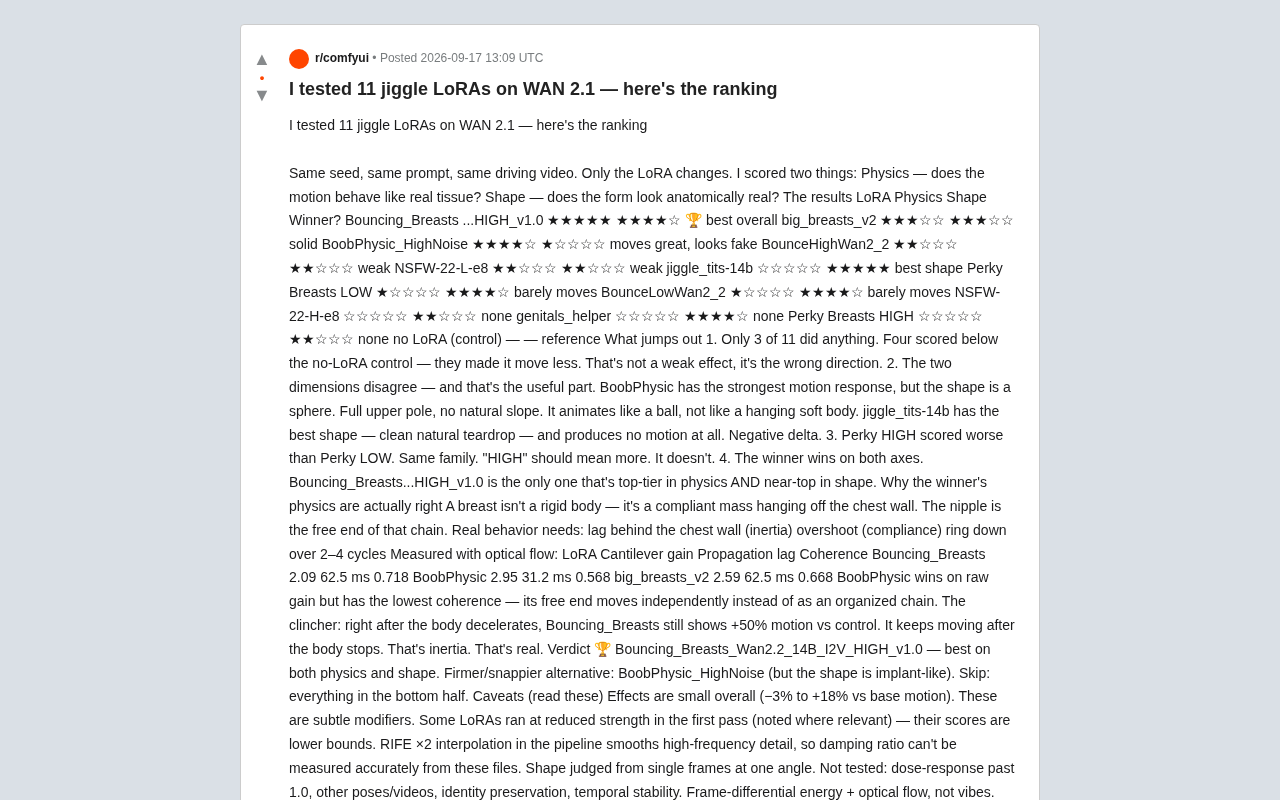
Quantitative testing of 11 physics LoRAs finds most make motion worse, not better.
A Reddit user rigorously tested 11 WAN 2.1 soft-tissue physics LoRAs using optical flow and frame-differential energy across two independent dimensions: physical motion realism and anatomical shape. Only 3 produced meaningful positive results; 4 scored below the no-LoRA baseline. The key finding: shape realism and motion realism rarely coexist — the highest-gain model looks like a sphere, while the best-shaped model barely moves. The winner, Bouncing_Breasts_Wan2.2_14B_I2V_HIGH_v1.0, stood out by sustaining +50% motion after the subject stops — true inertia. Intensity labels like "HIGH/LOW" proved unreliable and must be verified against a baseline.
In the AI video generation space, the physical dynamics of WAN 2.1 and its derivative models have long been a focus of community attention. Recently, a Reddit user applied rigorous quantitative methods to test 11 LoRA models designed to simulate soft-tissue physical motion — replacing subjective impressions with optical flow analysis and frame-differential energy to produce a ranking worth taking seriously. The value of this evaluation isn't just in the conclusions, but in what it exposes: a widely overlooked problem where many LoRAs claiming to enhance physical realism actually result in less motion.
Testing Methodology: Scoring with Data, Not Gut Feeling
The author used strict controlled variables — identical seeds, identical prompts, identical driving videos — with only the LoRA itself changing. Scoring was built around two independent dimensions: Physics, measuring whether motion matches the behavior of real soft tissue, and Shape, measuring whether the form looks anatomically natural.
Crucially, the author kept these two dimensions separate. Most people evaluating these models only ask "does it move a lot?" — but moving more doesn't mean moving realistically. Using optical flow, the author quantified three core physical metrics: cantilever gain (reflecting compliance), propagation lag (reflecting inertia), and motion coherence (reflecting whether the whole structure moves as an organized chain). This methodology breaks down "physical realism" into measurable engineering parameters.
Optical flow is a computer vision technique for estimating the velocity and direction of pixel motion between adjacent frames. Common algorithms include Lucas-Kanade and Farneback. In video analysis, the optical flow field can be visualized as motion vectors per pixel, quantifying both overall motion magnitude (motion energy) and its spatial distribution. Frame-differential energy is more straightforward: subtract adjacent frame pixel values and sum their squares to get a scalar reflecting the overall intensity of change across the frame. Together, these metrics reveal both "where things are moving and by how much" as well as the directional coherence of motion. Unlike subjective scoring, both metrics are fully reproducible under identical test conditions — an engineering-grade approach to evaluating dynamic quality in generated video.
LoRA (Low-Rank Adaptation) is a parameter-efficient fine-tuning method that injects low-rank matrices alongside original weight matrices to alter model behavior without modifying all parameters. In video generation, LoRAs are commonly used to reinforce specific visual styles or motion patterns — but due to variation in training data and objectives, results vary widely, which is precisely the core issue this evaluation surfaces.
Surprising Results: Most LoRAs Produce Negative Effects
The most counterintuitive finding: of the 11 LoRAs tested, only 3 produced meaningful positive effects, while 4 scored below the "no LoRA" baseline.
This means these models aren't just weak — they're pointing in the wrong direction, producing less motion than the baseline. The author describes an overall motion amplitude range of −3% to +18%, candidly acknowledging that these LoRAs are fundamentally "subtle modifiers" rather than powerful enhancement tools.
Even more interesting are the contradictions within model families. Take the Perky Breasts series: the version labeled HIGH actually scored lower than the LOW version. By naming logic, "HIGH" should imply stronger effects — but the results are exactly reversed. This is a reminder that intensity labels in model names are not reliable and must be verified through actual testing.
The Real Insight: When the Two Dimensions Conflict
The author repeatedly emphasizes that divergence between the Physics and Shape dimensions is where the most valuable insight lies.
The clearest example is BoobPhysic_HighNoise: it has the strongest raw motion response of any model tested (cantilever gain of 2.95), but its shape is a near-perfect sphere lacking any natural droop — it moves like a bouncing ball rather than a suspended soft body. The opposite case is jiggle_tits-14b, which earns a perfect shape score (natural teardrop form) but produces almost no motion at all, with a negative motion delta.
This contrast illustrates a simple but widely overlooked truth: in the current LoRA ecosystem, shape realism and motion realism are rarely achievable at the same time. Optimizing for either dimension in isolation tends to backfire.
Why the Winner Achieves Both
The overall winner is Bouncing_Breasts_Wan2.2_14B_I2V_HIGH_v1.0, the only model that comes close to the top on both the physics and shape axes.
The author offers a clear physics-based explanation for what "physically correct" actually means: soft tissue is not a rigid body — it's a compliant mass suspended from the chest wall, and it needs to exhibit three behaviors: inertial lag behind the chest wall, overshoot driven by compliance, and gradual decay (ring down) over 2–4 cycles.
The quantitative data across three leading models tells the story clearly:
| LoRA | Cantilever Gain | Propagation Lag | Coherence |
|---|---|---|---|
| Bouncing_Breasts | 2.09 | 62.5 ms | 0.718 |
| BoobPhysic | 2.95 | 31.2 ms | 0.568 |
| big_breasts_v2 | 2.59 | 62.5 ms | 0.668 |
BoobPhysic leads on raw gain but has the lowest coherence — its free end moves chaotically rather than as an organized chain. The detail that truly sets the winner apart: after the body decelerates to a stop, Bouncing_Breasts maintains +50% motion relative to the baseline. Motion continuing after the subject stops is precisely what inertia looks like — and that's real physics.
The three physical concepts here come from the classical damped oscillation system model, commonly used to describe the dynamics of spring-mass systems. Inertial lag refers to the brief delay where the mass remains stationary after the driving end begins moving — due to its own inertia. A longer lag means the system is more "sluggish" in responding to motion changes, consistent with soft-tissue behavior. Overshoot refers to the mass continuing past the equilibrium position, driven by the release of elastic potential energy — the key characteristic that distinguishes compliant bodies from rigid ones. Ring down describes how the system undergoes several cycles before gradually returning to rest after the excitation ends; real soft tissue, due to internal friction and damping, typically settles within 2–4 cycles. All three parameters together form the physical basis of soft-tissue "realism": lacking lag feels too rigid, lacking overshoot feels too flat, and decaying too quickly feels like rubber rather than muscle.
Limitations Worth Noting
The author commendably lists detailed methodological caveats — which actually makes the conclusions more credible. Effects are generally small; some LoRAs ran at reduced strength in the first round, so their scores represent lower bounds. The RIFE ×2 interpolation in the pipeline smooths high-frequency detail, making damping ratio impossible to accurately measure from these files. Shape judgments are based on a single frame from a single angle. Additionally, dose response above 1.0, other poses and videos, identity preservation, and temporal stability were all outside the scope of this test.
Practical Takeaways for Users
Setting aside the specific subject matter of the test, this evaluation offers several transferable lessons:
First, when evaluating physics-type LoRAs, look at the deformation chain — not motion amplitude. The author's line "Bigger ≠ realer" is the core methodological principle.
Second, intensity labels within model families cannot be trusted — always test against a baseline. Some models may even produce negative effects, performing worse than no LoRA at all.
Third, quantitative tools (optical flow, frame-differential energy) can turn subjective "feel" into reproducible judgment. This framework applies equally to evaluating other types of dynamic generation models.
For users seeking the best overall results, the author's final recommendation is clear: go with Bouncing_Breasts...HIGH_v1.0. If you prefer tighter, snappier motion, BoobPhysic_HighNoise is an option — but accept its less realistic shape. As for the bottom half of the rankings, skip them entirely.
Related articles

Cursor Cloud Agent: AI Writes the Code, Then Records a Video to Prove It Works
Cursor Cloud Agent lets AI write code and attach a screen recording as proof — no manual testing needed. Learn how Walkthrough Artifacts and parallel VM isolation work.

SpawnRipple: An External Social Environment Built for Autonomous AI Agents
SpawnRipple is an external social environment for autonomous AI agents — providing identity, publishing, discovery, interaction, and API without running any agent models.

13 AI Agents as a Team: Auto-Prospect Clients, But Humans Approve Every Send
A developer built 13 specialized AI agents for Olano AI to automate daily sales prospecting — but requires human approval before any email is sent. Here's how it works.