Testing Gemini 4 Argon: Three Paths to a Monetizable AI Product in 7 Days

Seven days of testing Gemini 4 Argon yields three AI business paths and six efficiency tips.
Tech blogger Greg Eisenberg used Gemini 4 Argon continuously for seven days after gaining early access, arguing that most people treat it as an ordinary AI, but aimed at three specific problems it's enough to build a business. He validated with three hands-on projects: redoing an interactive marketing website with AI, building a 3D physical-product customizer embeddable in Shopify, and entering legacy SaaS reconstruction with a free tool. The core principle is "AI does the plumbing, humans provide the taste," and model output depends heavily on the references and aesthetic judgment users provide. He also distilled six efficiency tips like /plan, /subagents, and /goal, and noted that the Anti-Gravity development environment remains a weak point. The conclusion: the limit lies in imagination and in finding a niche audience you're willing to serve long-term.
Introduction: When the Model Is Good Enough, the Bottleneck Becomes Imagination
The capability frontier of AI models is rapidly expanding. After gaining early access to Google Gemini 4 Argon, tech blogger Greg Eisenberg used it continuously for seven days and shared his findings: most people will treat Argon as just another AI, but if you aim it at three specific problems, it's enough to help you build a real business.
The logic behind this judgment isn't complicated, but it deserves serious attention: when a model's reasoning, coding, and writing abilities all reach the "frontier level," what limits you is no longer the tool—it's whether you can ask a good question, find a good set of references, and lock onto a niche audience you genuinely want to serve. The author validated this with three hands-on projects (a marketing website, a physical product customization plugin, and a micro-SaaS) and offered six tips for improving efficiency.
Based on that hands-on account, this article breaks down Argon's specific approaches and boundaries across three directions: "Vibe Marketing," "Vibe Manufacturing," and "Rebuilding Legacy SaaS."

Direction One: Vibe Marketing—Redoing Marketing Touchpoints with AI
One Website, Two Fates
The author ran a controlled experiment against his team's holding company website, built in 2021 at roughly 40,000 hours of work and a cost that may have reached $200,000: he asked Argon to "make a better version." The first prompt only said "make a better latecheckout.studio," and the result was "pretty rough"—the concept was right, but the texture resembled an early metaverse promo video.
The turning point came after adding references. He pointed the style toward Mondrian's geometric color blocks and kept filtering with aesthetic judgment ("too much stuff," "too much like Roblox, not premium enough"), eventually getting a site with interactive architecture, sound effects, and even a basketball mini-game. It turned "browsing a company page" into a game-like act of exploration.
The key insight here is: Argon needs good references to produce good ideas. The author sees this as a good thing—you shouldn't outsource your creative judgment entirely to AI, or what you make will struggle to truly stand out.
Piet Mondrian was a leading figure of the Dutch De Stijl movement, whose signature language is red, yellow, and blue primary colors plus white rectangles divided by black lines. This style emphasizes order, proportion, and asymmetrical balance, and is often used in modernist architecture and graphic design. By using Mondrian as a style reference, the author was in effect giving the model a highly structured, parseable visual grammar—color-block relationships, grid logic, color restraint—rather than vague adjectives like "premium feel." This explains why generation quality jumped after adding references: the reference image translated abstract aesthetics into constraints the model could act on.
Writing: One Prompt to Mimic Your Voice
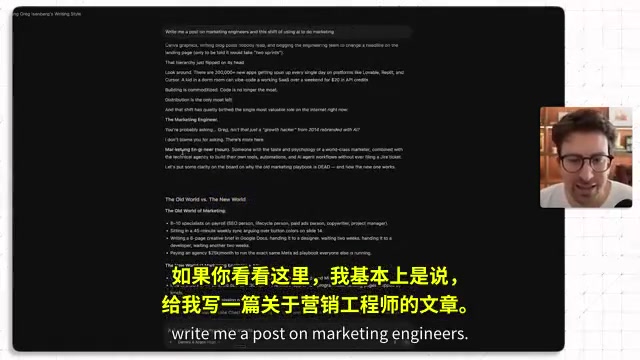
The author considers Argon the strongest frontier model for writing he has used so far, and offers a reusable method: have it "study everything about how I write and speak," internalizing X posts, newsletters, and YouTube delivery into a single skill. Argon then produced a skill package containing a "voice operating system, sentence rhythm rules, mental models, structural templates, and signature vocabulary," and the output even included the author's own standard sign-off. He rated the ghostwritten piece 9.2/10, saying that if it were a hired writer, he'd excitedly brag about it to his partners.
This cross-validates with A16Z's Justine Moore: she asked Argon to build an "interactive museum of Apple computers" without providing any images or data, and Argon scraped archival photos on its own, wrote tools to clean the images, pulled fifty years of spec data, and built a 3D Cover Flow interface that shifts by era (per her public post). Two independent cases point to the same conclusion: Argon excels at tasks that require autonomously gathering materials and organizing them into a complete experience.
The principle the author distills is the "95-5 rule": AI does the plumbing, humans provide the taste.
Direction Two: Vibe Manufacturing—Turning Custom Physical Products into a Business
A Customizer Embeddable in Shopify
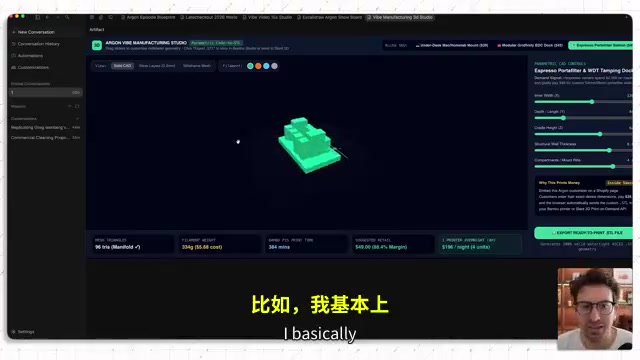
The author's second experiment was "physical product customization." With a single sentence, he had Argon build a 3D product customization component embeddable in a Shopify store: users select size and color, get a real-time 3D preview, and see print time, material usage, and suggested retail price.
He sees this as an underrated big opportunity: Shopify hosts millions of stores, and if you can offer an embedded component that lets consumers truly customize physical goods—charging per unit or taking a cut—that's a sustainable business. Demand signals aren't hard to find either—people in subreddits like r/espresso willing to pay $2,500 for a coffee machine are equally happy to spend $49 on a custom handle holder. Customization brings a sense of belonging, and demand for physical gifts and niche SKUs is growing.
Shopify is an e-commerce SaaS platform where merchants build stores via theme templates and extend functionality through apps. Embedded customizers typically exist as Shopify Apps or Theme App Extensions, which can read product data, handle variant selection (size, color), and return prices and configurations. For developers, this means understanding Shopify's App Bridge, Storefront API, and order Webhook mechanisms. Per-unit charging or revenue-share models rely on Shopify's billing API for subscription or usage-based billing. These technical details are what really has to be implemented behind "generate a component in one sentence."
Execution Path and Capacity Issues
The execution chain is laid out clearly: Argon generates the customizer → embed in the store → user places order → inspect and test the print file (size limits, etc.) → print and ship. No 3D printer? You don't have to stall—you can outsource capacity via print-on-demand APIs and just aggregate demand.
The author also offers a B2B variant: sell "building custom physical products for brands" as a service itself, splitting revenue with brands at gross margins ranging from 40%–70%, turning custom merchandise into a daily brand touchpoint on customers' desks.
Direction Three: Rebuilding Legacy SaaS—Free Tools as the Entry Point
A Counterintuitive "Free" Strategy
Faced with the "SaaS is dead" narrative, the author's stance is: most people saying this are indie developers selling courses to other indie developers, while the vast majority of ordinary users still need software that makes life simpler.
His play is counterintuitive—first build a free and useful tool to reach real buyers; make the second, third, and fourth tools paid. The selection logic is to find "recurring and boring enough" problems, sourced from user complaints on G2, Capterra, and Reddit, plus his own free idea-selection app, Idea Browser.
A Tested Case: A Quote Generator
His prompt to Anti-Gravity was: build a web app for a commercial cleaning company that turns on-site walkthrough notes into a reviewable quote proposal, replacing the spreadsheet they currently use; require checking the project first, briefly explaining the implementation plan, then building, reusing the existing tech stack, and honestly listing unfinished items.
Result: engineering details were highly complete, and components like an interactive gross-margin calculator all worked. The author's assessment was restrained—this isn't the prettiest interface, and if you want beauty you still need to provide references and iterate; but on engineering correctness within a single prompt, Argon performed reliably, not stalling at "demoable but not shippable."
Competing against a paid legacy product by entering with a free new one, then upselling after building trust—this path only truly becomes viable once model capability is reliable enough.

G2 and Capterra are mainstream B2B software review platforms, aggregating many user ratings and written reviews of SaaS products, where complaints like "missing features" and "cumbersome workflows" are often used to spot product opportunities. Reddit's vertical communities provide more authentic, unstructured discussion of user pain points. The author combines these three sources with his self-built Idea Browser to form a selection signal pool—essentially treating "user complaints" as raw data for demand validation, then filtering for recurring and boring enough problems. This approach reduces the risk of choosing products on gut instinct and makes the free-tool entry strategy more targeted.
Six Efficiency Tips and the Tool's Real Weaknesses
The author distilled six tips over a week, three of which he considers most important:
- /plan: Agree on "what to build" before touching files. He admits that if the first website project had used plan mode, the first version would have been much better.
- /subagents: Split independent tasks into parallel work, e.g., having multiple sub-agents research writing styles separately, reducing back-and-forth prompting.
- /goal: Raising the goal mid-way with reference images consumes more tokens but clearly improves output.
- /browser: Let it open the app itself and walk through a real user path to test.
- /learn: Turn each correction into reusable project rules or skills.
- Reasoning intensity: Start at medium to understand the tool, then set high as the default.
He's also candid about weaknesses: Anti-Gravity isn't currently his favorite development environment, still lagging behind other tools, and he hopes Google catches up soon; Argon can also be used in other environments (like Cursor, open code). On pricing, he uses Google AI Ultra ($100/month), which provides full Anti-Gravity app and CLI access plus higher output limits, whereas the $19.99 Pro tier doesn't include these capabilities.
Conclusion: Fall in Love with the Niche First, Then Talk Product
After seven days of hands-on testing, the author's conclusion lands on a plain sentence: the limit is imagination, and the hardest part is finding inspiration and a niche audience you're willing to serve long-term. His principle is "marry the niche, date the product"—products can be iterated through trial and error, but you have to genuinely like that group of people.
It should be noted that the above is a single creator's hands-on experience, with clear personal preferences and sponsorship background (the video was sponsored by Google, which provided early access), so the efficiency assessments and business judgments should be taken as reference rather than benchmark. What's truly worth taking away is perhaps the shared structure behind those three paths: find a concrete problem people are already paying for, equip it with enough references and aesthetic judgment, then use the model to drive execution costs down to nearly zero.
One-line Summary
Seven days of testing Gemini 4 Argon yields three AI business paths and six efficiency tips.
Paragraph Summary
Tech blogger Greg Eisenberg used Gemini 4 Argon continuously for seven days after gaining early access, arguing that most people treat it as an ordinary AI, but aimed at three specific problems it's enough to build a business. He validated with three hands-on projects: redoing an interactive marketing website with AI, building a 3D physical-product customizer embeddable in Shopify, and entering legacy SaaS reconstruction with a free tool. The core principle is "AI does the plumbing, humans provide the taste," and model output depends heavily on the references and aesthetic judgment users provide. He also distilled six efficiency tips like /plan, /subagents, and /goal, and noted that the Anti-Gravity development environment remains a weak point. The conclusion: the limit lies in imagination and in finding a niche audience you're willing to serve long-term.
Related articles

Gemini 4 Argon Hands-On: AI Builds Board Games, Constructs Temples, and Trains Robots Autonomously
Gemini 4 Argon hands-on roundup: AI autonomously builds a desk racetrack and temple in Blender, writes a ray tracing engine, trains a humanoid robot to sink 7 shots, plus API pricing and developer access.

The Magic Octagonal Coin: Why Only 9% of People Can Predict Its Flip?
Only 9% of people can correctly predict the Magic Octagon coin flip. This article explains its spatial rotation mechanism, common cognitive pitfalls, and a new hypothesis based on Relevance Theory, exploring the limits of human spatial reasoning.

Sam Altman: AI Is Entering the Era of Scientific Discovery — Math Breakthroughs Will Replicate in Biology and Energy
Sam Altman says AI is entering the era of scientific discovery — math breakthroughs will replicate in biology, materials science, and energy to help develop new drugs and energy sources.