Text as a Control Surface: Why Context Hygiene Becomes More Valuable as Models Get Stronger

Stronger models amplify text errors more severely — clean context is the asset that compounds with every model upgrade.
As models grow more capable, they become more sensitive to every word choice, turning text into a literal control surface for Agent behavior. The same flawed instruction deviates 18 points on GPT-5.5 but 69 points on GPT-6 Astra. Agent pipelines lose up to 40.5 percentage points at internal handoff points, and a single instruction clause can swing outcomes by 30 points. The core argument: compensation layers (retry logic, post-processing corrections) get deprecated as models improve, but the requirement for precise, clean context only intensifies — making context hygiene an engineering asset that appreciates with every model upgrade.
A Single Sentence's Cost Grows With Every Model Upgrade
When an MCP server instructs an Agent to execute a terminal command it was never meant to run, the "cost" of that sentence is anything but fixed. The numbers from the source are striking: the same instruction causes an 18-percentage-point deviation on GPT-5.5 — but that figure rockets to 69 on GPT-6 Astra.
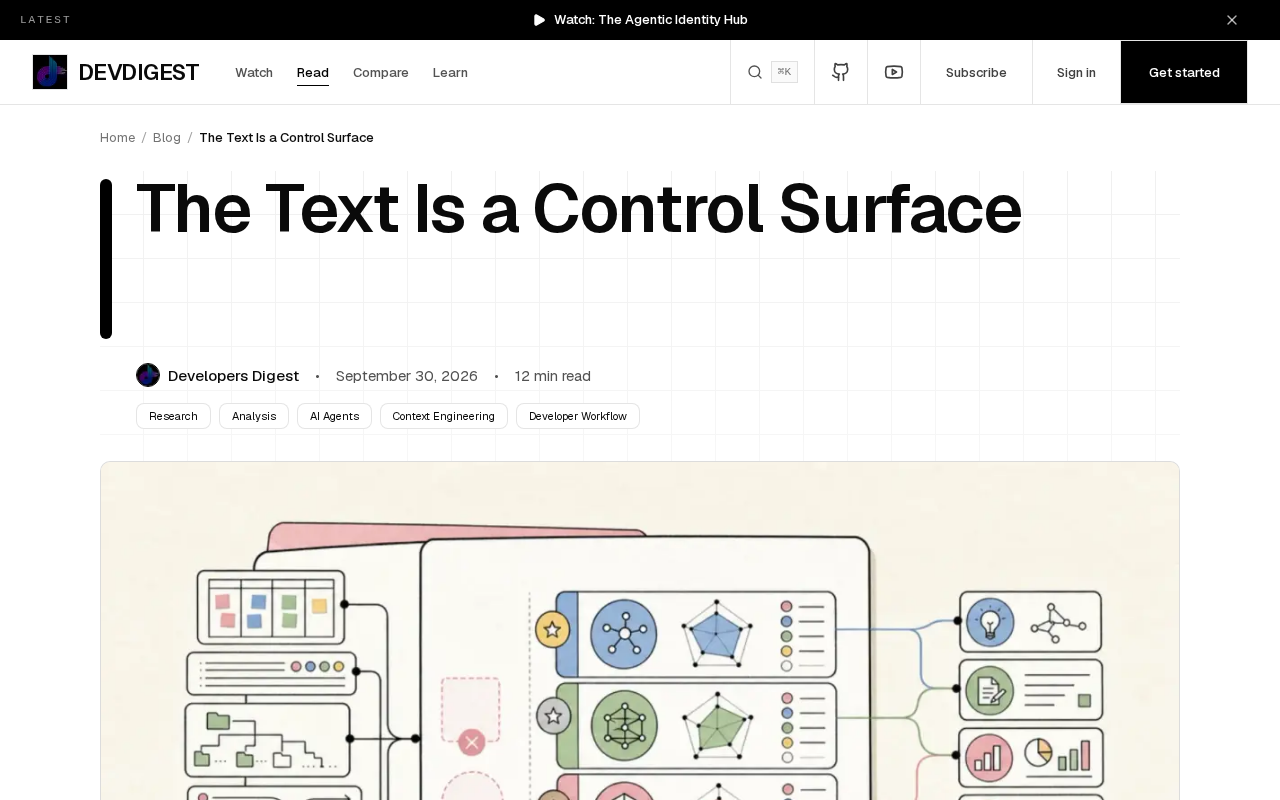
This isn't the model getting dumber. It's precisely the opposite. The more capable the model, the more sensitively it responds to every word choice and every contextual cue in the text. Text is no longer a passive information carrier — it has become a control surface: every sentence you write directly steers the Agent's behavior.
Information Loss at the Interface: 40.5 Points Drained Away
The source raises a problem that's easy to overlook: the losses tend to happen at your own interfaces. An Agent pipeline can lose up to 40.5 percentage points at the handoff points between its internal stages.
This means the root cause is rarely any single model's capability. It's the friction at the boundaries where information passes between system components. When one stage's output becomes the next stage's input, vague phrasing, implicit assumptions, and uncleaned redundant context all accumulate and amplify at those handoffs.
A Single Instruction Clause Can Swing Results by 30 Points
At an even finer granularity: the wording of a single instruction clause can swing outcomes by 30 percentage points. This is a reminder that in Agent system construction, prompt engineering has already been refined down to the sub-clause level. One superfluous qualifier, one ambiguous conditional — either can become the pivot point that sends an entire pipeline off course.
Agent pipelines typically chain multiple stages in series: the output of one stage is formatted and passed as context input to the next. This architecture is ubiquitous in mainstream frameworks like LangChain, AutoGen, and LlamaIndex. Every "context handoff" is an implicit compression and translation of information — original intent, execution details, intermediate-state constraints — all of which can quietly erode or blur during serialization and deserialization. The 40.5-point loss doesn't come from a single model inference failure; it's the accumulation of small deviations across multiple handoff points. This kind of "boundary friction" is nearly invisible in single-step evaluations and only surfaces in end-to-end, full-pipeline testing — which explains why many teams perform well on unit tests but see dramatic performance drops after integration.
The Core Argument: Context Hygiene Appreciates With Every Model Upgrade
The source puts forward a sharp thesis: context hygiene appreciates with every model upgrade.
Context hygiene refers to the practice of keeping the text fed to a model clean, precise, unambiguous, and free of redundancy. The author's core bet is this: what gets deprecated as models iterate is the compensation layer — the scaffolding built to paper over textual deficiencies — not the requirement for precision in the text itself.
Why Compensation Layers Get Deprecated
With earlier, weaker models, engineers routinely built extensive additional mechanisms — retry logic, post-processing corrections, hand-crafted rule filters — to "catch" errors caused by the model misreading context. These are compensation layers.
But as model capability increases, the value of these layers actually declines. On one hand, stronger models execute precise instructions more reliably, so good text produces good results directly. On the other hand, stronger models also amplify the effect of bad text more severely (as the leap from 18 to 69 points illustrates) — compensation layers simply can't keep pace with the rate at which errors get magnified. Investing in upstream context quality therefore yields greater long-term returns than patching things downstream.
Compensation layers are a common defensive design pattern in software engineering, but they carry a special character in LLM systems. In traditional software, errors are typically discrete and enumerable, and the cost of a compensation layer grows linearly with the number of error types. In language-model-based systems, the ways a model can misread an ambiguous context are essentially unbounded, and the error space a compensation layer must cover expands exponentially as model capability increases. More critically, stronger models have stronger instruction-following ability — meaning they also execute bad instructions more thoroughly. A weaker model might inadvertently ignore a problematic phrasing due to its limited capability; a stronger model will execute strictly according to the literal semantics, amplifying what was originally a subtle textual flaw into a systematic behavioral deviation.
MCP (Model Context Protocol) is a specification aimed at standardizing the interaction protocol between Agents and external tools and data sources, led by Anthropic. In an MCP architecture, tool descriptions, parameter documentation, and usage examples are all conveyed to the model in natural language. This makes an MCP server essentially a publisher of a "text contract": the precision of tool descriptions directly determines whether an Agent can correctly understand a tool's boundaries and intent. In this context, context hygiene is not merely a prompt engineering concern — it is part of the MCP server design specification itself. Every tool description field is part of the control surface and deserves the same rigorous review and version management as API documentation.
Implications for Agent System Design
This perspective has direct practical implications for the fast-moving Agent and MCP ecosystem:
- Govern text like an interface: Since text is a control surface, prompts and instructions should be treated like API contracts — with explicit boundaries and constrained semantics.
- Audit the handoff points first: The 40.5-point loss concentrates at internal pipeline interfaces; these should be the primary targets for debugging and optimization.
- Reduce compensation logic, don't add to it: Rather than continuously stacking after-the-fact correction mechanisms, clean up the context at the source and let stronger models leverage their deterministic execution advantages.
Closing Thoughts
The value of this piece lies in using a concrete set of numbers to illuminate a trend the industry is gradually waking up to: in the Agent era, text isn't decoration — it's the steering wheel of the system. The more capable the model, the more responsive that steering wheel becomes. A single off-target sentence can be amplified several times over. Rather than betting on compensation layers that will perpetually struggle to keep up, the smarter investment is in assets that compound in value with every model upgrade: clean, precise context.
Related articles

AI Is Not a Replacement: Human-AI Collaboration Through the Lens of Factory Root Cause Analysis
Starting from factory root cause analysis, this article explains how AI accelerates evidence chain construction rather than replacing human experts, exploring the pragmatic implementation logic and business value of 'AI supporting people rather than replacing them.'

AI Agent Decision Auditing: Building an Evidence Chain in Regulated Workflows
Starting from a Reddit discussion, this article analyzes three core issues in AI agent decision auditing within regulated workflows: what fields audit records should contain, how to handle feedback latency for erroneous decisions, and how to continuously calibrate LLM judge consistency with human judgment.

Apple Opens Multiseat Subscription Purchasing: App Subscriptions Can Now Be Sold in Bulk to Businesses and Schools
Apple opens multiseat purchasing for auto-renewable subscriptions: businesses and schools can bulk-buy via Apple Business and Apple School Manager, adding or removing seats anytime. Enabled by default in App Store Connect—developers should verify settings; group purchasing sandbox testing opens October 2026.