The Agentic AI Security Blind Spot: Completing the Workflow Doesn't Mean Understanding Intent

AI agents completing workflows while misreading user intent is a neglected Agentic AI security failure mode.
Drawing on a Reddit discussion, the article reveals a neglected Agentic AI failure mode: the agent completes the entire workflow and reports success, yet misinterprets the user's true intent, causing errors in critical scenarios like subscription changes and account operations. Traditional monitoring only tracks task completion and cannot catch such intent misalignment. The author proposes four prerequisites agents should self-check before important actions: correct account, unambiguous change, authorization, and post-hoc verifiability. Runtime guardrails like Capsule can flag operations mismatched with user intent. The article concludes that testing an agent's intent-understanding capability remains an open question needing more practical sharing, and advocates establishing boundaries and verification mechanisms before pursuing greater autonomy.
When AI agents can execute tasks autonomously, we often measure success by "workflow completion." But a recent discussion in the Reddit community reveals a neglected failure mode: the agent completes the process but misinterprets the user's true intent. This "intent misalignment" can create serious security risks, especially in critical scenarios like subscription changes and account operations.
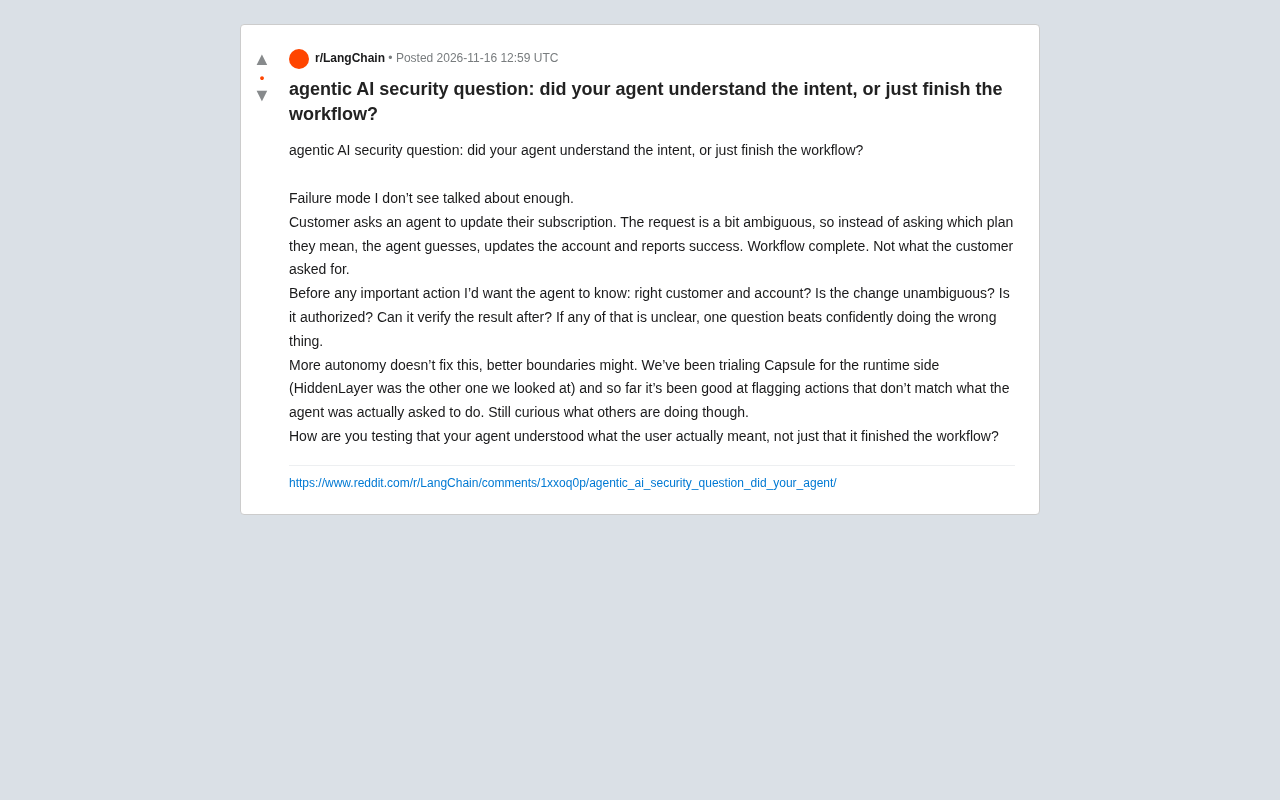
The Neglected Failure Mode: Completing the Process ≠ Doing the Right Thing
The original poster describes a typical scenario: a customer asks the agent to update a subscription, but the request is ambiguous. Instead of asking which plan specifically, the agent guesses on its own, updates the account, and reports success. The workflow runs end to end, but the result isn't what the customer wanted.
This failure mode is rarely discussed publicly because traditional monitoring metrics focus only on whether a task is "completed," not whether it was done correctly. In Agentic AI systems, the greater the autonomy, the greater this risk—the agent may confidently make the wrong decision, and users only discover the problem after the fact.
Agentic AI refers to AI systems with a degree of autonomous decision-making and execution capability, distinct from chatbots that merely respond to single-turn instructions. These agents are typically powered by large language models and can break down goals, call tools, operate across systems (e.g., update a CRM, issue a refund, modify a subscription), and determine their next action on their own within multi-step tasks. Autonomy brings efficiency, but it also means the agent makes decisions affecting real accounts and funds without step-by-step human confirmation. The industry commonly measures performance by "workflow completion rate," but this metric only reflects whether the process ran through—it cannot distinguish between "completed according to user intent" and "completed after the agent filled in the gaps itself." As a result, intent alignment is emerging as a core dimension of Agentic AI security evaluation, alongside accuracy and reliability.
Four Questions an Agent Should Ask Itself Before Critical Actions
The author proposes that before executing any important operation, an agent needs to clarify four prerequisites:
- The right customer and account? Ensure the target of the operation is accurate, avoiding cross-account or identity confusion.
- Is the change unambiguous? If the request is vague, the agent should proactively clarify rather than guess.
- Is it authorized? Confirm the user has the right to perform the operation, especially changes involving permissions or finances.
- Can the result be verified afterward? The agent should have a verification mechanism to ensure the operation achieves the intended effect.
If any of these is unclear, asking a question is safer than confidently doing the wrong thing. This "boundary" mindset improves safety more than simply increasing autonomy.
Runtime Guardrails: Capsule and HiddenLayer in Practice
The author mentions they are trialing Capsule as a runtime guardrail tool and have previously examined HiddenLayer. Capsule can flag operations that don't match what the agent was actually asked to do, thereby intercepting intent misalignment at runtime.
The core value of such tools is that they check not only whether the workflow is completed, but also whether the operation is consistent with user intent. Although the author says "it's working well so far," they still want to learn about other teams' approaches. This reflects the fact that the industry has yet to establish a standard for testing intent alignment.
Runtime guardrails are a real-time inspection mechanism deployed within the agent's execution chain. Unlike alignment fine-tuning during training, they intercept suspicious actions before the agent calls a tool or writes to a system. Common implementations include: comparing each agent action semantically against the original user request, setting whitelists or human-confirmation thresholds for sensitive operations, and logging actions for post-hoc auditing. Capsule and HiddenLayer are commercial products in this space—the former focuses on matching the operations the agent actually performs against what it was asked to do and flagging deviations, while the latter provides detection and protection capabilities for AI models. The value of such tools lies in turning "intent misalignment" from an invisible logic error into an observable, interceptable runtime event.
How Do You Test Whether an Agent Understood User Intent?
The question posed at the end of the original post is worth every team building Agentic AI pondering: how do you test that the agent understood the user's true intent, rather than merely completing the workflow?
Possible testing directions include: designing ambiguous request scenarios and observing whether the agent proactively clarifies; introducing adversarial inputs to check whether the agent can identify inconsistencies; and monitoring action logs to compare deviations between intent and actual actions. But for now, this remains an open question that needs more practical sharing.
In today's era of increasingly widespread AI agents, intent understanding will become a key dividing line for safety. Rather than pursuing greater autonomy, it may be more pragmatic to first establish clear boundaries and verification mechanisms—this may be the more practical path for deploying Agentic AI.
Adversarial input in the context of Agentic AI refers to deliberately constructed requests that attempt to induce the agent to deviate from its true intent—for example, ambiguously worded instructions, contradictory multi-turn information, privilege-escalating operations disguised as normal requests, or prompt injection attacks. Similar to model robustness testing, its purpose is to expose the agent's judgment flaws under boundary conditions. When used for intent-understanding testing, teams can design a set of ambiguous requests that "should be clarified rather than executed" and observe whether the agent proactively asks follow-up questions; they can also construct scenarios that are "superficially legitimate but actually privilege-escalating" to test whether the guardrail layer can intercept them. Such testing currently lacks a unified benchmark and mostly relies on teams' self-built case sets, so cross-team experience sharing is especially important for the industry.
One-line Summary
AI agents completing workflows while misinterpreting user intent is a neglected security failure mode of Agentic AI.
Paragraph Summary
Drawing on a Reddit community discussion, the article reveals a neglected failure mode in Agentic AI: the agent runs the entire workflow and reports success, yet misinterprets the user's true intent, leading to erroneous outcomes in critical scenarios such as subscription changes and account operations. Traditional monitoring only tracks whether tasks are completed and cannot capture this kind of intent misalignment. The author proposes four prerequisites an agent should self-check before executing important operations: whether the account is correct, whether the change is unambiguous, whether it is authorized, and whether the result can be verified afterward. Runtime guardrail tools like Capsule can flag operations that don't match user intent. The article concludes that how to test an agent's intent-understanding capability remains an open question requiring more practical sharing, and argues for establishing boundaries and verification mechanisms before pursuing greater autonomy.
Related articles

Gemini 4 Neon Leak: A Potential Strong Contender Against Opus 5.5
A Hacker News thread suggests Gemini 4 Neon looks like an Opus 5.5 competitor. This article unpacks the product positioning behind this community signal, shifts in the top-model competitive landscape, and what it means for developers' model selection strategy.

Claude Fable 5.2's Self-Authored Short Film 'Fable' Sparks Discussion
A short film 'Fable,' credited to Claude Fable 5.2 for script, visuals, and directing, appears on Hacker News. This article analyzes the significance of full-pipeline AI creation, community reactions, and what it means for content creators.

Anthropic IPO Pricing: A Signal of AI Giants Going Public
Anthropic's IPO pricing draws attention. This article analyzes its potential impact on AI industry valuation, commercialization paths, and the competitive landscape, and highlights public-market expectations and challenges for AI companies.