The Agentic Flooding Crisis: AI Agents Overwhelm Government Public Service Systems

AI agents flooding government digital services create unprecedented challenges for public infrastructure and equity.
As AI agents become capable of autonomously browsing websites, filling forms, and calling APIs, government public service systems face a new threat: 'agentic flooding.' Unlike DDoS attacks, these are legitimate requests at machine scale, overwhelming systems designed for human-paced interaction. This creates a fairness paradox—AI assistants could help vulnerable populations access services, but unchecked flooding may crash systems or force barriers that hurt those same groups. Solutions include agent identity frameworks, dedicated government APIs, and fundamentally redesigning system architectures for hybrid human-AI access environments.
An Overlooked New Pressure Point
When we discuss the capability boundaries of Agentic AI, we tend to focus on how complex the tasks they can complete or how much human labor they can replace. Agentic AI refers to artificial intelligence systems with autonomous planning, decision-making, and execution capabilities, distinct from traditional passive-response AI. These agents can decompose complex goals into subtasks, autonomously select tools and strategies, and dynamically adjust their behavior based on environmental feedback during execution. Since 2024, with the capability leaps of large language models like GPT-4o, Claude, and Gemini, combined with the maturation of agent frameworks such as Langchain, AutoGPT, and CrewAI, AI agents have moved from lab concepts to actual deployment—they can control browsers, call APIs, fill out forms, essentially playing the role of "digital proxies."
But an emerging problem that few are paying attention to: when thousands of AI agents begin automatically accessing government public service systems, what kind of impact will these digital infrastructures—originally designed for humans—face?
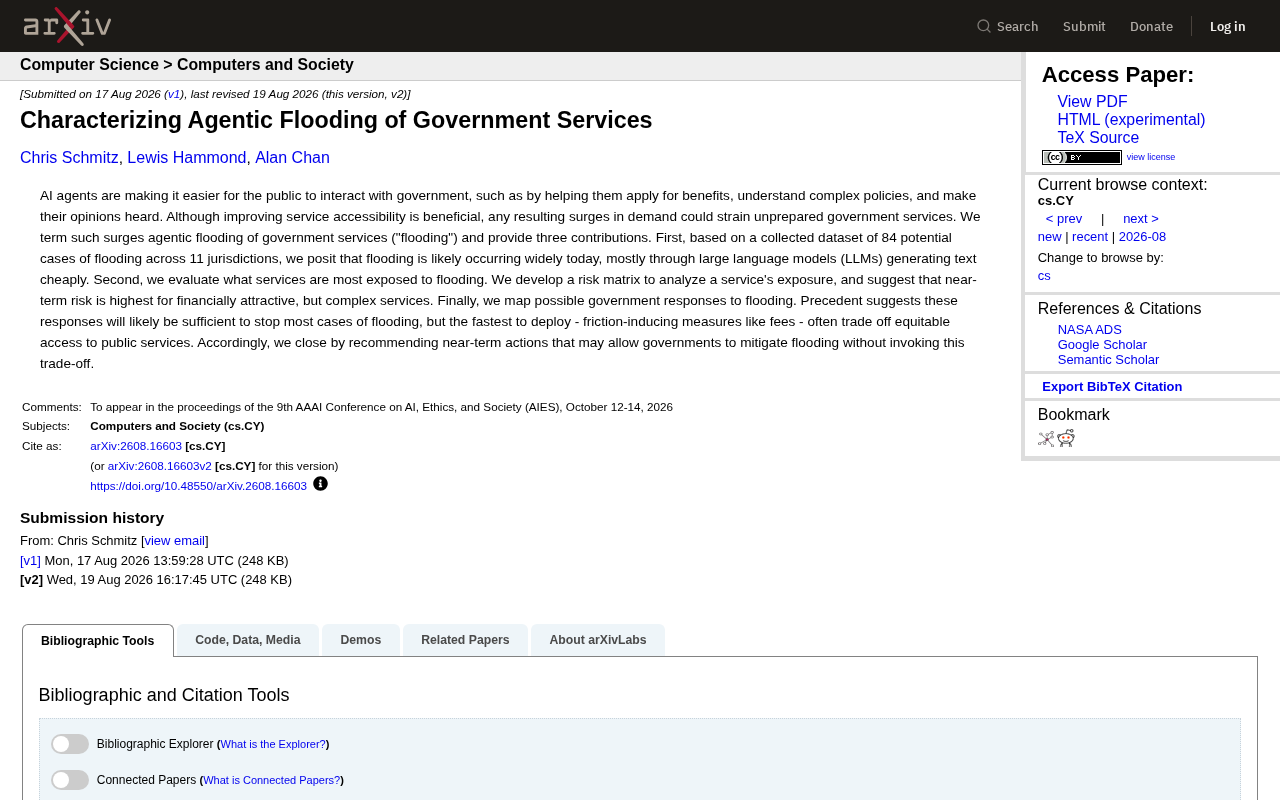
A recent study that sparked heated discussion on Hacker News, Characterizing Agentic Flooding of Government Services, cuts right to this topic. The article received 63 upvotes and 75 comments, reflecting the tech community's keen interest in this issue—it touches not just on technical problems, but on deeper contradictions involving public policy, system design, and even social equity.
What Is "Agentic Flooding"?
"Agentic flooding" refers to the phenomenon of large numbers of AI-driven automated programs accessing, querying, and even submitting government online services on behalf of users. This is fundamentally different from traditional DDoS (Distributed Denial of Service) attacks—DDoS attacks flood target servers with massive fake requests to make them unresponsive, with attackers typically using botnets to simultaneously send huge volumes of meaningless traffic. In agentic flooding, every request is "meaningful": they carry real user credentials, submit legitimate form data, and follow normal business processes—querying benefit eligibility, scheduling appointments, submitting forms, retrieving public information. This renders traditional DDoS defenses (such as traffic scrubbing, IP blacklists, and request pattern filtering) almost completely ineffective, because systems cannot distinguish between human and agent operations at the level of individual request legitimacy.
Three Core Differences from Traditional Web Traffic
First, non-linear scale growth. The number of requests a human user can initiate within a given period is limited, but an AI agent can launch hundreds of attempts in seconds. When every citizen is equipped with their own AI assistant, the concurrent pressure on government systems could be dozens of times their designed capacity.
Second, machine-like behavioral patterns. Humans hesitate when filling forms, take breaks, make mistakes and then correct them, while agent access is highly regular, dense, and continuous. This completely invalidates the load assumptions underlying government service systems—they were never designed to handle visitors that "never tire."
Third, ambiguity of intent. Is an agent that repeatedly retries legitimately helping a user conduct business, or is it performing data scraping, eligibility arbitrage, or even system probing? This indiscernibility of intent puts traditional access control strategies in a dilemma.
Why Government Digital Services Bear the Brunt
Government digital services typically possess several characteristics that make them particularly vulnerable.
First, they are mostly monopolistic—you can't "switch providers" to get a passport or claim benefits, meaning all demand converges on a single system. Second, these systems typically carry heavy technical debt and update slowly. Technical debt is a software engineering concept referring to compromises and shortcomings accumulated in system design for short-term delivery speed; these "debts" are "repaid" in the future through increased maintenance costs and rising system fragility. The technical debt problem in government IT systems is especially severe: the U.S. federal government spends over $100 billion annually on legacy system maintenance, with many critical systems still running on mainframe programs written in COBOL; the UK Government Digital Service (GDS) has disclosed that some of its benefit systems are built on 1980s-era architecture. These systems were designed to handle thousands to tens of thousands of human interactions per day, not millions of automated requests, and they lack modern cloud-native architecture capabilities such as microservices, containerization, and auto-scaling.
More critically, government services carry a public mission. They cannot simply block suspicious traffic with paid CAPTCHAs, rate limits, or bot verification the way commercial websites do—because doing so would likely harm vulnerable groups who genuinely need help, especially those who rely on AI assistants to overcome the digital divide, language barriers, or physical disabilities.
The Fairness Paradox of AI Agents
Hidden here is a profound fairness paradox.
AI agents could serve as tools for universal access: an elderly person unfamiliar with bureaucratic processes, an immigrant whose native language isn't the local one, a person with disabilities who has limited mobility—all could more equally access public services through AI assistants. From this perspective, agent access should not simply be viewed as a "threat." UN data from 2023 shows that approximately 2.7 billion people worldwide still lack internet access, and even in developed countries, elderly people, low-income groups, people with disabilities, and immigrant communities face significant barriers when using digital government services. UK government research indicates that about 22% of adults lack basic digital skills—precisely the people who most need public services. The potential of AI agents as "digital intermediaries" lies in lowering this barrier—replacing complex form-filling with natural language interaction, and replacing the need to understand bureaucratic procedures with automated processes.
On the other hand, if systems are brought down by high-frequency automated access, or forced to strengthen verification thresholds, the people ultimately harmed are precisely those who need help the most. Users or organizations with stronger technical capabilities who can deploy "smarter" agents may gain advantages in resource allocation—potentially widening rather than narrowing the digital divide. This "Matthew Effect" is particularly dangerous in public resource distribution: when limited system processing capacity is preferentially occupied by the efficient agents of tech-savvy elites, vulnerable groups are pushed into even longer waiting queues.
Viable Paths for Addressing Agentic Flooding
Facing this challenge, industry and researchers have proposed several directions, though none are fully mature yet.
Establishing Agent Identity and Authorization Mechanisms
Rather than trying to distinguish "human vs. machine," it's better to establish a trusted agent identity system. Let compliant AI assistants carry verifiable credentials declaring which user they represent and their access intent, while government systems implement differentiated rate and priority management accordingly.
This direction has technical grounding. Verifiable Credentials (VC) is an open standard developed by W3C that allows entities to prove certain attributes or authorizations in a cryptographically secure manner without exposing unnecessary personal information. In an agent identity system, this means an AI assistant can present a cryptographically signed credential to a government system proving "I am authorized by user Zhang San to query their social security information," and this credential can be verified for authenticity by third parties. The related technical ecosystem also includes Decentralized Identifiers (DID), OAuth 2.0 device authorization flows, and emerging standards like the AI Agent Protocol currently under discussion. However, the challenge with these mechanisms lies in the need for cross-institutional, cross-platform interoperability consensus, making short-term implementation quite difficult.
Providing Official API Interfaces for Agents
A more fundamental approach: since automated access is inevitable, governments should proactively provide structured, efficient API interfaces, redirecting agents from the inefficient path of "simulating humans clicking web pages" to dedicated channels. This both reduces system load and regulates data access boundaries.
This strategy is not entirely without precedent. Estonia's X-Road system is one of the world's most successful government data exchange platforms, connecting over 900 government and private sector institutions through a unified API layer, processing over 1 billion data exchanges annually. The U.S. data.gov and the UK's GOV.UK API platform also provide structured government data interfaces. However, these existing practices are primarily designed for inter-institutional data exchange, not direct access from massive numbers of individual agents. APIs designed for agents need to consider fine-grained rate limiting, intent-based access control, and auditable usage tracking, which far exceeds the architectural complexity of current open data platforms. Advancing this path requires governments to invest substantial digital modernization resources—precisely what many government agencies lack most.
Redesigning System Load Assumptions
The most pragmatic point is that public service system architectures must update their fundamental assumptions—no longer using "the natural rhythm of human users" as the baseline, but instead presetting a highly AI-mediated access environment, building elastic scaling, intelligent throttling, and priority scheduling capabilities from the ground up. This means adopting cloud-native architectures, implementing auto-scaling strategies, deploying fine-grained traffic management based on user identity rather than IP addresses, and establishing real-time anomalous behavior detection systems. Essentially, governments need to shift from "websites designed for people" thinking to "service platforms designed for hybrid access environments" thinking.
Conclusion: Digital Governance Systems Must Prepare Early
Agentic flooding is not a distant science fiction scenario—it's a reality quietly unfolding with the proliferation of ChatGPT-style assistants, browser agents (such as Anthropic's Computer Use feature and OpenAI's Operator), and automated workflows. It reminds us that AI's social impact extends far beyond obvious narratives like "replacing jobs" to include hidden impacts on existing public infrastructure.
The real challenge lies in how to build digital governance systems that can coexist with AI agents without sacrificing the universality of public services. This is both a technical problem and a policy and ethical one—and the time we have to prepare may be shorter than we imagine. How quickly governments around the world respond to this issue will determine whether future public digital services move toward more inclusive "agent-friendly" infrastructure, or fall into a vicious cycle of "blocking, confrontation, and degradation."
Related articles

AgentCore in Practice: Connecting Custom Tools and MCP Servers to Agents
DebuggerCafe tutorial shows how to connect custom tools and MCP servers to Amazon Bedrock AgentCore agents, covering tool contract design, MCP reuse, and production concerns.

816B Parameters Scores Only 39? The Real Cost-Effectiveness of the Open-Source LLM Parameter Race
Meta's 816B Muse Spark Open scores just 39 on Artificial Analysis, while 180B Qwen3.8-Flash-Next scores 40. This article analyzes 11 open-weight models' parameters vs. scores, exploring the real impact of activated parameters, quantized size, and deployment cost.

Aerial Manipulators: The Next Step for Drones from 'Seeing' to 'Changing'
Starting from a Reddit discussion, this article analyzes the technical challenges, potential applications, and deployment bottlenecks of aerial manipulators, exploring the key challenges for drones moving from environmental perception to physical manipulation.