The AI Bottleneck Isn't Intelligence — It's Context: How a Unified Semantic Layer Breaks the Deadlock

Enterprise AI fails on context, not intelligence — Databricks Genie uses an ontology layer to fix that.
The article argues that enterprise AI underperforms not due to a lack of intelligence, but because business context is scattered across isolated systems. Databricks Genie Ontology addresses this by building a unified context layer — using ontologies to formally define business entities and their relationships, while blending manually curated definitions with AI-learned user preferences. Unlike RAG, which only locates relevant text, an ontology layer encodes *how* concepts relate, enabling AI to move from passive Q&A to autonomous action. The article maintains a measured tone, noting that ontology construction is costly, metric disagreements are common, and the claims are drawn from vendor demos that have yet to be validated at scale.
The Real Weakness of AI: Missing Context
When people discuss the capabilities of large language models, the conversation tends to center on reasoning ability, parameter count, and benchmark scores. But one frequently overlooked fact is this: when AI underperforms in enterprise settings, the problem usually isn't the "intelligence" itself — it's the "context."
As one widely circulated observation from the enterprise AI space puts it: "AI doesn't have an intelligence problem. It has a context problem." This statement cuts right to the core pain point of deploying AI in real organizations. The model is smart enough — it just doesn't know your business.
The root cause is that enterprise business context is scattered across dozens of isolated systems: dashboards, documentation, support tickets, chat logs. When a business user wants a quick, trustworthy answer, the relevant information is spread across a dozen different tools. Meanwhile, data teams are buried under a constant flood of ad hoc requests, with little room to do more meaningful work.
A Unified Context Layer: Bridging the Semantic Gap
The solution centers on building a unified context layer. Its core value proposition is straightforward: give AI the ability to answer questions grounded in trusted business context, execute tasks autonomously, and ultimately give teams their time back.
The operative word here is "trusted." The biggest difference between enterprise use cases and general-purpose Q&A is that answers can't be "probably right" — they must be grounded in clearly defined business metrics, calculation logic, and relationships. If AI misinterprets what "active users" means, or pulls from the wrong data table, then a fluent-sounding answer is worse than no answer at all.
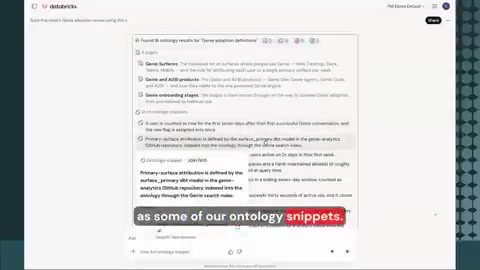
As shown in the demo screenshot, the system combines "context that we curated by hand" with information the AI has learned on its own. This human-machine collaboration ensures the accuracy of critical business definitions while still allowing the AI to reason flexibly on top of them — rather than being locked into rigid rules.
Genie Ontology: AI Powered by Ontological Structure
The specific product under discussion is Databricks' Genie Ontology. The concept of an ontology comes from knowledge engineering, referring to a structured definition of business entities, their attributes, and the relationships between them — essentially giving AI a "semantic map of the enterprise."
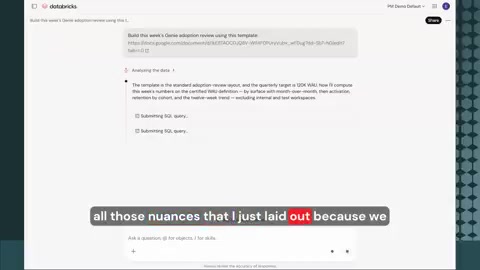
Several noteworthy workflow characteristics stand out from the product demo:
Understanding How Users Express Themselves
The system claims that "Genie already has a good sense for how I like to write these kinds of docs." This suggests the context layer isn't just storing business data definitions — it's also learning individual users' working preferences, so that outputs more closely match what people actually need.
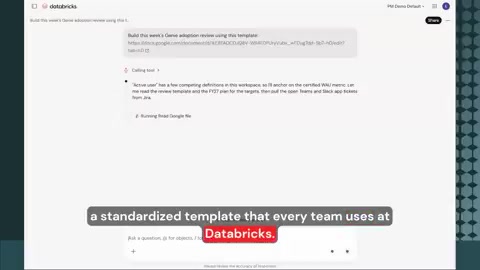
Ontology-Driven Data Asset Discovery
When executing a task, the AI first "started with some potentially relevant data assets" before drilling deeper. This ontology-backed retrieval path is far more principled than blind vector similarity matching, and it makes results easier to explain and trace.
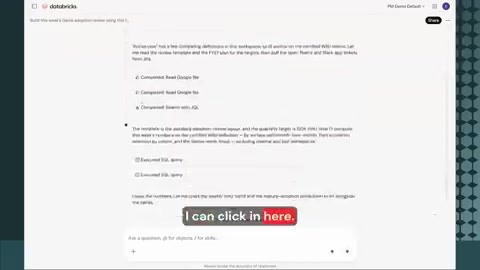
The term ontology has its roots in philosophy, where it refers to "the systematic study of the nature of existence." Knowledge engineering borrowed the term to describe the formal representation of concepts, attributes, and relationships within a given domain. In an enterprise data context, ontologies typically express knowledge as triples — for example, "Customer — belongs to — Region" or "Order — contains — Product" — and can include attribute constraints and business rules. The Knowledge Graph is the canonical industrial implementation of ontological thinking; companies like Google and LinkedIn built their enterprise semantic layers around this concept in their early years. The key advantage of introducing ontologies into AI-powered Q&A is explainability: the system can reason step by step along semantic relationship chains, with each inference traceable and auditable. This stands in sharp contrast to the "black-box similarity" of pure vector retrieval, and far better satisfies enterprise requirements for answers that are auditable and traceable for compliance purposes.
Why the Ontology Layer Is Critical Enterprise AI Infrastructure
Elevating the context layer to an ontological level has a clear underlying logic. Relying purely on RAG (Retrieval-Augmented Generation) to feed documents into a model only solves the problem of "where is the information" — it doesn't address "what are the relationships between pieces of information." An ontology is precisely what defines those connections between entities.
When AI can understand a semantic network — that an "Order" is linked to a "Customer," that a "Customer" belongs to a "Region," and that a "Region" maps to a "Sales Owner" — only then can it truly act autonomously, rather than simply responding to passive queries. This is the dividing line between an "AI chat assistant" and a genuine "AI agent."
For data teams, the practical implications are equally direct: once business definitions are codified in the ontology layer and reused by AI, repetitive ad hoc data requests drop sharply, freeing teams to return to more creative and impactful work.
RAG (Retrieval-Augmented Generation) is currently the most mainstream approach to supplementing context in enterprise AI deployments. When a user asks a question, the system first retrieves relevant passages from a document library, then feeds them alongside the question to a large model to generate a response. This approach effectively compensates for the model's training data cutoff and allows it to draw on private knowledge. But RAG's fundamental mechanism is "similarity matching" — it excels at finding text that is semantically close to the query, yet is largely powerless when it comes to structured business logic. For example, RAG can retrieve a document that mentions "active users," but it cannot automatically understand how that metric is calculated, which data table it maps to, or why its definition differs from "paying users." This is precisely where an ontology layer adds value: rather than storing text, it explicitly encodes a graph of relationships between entities, giving AI a traversable semantic structure of the business — rather than having it guess at context based purely on vector distance.
A Sober Assessment: The Reality Beyond the Demo
It's worth noting that the information above comes primarily from the vendor's official marketing materials and an on-demand demo — a single-source, vendor perspective. The conceptual direction of an ontology layer is sound, but real-world enterprise deployment still faces significant challenges: building and maintaining a business ontology is expensive; organizations frequently disagree on how metrics should be defined; and keeping manually curated context continuously up to date is a long-term operational challenge.
The "context problem" is genuinely one of the central issues in enterprise AI today, and a unified context layer / ontology layer does represent a technically promising path forward. But how much of teams' time it can actually reclaim in practice remains to be tested across real-world deployments.
Note: This article is based on publicly available vendor demo materials. All capability descriptions should be verified against official sources.
Related articles

Why Does the Tesla Roadster Need to Fly? A Deep Dive into Musk's Wild Demo
Tesla's Roadster launch showed wall-climbing, upside-down driving, and flying stunts—but The Vergecast notes the demo car may lack a battery, the Rocket version is invite-only and not street-legal, and the website terms don't guarantee delivery. After nine years of delays, why does this car still need to exist?

AI Is Not a Replacement: Human-AI Collaboration Through the Lens of Factory Root Cause Analysis
Starting from factory root cause analysis, this article explains how AI accelerates evidence chain construction rather than replacing human experts, exploring the pragmatic implementation logic and business value of 'AI supporting people rather than replacing them.'

AI Agent Decision Auditing: Building an Evidence Chain in Regulated Workflows
Starting from a Reddit discussion, this article analyzes three core issues in AI agent decision auditing within regulated workflows: what fields audit records should contain, how to handle feedback latency for erroneous decisions, and how to continuously calibrate LLM judge consistency with human judgment.