The AI Coding Era: Engineering Taste Matters More Than Code Velocity
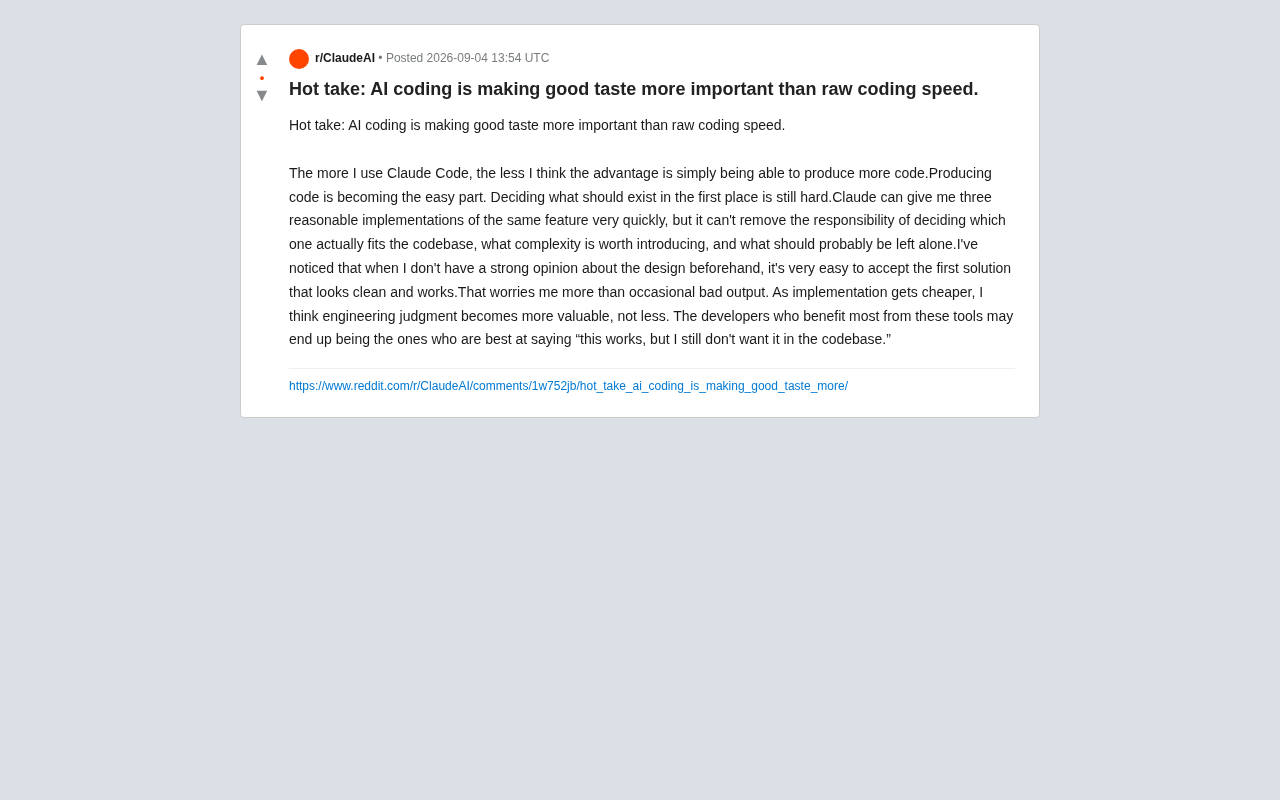
In the AI coding era, engineering taste and judgment matter more than implementation speed.
As AI coding tools make code generation nearly effortless, the real challenge shifts from implementation to judgment. This article explores how developers can cultivate engineering taste across three dimensions—architectural consistency, complexity sensitivity, and strategic deletion—to navigate the AI era where the most valuable skill is knowing what code should never be written.
AI Makes Coding Easier, But Decisions Harder
As AI coding tools like Claude Code become widespread, an interesting phenomenon is emerging: generating code is getting easier and easier, but deciding "what code should be written" is actually getting harder. This isn't a step backward—it's a fundamental shift in where the center of gravity lies in engineering practice.
AI can produce three reasonable implementations of the same feature in seconds, but it can't make the critical judgment calls for developers: Which approach truly fits the existing codebase? Which added complexity is worth it? Which features shouldn't exist at all? The answers to these questions still require human engineering judgment.
"It Works" Doesn't Mean "It Should Ship"
A senior developer shared an observation on Reddit: When you don't have a strong preconception about the design, it's all too easy to accept the first solution AI gives you that looks clean and runs correctly. This kind of "path dependence" is more concerning than the occasional incorrect output.
The concept of "path dependence" originates from economics and technological evolution theory, proposed by economists Brian Arthur and Paul David in the 1980s. It was initially used to explain why the QWERTY keyboard layout dominated the market long-term despite the existence of superior alternatives. In a software engineering context, path dependence means that early technical choices constrain the decision space for everything that follows—once you accept AI's initial architectural proposal, all subsequent code builds around that choice, and the cost of correction grows exponentially over time. This is closely related to the "anchoring effect" in behavioral economics: AI's first output naturally becomes the developer's cognitive anchor, and even when better solutions exist, people tend to make minor adjustments around the anchor rather than starting over.
In the traditional coding era, the cost of writing code (time, effort) itself served as a filtering mechanism. Developers would carefully weigh whether a feature was worth implementing. But when AI reduces the implementation cost to near zero, that natural barrier disappears. The result can be a codebase filled with code that is "technically fine but shouldn't exist from a design standpoint." This phenomenon is directly related to the concept of "software entropy" in software engineering—borrowing from the second law of thermodynamics, software systems inevitably trend toward disorder and increasing complexity through continuous modification. Lehman's Laws of Software Evolution (proposed in 1974) state that software systems in continuous use must constantly adapt to change, but each adaptive modification increases system complexity. When AI eliminates implementation cost as a natural source of friction, software entropy may accumulate far faster than in the era of manual human coding, making code review and architectural gatekeeping more valuable than ever.
The deeper risk lies in the accelerated accumulation of "technical debt." Technical debt was first coined by Ward Cunningham in 1992, drawing an analogy to financial debt—suboptimal technical decisions made for short-term delivery speed that require paying "interest" (maintenance costs, refactoring costs) in the future. In the traditional model, the rate of technical debt accumulation was limited by human coding speed; in AI-assisted development, teams may accumulate massive technical debt in very short periods without even realizing it, because every piece of code looks "clean and functional." Martin Fowler categorized technical debt into four quadrants—reckless/prudent × deliberate/inadvertent—and the type AI most readily creates is precisely the most dangerous: "inadvertent and reckless." Developers don't even know they're taking on debt.
This reveals a paradox: the more powerful the tool, the more important human judgment becomes. It's like when photography went digital—pressing the shutter became zero-cost, but the core competency of a great photographer shifted from "making every frame of film count" to "knowing which moments are worth capturing."
Three Core Dimensions of Engineering Taste
In the AI coding era, what does "good taste" actually mean? It can be understood across three dimensions:
Architectural Consistency
AI-generated code may be locally flawless in logic but completely at odds with the overall style of the codebase. Great developers can spot this inconsistency and choose the solution that "AI ranked third, but best fits the project's DNA." Maintaining codebase consistency matters far more than locally optimizing any single feature.
The importance of architectural consistency traces back to the "conceptual integrity" principle proposed by Fred Brooks in The Mythical Man-Month—a well-designed system should look as if it came from a single mind, even when built by a large team. This consistency manifests across multiple dimensions: naming conventions, error-handling strategies, data flow patterns, and levels of abstraction. When generating code, AI models typically choose the most "generic" implementation based on statistical patterns in training data, rather than optimizing for a specific project's style preferences. Even with project context provided, AI struggles to fully grasp the design philosophy behind a codebase—such as why a team chose a functional style over object-oriented, or why certain seemingly redundant abstraction layers were intentionally introduced. Conway's Law also reminds us that software architecture tends to mirror an organization's communication structure—a dimension of organizational knowledge that AI has even less access to.
Complexity Sensitivity
Every new feature introduces complexity—new dependencies, new abstraction layers, new maintenance costs. AI won't proactively evaluate whether "this convenience is worth the additional 10% complexity." That requires humans to make trade-offs based on long-term maintenance experience. Experienced developers know how to find the balance between functionality and maintainability.
Complexity management has deep theoretical roots. Rich Hickey (creator of Clojure) explicitly distinguished between "Simple" and "Easy" in his famous talk Simple Made Easy: simple is objective, meaning components are not intertwined; easy is subjective, meaning something is close to your current capabilities. AI makes code easier to write, but that doesn't necessarily make systems simpler. John Ousterhout, in A Philosophy of Software Design, further decomposed complexity into three symptoms: change amplification (one change requires modifications in many places), cognitive load (the amount of knowledge needed to understand the code), and unknown unknowns (not knowing what will be affected). Every new AI-generated module potentially increases hidden complexity across all three dimensions—and this increase often only becomes apparent months later during maintenance.
Strategic Deletion
The best code is often code that's never written. When AI enthusiastically offers five implementation approaches, a top developer might say: "Wait—do we actually need this feature?" This "courage of restraint" is something AI cannot simulate. Removing unnecessary features requires more wisdom than implementing every possible one.
"The best code is no code at all" is an idea with deep roots in software engineering history. Antoine de Saint-Exupéry's famous quote—"Perfection is achieved, not when there is nothing more to add, but when there is nothing left to take away"—is widely cited in software design. In practice, this aligns with the YAGNI principle (You Aren't Gonna Need It), proposed by Kent Beck, the founder of Extreme Programming (XP), which advocates against writing code for hypothetical future needs. Jason Fried, co-founder of 37signals, elevated this into a product philosophy, arguing that true innovation lies in the courage to say no to feature requests. In the AI era, this restraint becomes especially difficult, because the "let's just try it—it costs almost nothing" mindset dramatically lowers the psychological threshold for adding features—and every seemingly harmless small feature can become the seed of future architectural decay.
Redefining the Core Value of Developers
This trend has profound implications for developer careers. Those who benefit most from AI tools may not be the fastest typists, but rather those who know how to say, "This code runs, but I don't want it in the codebase."
Specifically, the following capabilities are becoming more valuable:
- Systems Thinking: Understanding how local changes affect the overall architecture. Systems thinking originates from Peter Senge's theoretical framework in The Fifth Discipline, emphasizing seeing the interconnections between things rather than isolated chains of events. In software systems, this means understanding how an API change propagates along the call chain, or how a data model adjustment impacts a dozen upstream and downstream services.
- Historical Perspective: Knowing how similar problems have evolved in the past. Developers who have lived through the technology cycle from monolithic architecture to microservices to "moderate distribution" can more keenly identify the familiar patterns of over-engineering in AI-generated solutions.
- User Empathy: Judging the genuine necessity of a feature. This aligns with the emphasis on "empathizing with users" in Design Thinking, requiring developers to step outside the technical perspective and evaluate feature value from the user's actual usage scenarios.
- Refactoring Instinct: Recognizing when to optimize rather than pile on new features. The 22 code smells defined by Martin Fowler in Refactoring now need to be extended to "code smells specific to AI-generated code"—such as over-abstraction, unnecessary application of design patterns, and styles that diverge from project conventions.
What these capabilities share in common is that they all require long-term experience accumulation and deep thinking, not mere technical execution. AI can help you write code, but it cannot replace your engineering judgment.
Final Thoughts
AI coding tools aren't making engineering simpler—they're making it different. The barrier to implementation has dropped, but the bar for design judgment has actually risen. Just as the Industrial Revolution decreased the value of physical labor while increasing the value of intellectual labor, the AI revolution is decreasing the value of "execution ability" while increasing the value of "judgment ability."
For developers, this means shifting from "How fast can I implement this feature?" to "How accurately can I judge whether this feature should be implemented at all?" The former is a skill; the latter is wisdom. And wisdom is precisely the thing AI finds hardest to learn.
In the AI coding era, cultivating engineering taste isn't optional—it's essential. Those developers who can make wise choices amid the infinite possibilities AI provides will become the truly irreplaceable talent.
Related articles

The White House Arcade Game Controversy: A Full Analysis of Racism Allegations and Copyright Disputes
The White House's policy-themed arcade games sparked dual controversies: the Build the Wall game drew racism accusations, and Tetris's copyright holder pushed back. A deep dive into ethics and law.

MiniMax H3 in Practice: Building a Combined REF2VA and FL2VA Workflow
Compare MiniMax H3's REF2VA and FL2VA modes across visual quality, motion, and audio, plus a ComfyUI fusion workflow combining both for optimal results.

Running a 90M-Parameter LLM on a Sony PSP: Where Are the Limits of Edge Inference?
A developer ran a 90M-parameter LLM on a 2004 Sony PSP at ~0.5 tok/s. This article analyzes the LLMPSP project's technical approach, quantization strategy, and what it reveals about the limits of edge AI inference.