The AI Compute Hunger Behind the RTX 5090 Price Surge

AI compute demand overflow is driving up RTX 5090 prices as consumer GPUs are conscripted into server farms.
Starting from a Reddit post about the RTX 5090's price in Germany rising from about 3,000 to 9,000 euros, the article notes the key revelation isn't the increase but that these GPUs are being converted to blower cooling and sent into server farms. The root cause is booming AI training and inference demand amid limited, expensive professional accelerators like the H100 and B200, pushing buyers toward consumer flagship cards and driving retail prices up. The article offers three suggestions: wait or choose last-gen products, watch secondhand and enterprise decommissioned equipment, and consider cloud compute rental.
From Gaming Card to Server Hardware: A Role Reversal
A recent Reddit discussion has drawn widespread attention: the price of the RTX 5090 in Germany has soared from roughly 3,000 euros at the start of the year to 9,000 euros—a staggering increase. The original poster initially calculated this as a 300% increase, later corrected by commenters to about 200% (i.e., the price tripled), but regardless of the exact figure, this price trajectory far exceeds the normal fluctuations of consumer-grade graphics cards.

The most valuable information in this post isn't the price itself, but the truth revealed in the comments: these graphics cards aren't being bought by gamers—they're being reconfigured and sent into server farms. One user explicitly pointed out that consumer-grade GPUs are being "rewired" for servers, or more precisely, fitted into blower configs to adapt to rack environments.
The Underlying Logic of the Price Surge: AI Compute Demand Overflow
The original poster offered a key insight: "People realize what AI can do and what it can sustain." This gets to the core of the issue—as demand for large model training and inference continues to expand, while professional-grade accelerator cards (such as the H100 and B200 series) have limited production capacity and high prices, buyers naturally turn their attention to consumer-grade flagship cards.
The RTX 5090 has memory capacity and compute power far beyond ordinary gaming needs. For small-to-medium-scale AI inference tasks or specific training scenarios, it's a more cost-effective alternative. When a large volume of such demand floods the market, supply and demand quickly become imbalanced, and retail prices are pushed to absurd levels. The jump from 3,000 to 9,000 euros in the German market is a direct manifestation of this imbalance.
H100 and B200 are NVIDIA's two generations of flagship data center accelerator cards: the H100 is based on the Hopper architecture, equipped with 80GB of HBM3 memory, and was the workhorse for large model training in 2023–2024; the B200 belongs to the Blackwell architecture, uses a dual-die package, and further improves memory and compute. These products typically cost tens of thousands of dollars per unit, and due to production constraints and export controls, lead times are long and channel markups are severe. This is precisely why buyers turn to consumer-grade flagship cards with larger memory and relatively lower per-card prices for inference or small-scale fine-tuning—this is the practical meaning of the word "overflow" in this article.
Blower config refers to a cooling structure where a turbo fan draws air in from one end of the card and blows it out axially along the card body, different from the common three-fan open-air cooling. Its advantage is that it can exhaust hot air directly out of the chassis, making it suitable for densely stacked multi-GPU rack servers; open-air cooling in dense deployments causes hot air to circulate inside the chassis, leading to system overheating. Therefore, converting consumer-grade GPUs to turbo cooling form is a common practice for cramming them into server farms, at the cost of higher noise and lower per-card cooling efficiency than open-air solutions.
Compute gap and inference demand: The lifecycle of large models is divided into two stages: training and inference. Training requires massive memory and inter-GPU interconnect bandwidth, almost necessitating professional accelerator cards; inference has lower interconnect requirements and places more emphasis on per-card memory capacity and unit cost. As inference request volumes skyrocket with the proliferation of applications, small-to-medium-scale deployers naturally choose consumer-grade flagship cards to fill the gap—this is the direct driver behind consumer-grade GPUs being "conscripted."
Chain Reactions in the Consumer Market
The impact of this price transmission on ordinary users is direct. Products originally positioned as high-end gaming hardware are now being pushed by enterprise procurement to price points most gamers cannot afford. More subtly, this demand is persistent—as long as the AI compute gap exists, consumer-grade GPUs will struggle to return to normal pricing.
One self-deprecating comment in the thread is quite telling: "I've even started using AI to help me think about everyday chores." This reflects the extent to which AI tools have permeated daily life, and also explains why underlying compute demand is so vigorous.
How Ordinary Users Should Respond
Faced with this situation, several points are worth considering. First, if it's not an urgent need, it's entirely reasonable to wait and see or choose previous-generation products—price bubbles will eventually deflate. Second, pay attention to the secondhand market and enterprise decommissioned equipment; sometimes you can find good value. Third, for developers who genuinely need compute power, cloud compute rental may be more cost-effective than buying hardware—after all, the price of a single graphics card is enough to rent cloud resources for quite a long time.
The phenomenon of consumer-grade GPUs being "conscripted" by AI demand is unlikely to ease in the short term. This is both a byproduct of the AI industry's booming development and a real reality facing the hardware supply chain.
Cloud compute rental refers to renting GPU instances provided by cloud service providers on an hourly or per-task basis, where users don't bear the costs of hardware procurement, depreciation, and operations. Its economics come from time utilization: if a self-purchased graphics card only runs a few hours a day, the idle cost is amortized onto effective compute; whereas cloud instances are scheduled by the provider across multiple users, achieving higher utilization. For developers with fluctuating demand or in the validation phase, rental is usually more cost-effective than buying, but for long-term full-load operation, self-built hardware may overtake on total cost of ownership—it needs to be estimated based on actual usage hours.
One-line Summary
AI compute demand overflow is driving up RTX 5090 prices, as consumer-grade GPUs are being conscripted into server farms.
Paragraph Summary
The article starts from a Reddit discussion about the RTX 5090's price in Germany rising from about 3,000 euros to 9,000 euros, pointing out that the most valuable information in the post isn't the increase itself, but the truth revealed in the comments: these graphics cards aren't being bought by gamers but are being converted to blower cooling form and sent into server farms. The author argues the root cause is that AI training and inference demand continues to expand, while professional accelerator cards like the H100 and B200 have limited production and high prices, so buyers turn to consumer-grade flagship cards with substantial memory and compute, causing supply-demand imbalance and pushing retail prices up. This demand is persistent, making it unaffordable for ordinary gamers. The article concludes with three suggestions: wait and see or choose previous-generation products, watch the secondhand and enterprise decommissioned equipment markets, and switch to cloud compute rental.
Related articles

Ollama+RAG Local Knowledge Base Setup: A Step-by-Step AnythingLLM Tutorial
Based on a Bilibili tutorial, this guide details building a local RAG knowledge base with Ollama + AnythingLLM: from general LLM knowledge limits and RAG principles to document upload, vector storage, and verification.

The Ultimate Ollama Tutorial: A Beginner's Guide to Running Large Models Locally for Free
Ollama is an open-source local large model management tool supporting free download and deployment of models like DeepSeek, with command-line and Web UI, cross-platform, automatic GPU/CPU scheduling — ideal for AI beginners and private deployment.
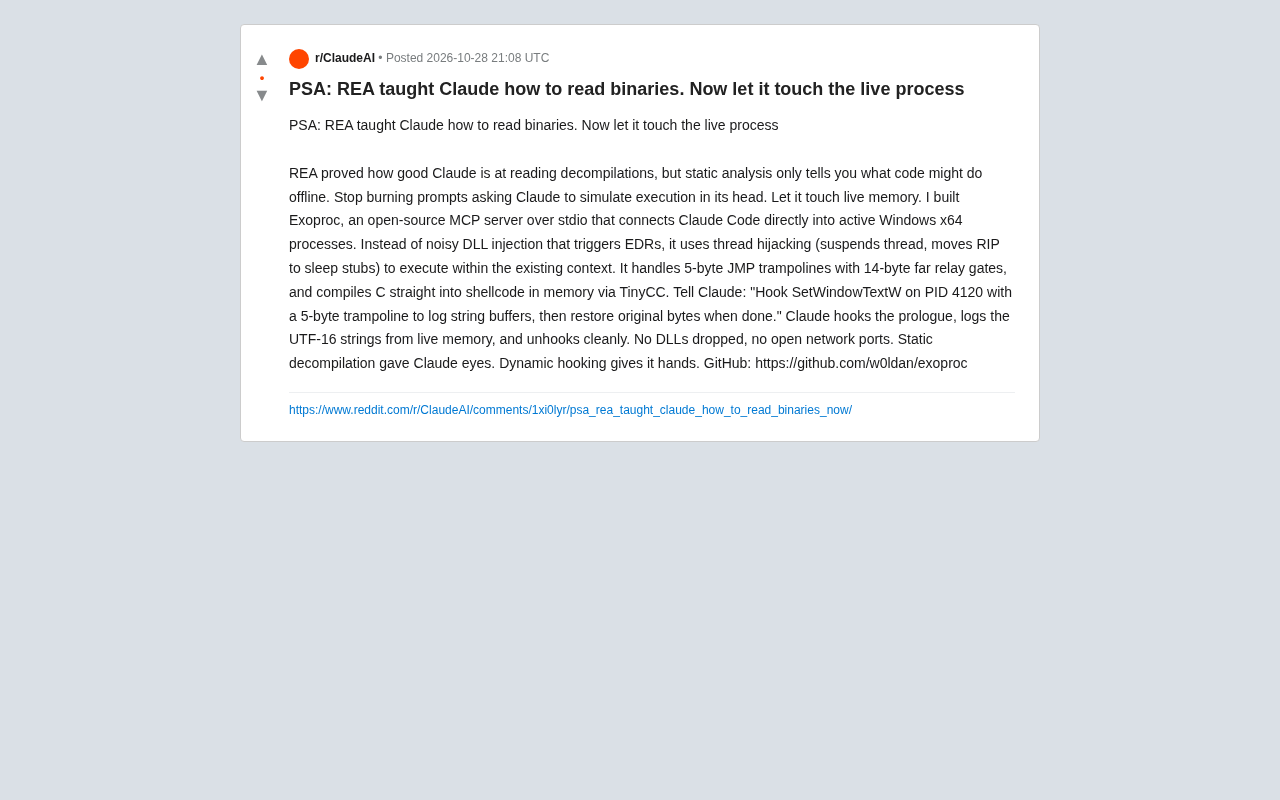
Giving Claude "Hands": Exoproc Open-Source MCP Server Enables Live Process Hooking
Exoproc is an open-source MCP server enabling Claude Code to hook live Windows x64 processes via thread hijacking, bypassing EDR for dynamic analysis. Static decompilation gave Claude eyes; dynamic hooking gives it hands.