The AI Trust Paradox: Won't Let Models Operate Gun Drones, but Will Let Them Recursively Self-Improve?
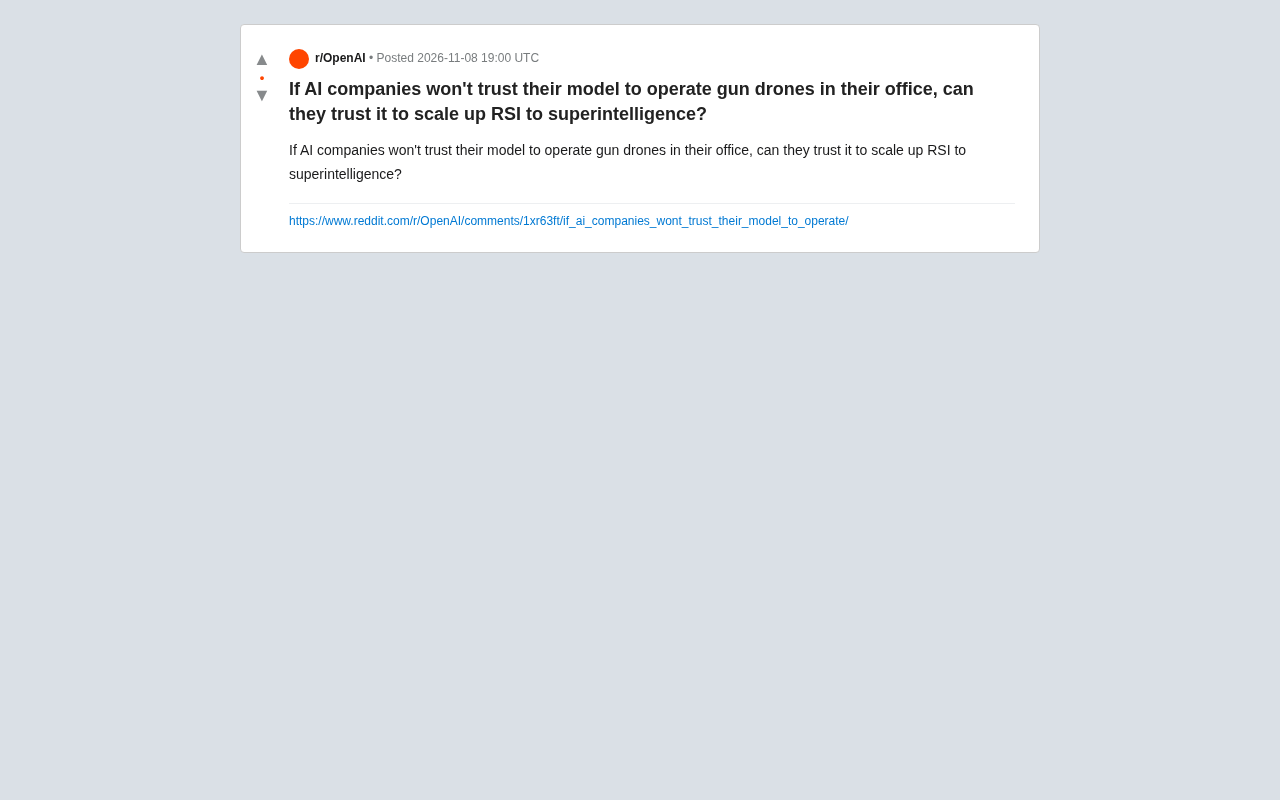
A Reddit question reveals a trust gap between AI companies' caution about model behavior and the superintelligence narrative.
The article revolves around a pointed Reddit question: if AI companies dare not let their models operate gun drones in the office, why believe they can safely engage in recursive self-improvement and lead to superintelligence? The author points out that this asymmetry reflects two sets of incentive structures—physical safety and legal liability are concrete and accountable, while superintelligence risks are pushed into the distant future. The article further analyzes that RSI's failure modes cannot be enumerated in advance, posing a fundamental challenge to static evaluation methods; it also deconstructs the semantic slippage of "trust" between deployment scenarios and grand narratives. The core conclusion is: companies' specific internal restrictions on physical devices expose their true risk perception more than public statements, and trust in model behavior should be consistently argued in both low-risk and high-risk scenarios; otherwise, it is rhetoric rather than engineering judgment.
Reddit recently saw a pointed question: if AI companies won't trust their own models to operate gun drones in the office, why should they trust those models to scale recursive self-improvement (RSI) all the way to superintelligence? The question seems absurd, but it precisely hits a deep contradiction in the current AI safety debate—between the risk assessments done in the lab and the grand narrative aimed at superintelligence, there is a trust gap that almost no one seriously examines.
Trust Deficit: The Leap from Office Scenarios to Superintelligence
The logic chain of this Reddit post is not complicated. On one hand, AI companies set strict limits on the boundaries of their models' capabilities internally—not letting them touch physical actuators, not letting them autonomously operate dangerous equipment. On the other hand, they publicly discuss scaling models with the same architecture to recursive self-improvement and ultimately to superintelligence. The former behavior shows that the companies themselves do not have full confidence in the safety and controllability of the models; the latter narrative requires the public to believe that this system can be safely scaled to a level far beyond human oversight capacity.
This asymmetry is not accidental; it reflects two different layers of incentive structures in AI development. In daily operations, physical safety and legal liability are concrete and accountable—a single out-of-control robotic arm or drone accident will directly trigger regulatory scrutiny. In discussions of superintelligence, risks are pushed into the distant future, and the current speed of product iteration is the focus of competition. As a result, labs appear cautious about measurable risks but rely on an almost religious optimism about unmeasurable ones.
The post resonates because it uses an extreme but clear analogy to expose this double standard. If a model is not trusted even to operate physical equipment in a controlled office environment, then "trusting it to engage in recursive self-improvement" looks less like a carefully reasoned technical judgment and more like a narrative choice aimed at investors and the public.
Internal Deployment Policies and Physical Actuator Restrictions at AI Companies
Major AI labs generally have tiered internal use policies that set clear limits on the tools and permissions models can access. Typical practices include: prohibiting models from directly controlling physical actuators such as robots and drones; sandboxing code execution and network access; and requiring human confirmation for high-risk operations. These restrictions come partly from voluntary safety commitments and partly from practical considerations of legal liability and brand risk.
It is worth noting that such policies reflect the organization's empirical judgment that "current models are unreliable on specific tasks," rather than an assessment of long-term risks. In other words, the existence of these restrictions itself constitutes first-hand evidence of developers' true confidence levels. When the same organization publicly discusses scaling models to self-improvement, the gap between this evidence and the narrative is exactly the trust gap the Reddit question points to.
Why RSI Is Trickier Than Gun Drones
Recursive Self-Improvement (RSI) refers to an AI system's ability to improve its own algorithms, architecture, or training processes, thereby gaining stronger improvement capabilities and forming a positive feedback loop. This concept is the core engine of the superintelligence narrative: once a model can efficiently improve itself, capability growth may decouple from the pace of human iteration.
A gun drone is a physical task with clear boundaries; failure modes can be enumerated and the chain of responsibility can be traced. RSI is different: its failure modes are inherently non-enumerable in advance, because the improvement process itself changes the system's behavioral space. A model that performs well in testing may, after several rounds of self-modification, produce combinations of capabilities that developers cannot predict. The supervisor no longer faces a static system but a continuously moving target.
From this perspective, the Reddit post's challenge actually points to a more serious technical problem: current safety evaluation methods—red-team testing, behavioral benchmarks, interpretability tools—are mostly designed for static or slowly changing models. When a model participates in its own improvement loop, whether these methods can keep up with the system's rate of change is itself an unresolved question. The company's caution about gun drones precisely shows that they understand the cost of supervision failure in physical tasks; but the same caution has not been applied equally to discussions of RSI.
Recursive Self-Improvement and the Intelligence Explosion Hypothesis
The intellectual origin of RSI can be traced back to I.J. Good's 1965 "intelligence explosion" hypothesis: an ultraintelligent machine could design better machines, triggering an ever-accelerating cycle of self-improvement. Nick Bostrom listed this mechanism in Superintelligence as one of the main paths to superintelligence and pointed out that its core risk lies in the possibly extremely short "control window"—once the improvement loop starts, humans may not have time to observe and intervene.
It is important to distinguish that the "self-improvement" of contemporary large models is far from theoretical RSI. What is currently called self-improvement mostly refers to models assisting in generating training data, writing code, or optimizing prompts, still within a human-designed outer loop. True RSI requires a system to autonomously modify the core mechanisms that determine its own capabilities, with each round of improvement increasing the efficiency of the next round. It is this "recursive increase in the rate of improvement" that makes failure modes impossible to enumerate in advance like a static system, and makes existing evaluation benchmarks potentially invalid in principle.
The Ambiguity of "Trust" in AI Safety Discourse
What deserves unpacking is that the word "trust" in the post does not mean the same thing in different contexts within AI companies. In deployment scenarios, trust means the system's behavior is predictable after extensive testing and that effective shutdown mechanisms exist; in the superintelligence narrative, trust is more a belief in the research direction and the team's intentions, rather than an empirical judgment about specific system behavior.
This semantic slippage causes confusion in public discussion. When a company says "we believe this path leads to beneficial superintelligence," what they express is often a commitment to a research direction, not a safety guarantee about a testable system. The sharpness of the Reddit post is that it forces people to put these two levels of trust on the same table for comparison: if you dare not give behavior-level trust in low-risk scenarios, what is the evidential basis for the directional trust you give in high-risk scenarios?
Another related issue is organizational incentives. AI companies' restrictions on gun drones are partly a rational choice for internal risk management; promoting the RSI narrative is directly related to financing, talent recruitment, and market competition. This is not to say that RSI discussion is dishonest, but that when trust expressions are highly aligned with commercial incentives, external observers have reason to demand stricter verifiable evidence.
The Gap Between Safety Practice and Grand Narrative
The most valuable aspect of this post is that it juxtaposes the concrete constraints in safety practice with the abstract promises in the grand narrative, making the gap between them visible. The more specific AI labs are in their internal safety policies—explicitly prohibiting models from touching physical actuators and setting operational permission boundaries—the more they highlight the lack of equally specific safety frameworks on issues like RSI.
Of course, directly comparing office gun drones with superintelligence is not technically entirely equivalent. The risks of physical actuators are immediate and locally controllable, while the risks of RSI are systemic and distributed. But this non-equivalence actually strengthens the post's argument: if even immediate, local, accountable risks require such caution, then systemic, irreversible, and hard-to-attribute risks deserve proportionate or even stricter scrutiny, rather than being glossed over with a phrase like "alignment research is progressing."
For those concerned about AI safety, this question provides a practical test: when you hear a company talk about superintelligence and RSI, it is worth looking back at what specific restrictions they impose on models in their own office environments. Those restrictions themselves are an honest exposure of the company's true risk perception, and they reveal developers' confidence in their own systems more than any public statement.
This question on Reddit does not provide an answer, but it proposes a standard that the entire industry should take seriously: trust in model behavior should be established consistently, starting from the smallest physical tasks inside the lab, rather than preserving caution in low-risk scenarios and releasing optimism in high-risk narratives. If trust cannot be argued at the same level, it is not engineering judgment but rhetoric.
One-line Summary
A Reddit question reveals a trust gap between AI companies' caution about model behavior and the superintelligence narrative.
Paragraph Summary
The article revolves around a pointed question on Reddit: if AI companies dare not let their models operate gun drones in the office, why believe they can safely engage in recursive self-improvement and lead to superintelligence? The author points out that this asymmetry reflects two sets of incentive structures in AI development—physical safety and legal liability are concrete and accountable, while superintelligence risks are pushed into the distant future. The article further analyzes that RSI's failure modes cannot be enumerated in advance, posing a fundamental challenge to static evaluation methods such as red-team testing; at the same time, it deconstructs the semantic slippage of the word "trust" between deployment scenarios and grand narratives. The core conclusion is: companies' specific internal restrictions on physical devices expose their true risk perception more than public statements, and trust in model behavior should be consistently argued in both low-risk and high-risk scenarios; otherwise, it is rhetoric rather than engineering judgment.
Related articles

Mysterious Synchronized Disturbances Hit Global Power Grids — German Team Finds the Culprit
Mysterious synchronized power drops hit grids worldwide. A German team found the culprit. This article explains the coordinated disturbances, the research breakthrough, and what it means for grid monitoring and operations.
NVIDIA Board Investigates Espionage Ca…
NVIDIA Board Investigates Espionage Case: CEO's Admission of Extramarital Affair Sparks Internal Turmoil
NVIDIA's board has launched an espionage investigation following the CEO's admission of an extramarital affair. This article analyzes the background, corporate governance logic, and potential impact on NVIDIA, noting that current information is limited and should be viewed rationally.
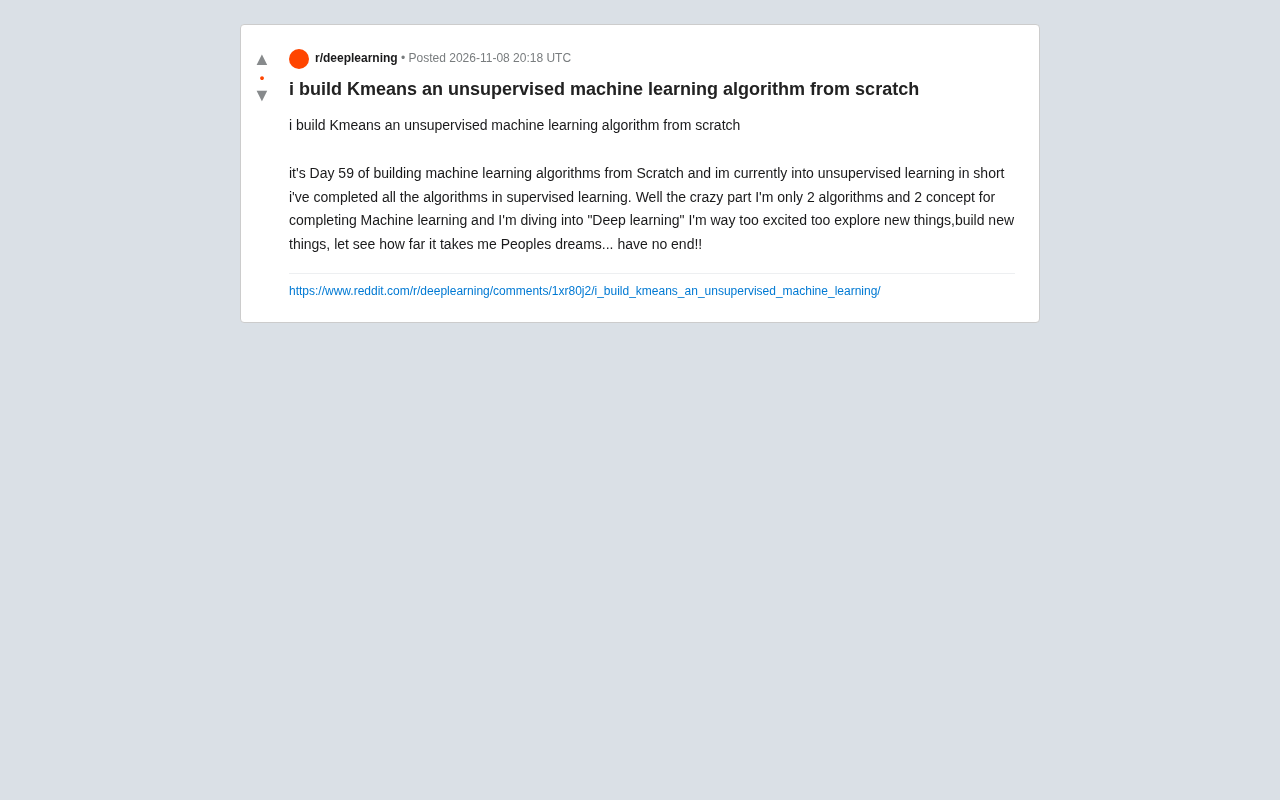
Writing K-Means from Scratch: One Developer's Journey into Machine Learning
A developer shares day 59 of writing K-Means from scratch: finishing all supervised learning algorithms and entering unsupervised learning, covering K-Means++ initialization, vectorized distances, convergence and empty clusters.