The Bend 2 Controversy: The Pitfalls and Hidden Costs of AI "Vibe Coding"

Vibe Coding lets AI write your code, but skipping real understanding can make you pay dearly later.
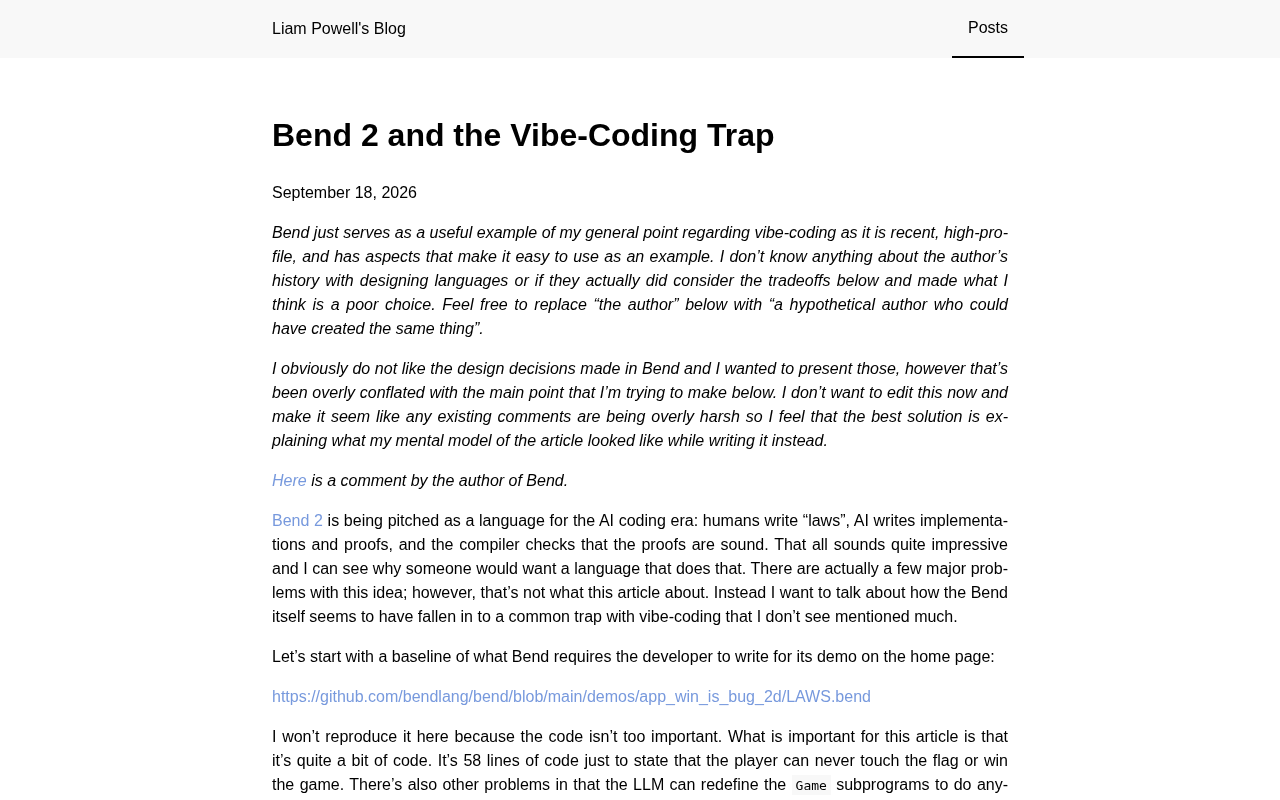
Developer Liam Powell's post "Bend 2 and the Vibe-Coding Trap" ignited a fierce Hacker News debate with over 150 comments. Using the high-performance parallel language Bend 2 as a case study, it argues that Vibe Coding — relying heavily on AI-generated code without deeply understanding the logic — is a breeding ground for technical debt. The community split into two camps: supporters compare AI to past abstraction leaps in programming history; skeptics counter that LLM output is probabilistic and unverifiable, and code nobody truly understands becomes a team-wide liability at scale. The post's practical advice: use AI as an accelerator, not a replacement, and always personally review critical logic around concurrency, security, and core business rules.
A Blog Post That Set Hacker News on Fire
Recently, a blog post by developer Liam Powell titled Bend 2 and the Vibe-Coding Trap sparked intense discussion on Hacker News, quickly accumulating 241 upvotes and 157 comments. The post struck a nerve in the tech community because it directly addresses a trend in software development that is becoming both increasingly popular and increasingly controversial — "Vibe Coding."
Vibe Coding refers to a style of development where developers rely heavily on large language models to generate code, pushing projects forward through intuition and feel rather than through a deep understanding of the underlying logic. Using the second version of the Bend programming language (Bend 2) as a jumping-off point, the article explores the deeper problems that can emerge when AI-assisted programming is taken to its extreme.
Note: Since the primary source material consists mainly of an article link and community discussion metadata, the following analysis draws on broader concerns about Vibe Coding as discussed in the developer community.
What Is the "Vibe Coding" Trap?
The term "Vibe Coding" was popularized by Andrej Karpathy and quickly went viral. It describes a new mode of development: a developer tells an AI what they want, accepts the generated code, runs it, observes the results, and iterates — all without reading the code itself. This approach can be remarkably efficient for rapid prototyping and small-scale projects.
However, as this blog post warns, the "trap" hides behind exactly that efficiency. When developers stop understanding the code they ship, problems quietly accumulate: technical debt silently balloons, hidden bugs become nearly impossible to track down, and a system's maintainability degrades sharply. For a language project like Bend — aimed at high-performance parallel computing — the bar for code correctness is far higher than in typical applications, and blindly relying on AI-generated code can introduce subtle, hard-to-detect flaws.
The term "Vibe Coding" was coined by Andrej Karpathy — OpenAI co-founder and former Director of AI at Tesla — in early 2025 on social media, where it spread rapidly. He described a workflow he had adopted for personal side projects: fully trusting AI output, pasting error messages directly back into the model when something broke, and almost never reading or manually editing code. The description resonated widely because of how authentic it felt and how accurately it captured a real developer experience. Notably, Karpathy introduced the concept with a degree of self-deprecating experimentalism — it was never meant as a serious engineering methodology. Yet "Vibe Coding" spread far beyond its original context at remarkable speed, quickly evolving into a cultural touchstone: enthusiastically embraced by some developers, and wielded by others as a critique of over-reliance on AI.
Why Bend Became the Focus of the Debate
Bend is a programming language designed to make large-scale parallel programming accessible to everyday developers — a project with an inherently idealistic, "lower the barrier" spirit. When a project whose mission is to simplify complexity collides with the Vibe Coding philosophy of "let AI write it for you," the tension between them becomes particularly fascinating.
The author's core concern is this: lowering the barrier should not mean abandoning understanding. A language can make parallel programming easier to approach, but if developers use AI Vibe Coding to skip learning the underlying mechanisms, they will be helpless when their programs hit performance bottlenecks or concurrency bugs. There needs to be some balance between a tool's ease of use and a developer's own growth — and excessive AI dependence may tip that balance in the wrong direction.
Bend is developed by the HigherOrderCO team, and its core technology is based on a computational model called Interaction Combinators, which automatically maps functional-style code to large-scale parallel execution on GPUs. The design goal is deeply ambitious — developers don't need to explicitly manage threads, locks, or memory layouts; the compiler infers the parallel structure automatically. But behind this high degree of automation lies a fairly intricate type system and ownership semantics. As a result, Bend is not a language where you can "just write something and have it run well": when a program experiences unexpected performance degradation or parallel contention, the background knowledge needed to debug it runs far deeper than in most languages. This is precisely why the author chose Bend 2 as the case study — it's a textbook example of a situation where "the tool is already highly abstract, and layering Vibe Coding on top makes the consequences especially severe."
Two Camps in the Community
The heated discussion on Hacker News makes clear that developers are sharply divided on Vibe Coding.
The Supporters
A portion of developers view Vibe Coding as a natural evolution of productivity. Just as high-level languages replaced assembly and compilers hid machine-level details, AI is simply another layer of abstraction. They argue that obsessing over "whether you understand every line of code" is an outdated fixation — what matters is whether the final product works. For exploratory projects and rapid idea validation, this approach is perfectly defensible.
The "rising abstraction levels" analogy that supporters invoke has genuine historical precedent: from punch cards to assembly, from assembly to high-level languages, from handwritten SQL to ORMs — every leap in abstraction level has triggered warnings that "this will make programmers lazy or worse," yet the outcome has consistently been higher productivity and developers freed to focus on higher-order problems. Supporters see AI as just another point on this historical curve, and argue that the standard for "understanding the underlying layer" should itself be redefined for each era. Critics, however, push back on this analogy: every previous abstraction layer came with strict formal semantic guarantees, and compiler output is deterministic. Code generated by large language models is, by its nature, probabilistic output — it lacks verifiable correctness guarantees. The same framework, they argue, simply doesn't apply.
The Skeptics
The other camp aligns with the blog author, insisting that "understanding" is an irreplaceable engineering discipline. They point out that AI-generated code, while appearing correct on the surface, can harbor security vulnerabilities, logical flaws, and performance problems. As systems scale and require long-term maintenance, code that no one truly understands becomes a burden for the entire team. Vibe Coding may deliver a short-term rush of productivity, but the cost tends to arrive in concentrated form — later in the project's life, when it's hardest to address.
Practical Takeaways for Developers
At its heart, the debate sparked by Bend 2 is asking a fundamental question about the boundaries of software development in the age of AI. AI coding assistants are undeniably powerful tools — but the value of any tool depends on the judgment of the person using it.
For practitioners, a pragmatic stance might be: treat AI as an accelerator, not a replacement. When using AI to generate code, still invest the effort to review, understand, and verify the critical logic — especially in areas involving concurrency, security, and core business functionality. Developers who are still learning should be particularly wary of settling too early into the comfort zone of Vibe Coding, because the cost of skipping foundational understanding will eventually come due, in a much harder form.
The fact that the tech community's attention to this topic keeps intensifying is itself a signal that a consensus is forming: AI can change how we write code, but it should not change our sense of responsibility for the code we ship.
Related articles

A Single Prompt Triggers a Global PHP Security Storm: Is AI a Savior or a Hidden Risk?
A single AI prompt triggered a global PHP security crisis affecting Wikipedia and the Internet Archive. This article reviews the incident, analyzes the OpenAI-Amazon controversy, and explores the security paradox of lowered vulnerability discovery barriers in the AI era and developer response strategies.

When AI Is Taken Away: How Reliance on Shortcuts Undermines Your Problem-Solving Resilience
A study of 1,222 people found that after using AI to answer questions, once AI was removed, people gave up on more problems than a control group that never used AI. The article analyzes the impact of AI reliance on learning resilience and metacognition, and explores design implications for AI learning tools.

Carta and NewView Partner to Let Startup Employees Cash Out Equity Early
Carta and NewView Capital partner to simplify startup tender offers, helping employees sell equity early. Analysis of the mechanism, liquidity pain points, and impact.