The Biggest IPO Ever? A Deep Dive into Anthropic's Prospectus

Anthropic prospectus breakdown: 14x growth, 1% penetration, and AI capital crowding-out risk.
The podcast breaks down Anthropic's reportedly filed S-1: $16.3B in H1 2026 revenue (14x YoY) but only ~1% of potential enterprise customers. The so-called $80B loss is an accounting treatment of convertible notes; real net burn is just $9–10B, with ~85% incremental gross margin and a compute multiplier cutting costs by an order of magnitude yearly. Risk-factor word clouds show compute (data centers, power, chips) as the top constraint, then regulation. By end-2027, AI financing needs may equal 30% of Treasury issuance—an unprecedented crowding-out risk. The show also explores the RSI vs. AI-safety paradox.
An IPO That Could Rewrite the Capital Markets
The latest episode of the All In podcast devoted a rare, lengthy breakdown to a prospectus from a company that hasn't even gone public yet. The subject is Anthropic, an AI company founded just six years ago. According to the show, the company has filed an S-1, with Goldman Sachs and Morgan Stanley set to lead the underwriting, targeting a raise on the order of a hundred billion dollars—which, if realized, would surpass SpaceX as the largest IPO in history.
The value of this episode isn't in reciting numbers, but in how several podcast hosts who have long tracked tech and capital dissect—layer by layer, from risk factors and revenue structure to capital efficiency and macro crowding-out effects—why this company is seen as "the best business in history," and the structural risks it may pose to the entire US economy.
An S-1 filing is the registration statement the US Securities and Exchange Commission (SEC) requires domestic companies to submit before an initial public offering (IPO). It contains detailed disclosures on the company's business, finances, risk factors, and management compensation, and the company may list and trade only after the filing is reviewed and declared effective. Underwriters (such as Goldman Sachs and Morgan Stanley) assist with pricing, the roadshow, and distribution, typically charging a percentage commission on the amount raised. Target raise size refers to the total capital a company plans to raise by issuing new shares; a hundred-billion-dollar scale is extremely rare in US stock market history—the previous largest IPO was Saudi Aramco's roughly $29.4 billion in 2019, and SpaceX, if it lists, would also be in the tens of billions. This magnitude means Anthropic's listing will directly absorb a large amount of market liquidity, and its pricing and subscription will become an important anchor for the valuations of subsequent AI companies.
The Revenue Curve: 14x Growth and 1% Penetration
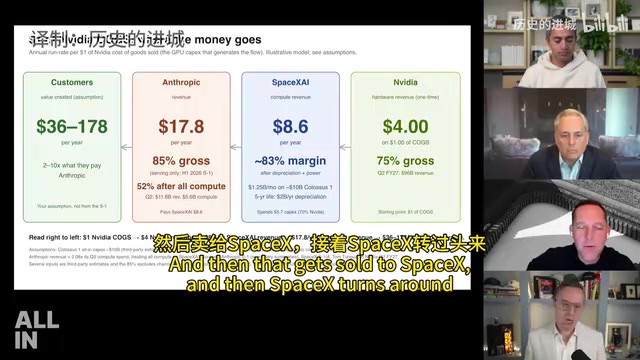
The most striking data from the show comes on the revenue side. According to the disclosure, Anthropic generated $16.3 billion in revenue in the first half of 2026, a 14x year-over-year increase; the second quarter alone brought in $11.6 billion. Even more notable is its customer structure: customers spending more than $100,000 a year grew from 200 at the end of 2024 to 1,500 at the end of 2025, and then to 11,900 by the end of September.
On the show, Freiburg offered a key perspective: if you define as potential customers the companies where "$100,000 a year in spending is less than 1% of their total expenditures," there are roughly 200,000 to 300,000 such enterprises in the US, and more than 1 million globally. That means Anthropic has so far reached only about 1% of its potential customer base.
Chamath further broke down the revenue tiers: about 40 million individual and small-business customers spend less than $100,000 a year; about 10,000 customers spend between $100,000 and $1 million; about 1,650 customers spend between $1 million and $10 million; and only 250 customers spend more than $10 million. In his view, the leap from million-dollar contracts to ten-million-dollar contracts is the hardest threshold to cross in enterprise procurement, and among the roughly 1,900 companies that can currently demonstrate ROI, many are themselves VC-backed AI-native companies—only a few hundred are true Global 2000 enterprises.

Capital Efficiency: The Misread "Huge Loss"
The "$80 billion loss" widely reported in the media was called a "ghost number" by Sacks on the show. He explained that the loss stems from convertible notes Anthropic issued to infrastructure partners such as Amazon—as the company's valuation rose, these notes were recorded as losses on the balance sheet and flowed through to the income statement, but this was not an actual cash loss. Had the company issued equity directly instead, this loss would never have appeared.
The real capital efficiency numbers are: the company has raised about $110 billion cumulatively, with total net burn of only about $9–10 billion, and still holds roughly $100 billion in cash and cash equivalents. Chamath said CFO Krishna Rao already had $125 billion in cash as of June, far above his earlier expectations.
On gross margin, the show noted that incremental gross margin has reached about 85%. More important is the concept of a "compute multiplier"—through algorithmic improvements, data curation, and architecture optimization (such as MoE), the company can reduce the cost of the same task by about an order of magnitude each year, while cutting its external price by only about half, with the difference converting into profit margin. Sacks argues this directly rebuts the bearish narrative that "open-source models will crush gross margins to zero."
Convertible notes are a hybrid financing instrument: they initially exist as debt, with an agreement to convert into equity at a preset price under specific future conditions (such as an IPO or a valuation threshold). In accounting terms, when the company's valuation rises, the conversion value increases, and the issuer must recognize a fair-value change loss on the income statement—but this is a non-cash item that does not affect actual cash flow. This is precisely why the "$80 billion loss" is called a "ghost number" on the show—it reflects the book conversion cost arising from a rising valuation, not operating cash burn. The true measure of capital efficiency is net cash burn (total capital raised minus cash and cash equivalents on hand), which strips out non-cash gains and losses and better reflects the company's actual "burn rate."
Risk Factor Word Cloud: Compute Is the Real Bottleneck
Chamath's team ran a word-frequency analysis of the S-1 risk factors, and the conclusion is clear: what management worries about most is compute, mentioned more often than any other topic, specifically pointing to data centers, power, chips, the grid, and hardware; next is regulation, including government policy, sanctions, and export controls; then come zero data retention and privacy, AI safety, profitability, competitors, and governance structure.
You may not have noticed that concerns about customer retention or employee turnover are almost invisible in the word cloud. Chamath's reading is that this is a company "on its front foot," clear about where its constraints lie. Within compute risk, data centers, financing commitments, and power are the three most heavily emphasized items.
This judgment leads to the show's most controversial political speculation: if compute and power are the lifeline of the AI race, then energy and data-center policy will become core issues of the election cycle. Chamath argues Democrats have an incentive to slow data-center and power approvals, while Republicans must get this right. Sacks offers the opposite hypothesis—since Anthropic's founders are regarded as among the most liberal in Silicon Valley, Democrats should embrace data centers to share in their wealth effect. The two ultimately failed to agree, but both concur that compute regulation will be the main battleground for years to come.

Risk Factors is the longest and most legally stringent section of an S-1 filing. A company must disclose all risks that could materially and adversely affect its business, finances, or stock price, including macroeconomic conditions, industry competition, regulatory compliance, supply chains, and cybersecurity. Because inaccurate disclosure can trigger litigation, management typically tends toward "over-disclosure," so the word-frequency distribution of risk factors can, to some extent, reveal where its real anxieties lie. Word cloud analysis visualizes keyword frequency to help quickly identify the thematic weight of a text. In this case, compute-related terms (data centers, power, chips, the grid) appear at high frequency, indicating that management sees infrastructure supply, rather than market demand, as the primary constraint—a sharp contrast with the "customer retention" and "competitive pricing" commonly found in the risk factors of traditional SaaS companies.
The Macro Crowding-Out Effect: When Seven Companies Start Competing with Treasuries
Chamath raised the most structural observation of the entire episode: the US economy has become highly levered to AI. A handful of the most important companies are undertaking massive spending, depleting their own cash and turning to debt markets for financing. By his estimate, the AI complex currently owes the market about $340–400 billion, and the capital it needs to raise by the end of 2027 will equal roughly 30% of US Treasury issuance over the same period.
He extrapolated the consequences in two directions: if capital flows to Treasuries and AI companies must pay higher interest rates, financing costs rise across the entire AI ecosystem, with negative effects transmitting layer by layer; if capital flows to AI companies and Treasuries must pay higher interest rates, borrowing costs across the US economy that are tied to Treasury yields will all rise. Both paths point to downside risk.
Sacks responded from another angle: precisely because the US is "winning across the board" on superintelligence, global capital has no choice but to buy US assets. He cited data suggesting that if Anthropic hits its revenue targets, its scale could exceed the combined total of the three best franchise businesses in US commercial history: the iPhone, Google's pay-per-click advertising, and Amazon.
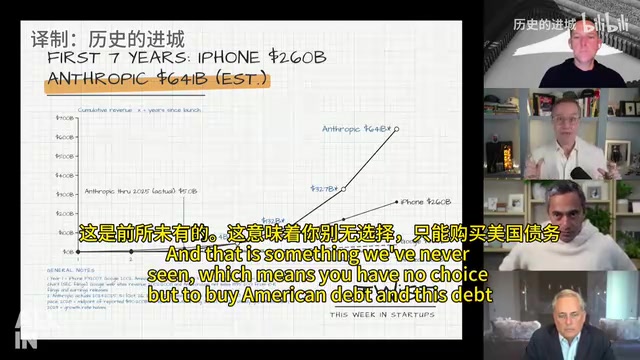
Crowding out is a macroeconomic concept: when governments or large institutions borrow on a massive scale, they absorb market savings, reducing the loanable funds available to other actors and pushing up interest rates, thereby suppressing private investment. The show extends this to AI giants: when a handful of tech companies simultaneously issue enormous bond or equity financings, their capital demands may compete with US Treasury issuance, driving up overall financing costs. US Treasuries are regarded as the global risk-free rate benchmark, and their yields directly affect the pricing of corporate bonds, mortgages, credit cards, and all manner of borrowing. If AI companies' financing needs reach 30% of Treasury issuance, it means capital markets must simultaneously absorb two giant drains—and interest-rate fluctuations on either side will transmit through the "benchmark rate—risk premium" chain to borrowing costs across the entire economy.
Recursive Self-Improvement and the Split Among the Doomers
The latter half of the show turned to a more subtle topic. Sacks noted that Anthropic is sprinting full-speed toward recursive self-improvement (RSI), with much of its cost reduction and efficiency gains coming from using its own models to generate algorithmic improvements. He cited an August blog post in which Anthropic disclosed that a considerable share of tasks related to developing its next-generation models had already been completed by RSI.
This raises a paradox: a company whose very identity rests on AI safety is precisely the one most aggressively advancing RSI. Sacks argues that Dario's earlier public letter on "pace" was, in a sense, preparing talking points in advance for future risks—"we want to slow down, but the world won't agree." He predicts a possible split between Anthropic and the doomers, because there is an irreconcilable tension between maintaining leadership and pursuing RSI.
Freiburg added from the perspective of organizational competition: governments and AI companies are fundamentally organizations competing for resources, and once AI organizations command resources in capital markets that begin to rival those of governments, governments—whether left or right—will try to bring them under control. He expects that compute capacity itself will eventually be allocated and regulated by governments.
Editorial View
The information density of this episode far exceeds that of an ordinary earnings breakdown. It offers insights at three levels at once: the micro-level unit economics (the compute multiplier and 85% incremental gross margin), the meso-level customer penetration (roughly 1% coverage of potential customers), and the macro-level capital-market crowding-out effect.
A caveat is in order: some of the figures on the show (such as the revenue tiers, the number of potential customers, and the scale of debt) are the hosts' estimates or citations, and the prospectus itself has not been made public, so readers should remain cautious. But even with a discount, the core argument holds: the capital demands of leading AI companies have grown large enough to compete with the sovereign debt market—a structural change that has never occurred before. As for the judgment of "the best business in history," Chamath himself concedes that in the $1.4–1.6 trillion valuation range, "pricing is basically fair, with no bargain to be had"—the real bet lies in the judgment about the next three to seven years.
One-line Summary
An Anthropic prospectus breakdown: 14x growth, 1% penetration, and the risk of AI capital crowding out the markets.
Paragraph Summary
The podcast breaks down the S-1 that Anthropic reportedly filed, disclosing $16.3 billion in revenue in the first half of 2026—a 14x year-over-year increase—yet covering only about 1% of potential enterprise customers. The so-called $80 billion loss is actually an accounting treatment of convertible notes; real net burn is only $9–10 billion, incremental gross margin is about 85%, and the compute multiplier reduces costs by an order of magnitude each year. The risk-factor word cloud shows compute (data centers, power, chips) is the biggest constraint, followed by regulation. At the macro level, the AI complex's financing needs by the end of 2027 may equal 30% of Treasury issuance over the same period, posing an unprecedented crowding-out risk. The show also discusses the paradox of recursive self-improvement and the AI-safety stance.
Related articles

Gemini 4 Neon Leak: A Potential Strong Contender Against Opus 5.5
A Hacker News thread suggests Gemini 4 Neon looks like an Opus 5.5 competitor. This article unpacks the product positioning behind this community signal, shifts in the top-model competitive landscape, and what it means for developers' model selection strategy.

Claude Fable 5.2's Self-Authored Short Film 'Fable' Sparks Discussion
A short film 'Fable,' credited to Claude Fable 5.2 for script, visuals, and directing, appears on Hacker News. This article analyzes the significance of full-pipeline AI creation, community reactions, and what it means for content creators.

Anthropic IPO Pricing: A Signal of AI Giants Going Public
Anthropic's IPO pricing draws attention. This article analyzes its potential impact on AI industry valuation, commercialization paths, and the competitive landscape, and highlights public-market expectations and challenges for AI companies.