The Brutal Economics of Consumer AI: The Problem Isn't the Technology, It's the Money

Frontier AI labs are going cautious on consumers because every interaction costs real compute — and scale only makes losses worse.
This article uncovers a counterintuitive pattern: the most technically capable frontier labs are growing increasingly cautious about consumer-facing AI products. The reason isn't technology — it's economics. Every user interaction in AI consumes real compute, making marginal costs impossible to drive to zero. The more engaged users are, the deeper the potential losses. The traditional internet logic of "scale equals value" breaks down here; user growth can become a cost burden rather than a moat. Enterprise and developer markets, with stronger willingness to pay and more predictable usage, offer a healthier cost-revenue dynamic. Most consumer AI today survives on capital subsidies, but the long-term viability of that model is uncertain — and ultimately, the winner will be decided by the unglamorous economics ledger.
Why Frontier Labs Are Growing Cautious About Consumer AI
A fascinating pattern is playing out across the AI industry: the frontier labs with the most powerful models are becoming increasingly conservative when it comes to consumer-facing products. On the surface, this seems counterintuitive — if capabilities are advancing at breakneck speed, why not aggressively push into the consumer market?
The real answer has nothing to do with technology. As relevant analyses have pointed out, frontier labs' hesitation around consumer AI isn't because the technology isn't good enough — it's because the economics are ugly. This observation cuts to the heart of the industry's central contradiction today: the enormous gap between surplus capability and fragile business models.
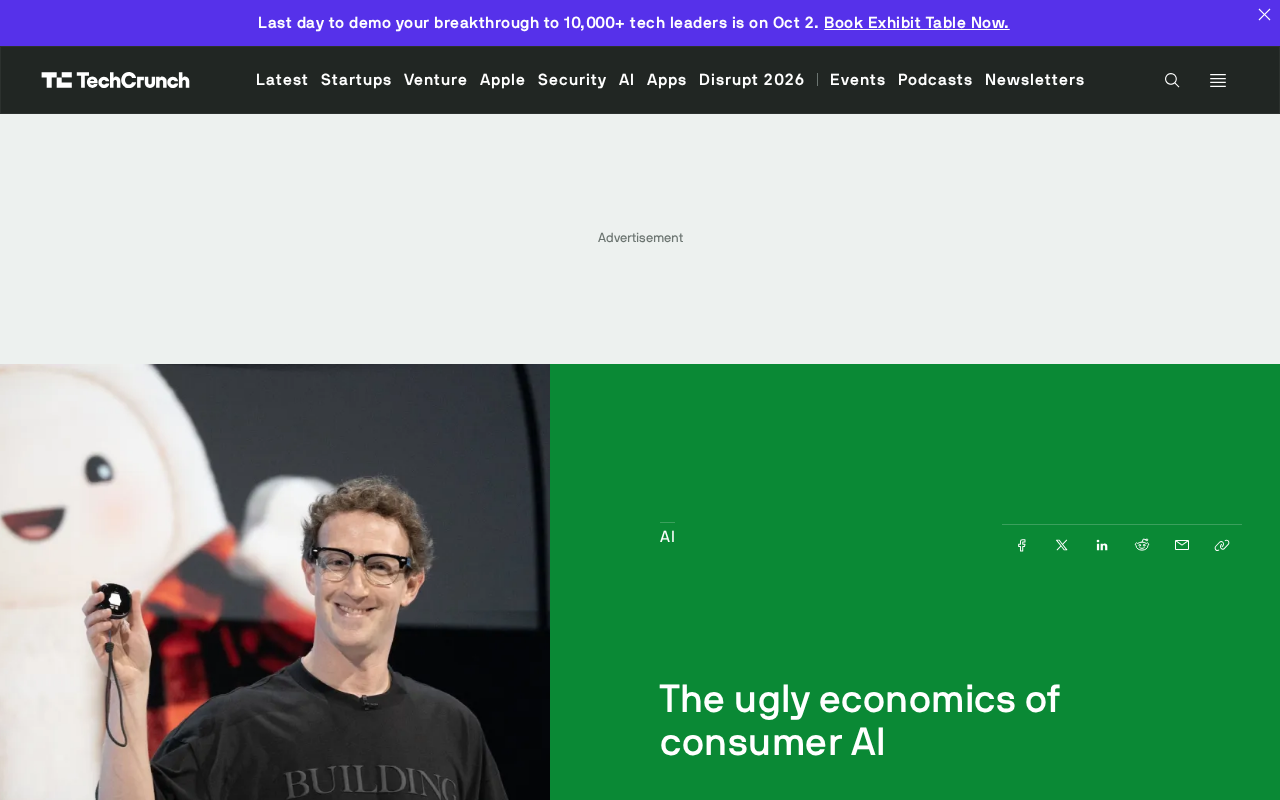
Why the Cost Structure of Consumer AI Is So Problematic
The biggest challenge facing consumer AI is its unit economics. Every user interaction — whether generating text, an image, or a block of code — corresponds to real compute consumption and inference costs. Unlike traditional software, where the marginal cost of replication trends toward zero once developed, AI products incur real, cumulative costs with every user served and every request processed.
This means that more users and higher engagement can actually translate to greater losses. For consumer products that attract large audiences through free or low-cost subscriptions, this is a nearly structural trap. When heavy users consume far more than their subscription covers, every additional active user retained represents another subsidy the platform must absorb.
Scale Is No Longer a Moat — It's a Liability
In the internet era, user scale was essentially synonymous with value — advertising, network effects, and data flywheels all depended on it. But in the context of consumer AI, pure growth in scale may accelerate cash burn. Without matching monetization efficiency, even the largest user base is just a cost center that keeps getting bigger.
Unit Economics is the core framework for assessing business model health — it measures the cost and revenue relationship tied to acquiring or serving a single user. For traditional SaaS software, marginal costs are nearly negligible; adding one more user requires almost no additional investment. But the inference stage of large language models requires continuous access to GPU clusters, and every generated token consumes real compute. For a GPT-4-class model, industry estimates put the inference cost per conversation in the range of a few cents. Heavy users may generate dozens of lengthy conversations per month, while a monthly subscription typically runs around $20. When actual usage by paying users significantly exceeds what the pricing model assumes, providers don't just fail to profit — they lose money on every transaction. In economics, this is known as Negative Contribution Margin, and it's a fundamental red flag for any business model.
The "scale moat" of the internet era rested on two premises: marginal costs approaching zero, and user data or network effects delivering sustained differentiation. For search engines, social platforms, and e-commerce, more users actually drove per-unit service costs down, while data accumulation built barriers that were hard to replicate. AI products do share a similar data flywheel logic — but the critical difference is that inference costs don't decrease as scale grows (at least not yet), and hardware procurement and depreciation are fixed expenses. More importantly, the capability gap between frontier labs is narrowing, and switching costs for users across different products are extremely low. This means that even with a massive user base, it's difficult to build enough pricing power to bridge the cost gap.
Why the Enterprise Market Is More Attractive
By contrast, more and more frontier labs are shifting their focus toward enterprise and developer markets — precisely because the economics are cleaner. Enterprise customers are willing to pay for clearly defined productivity gains, with much higher willingness and capacity to pay than ordinary consumers, and their use cases are relatively controlled and predictable.
Models like API calls, enterprise subscriptions, and custom deployments more directly translate compute costs into rational pricing, creating a healthier relationship between revenue and cost. This is why, even as companies cast a wide net on the consumer side, the real profit engine is typically found in the B2B market.
How Long Can the Subsidy Game Last?
Many consumer AI products today are still in the "burn cash for growth" phase, relying on capital infusions to sustain low or even free pricing. But the sustainability of this playbook is questionable. Once the capital environment tightens or investors start demanding a path to profitability, consumer products that can't generate their own revenue will face the most immediate pressure.
This model has historical precedent. Ride-hailing, food delivery, and bike-sharing all went through extended phases of burning cash to build scale, with the theory being: capture the market first, cultivate user habits, then raise prices once the competitive landscape stabilizes. But consumer AI faces two additional challenges. First, the underlying model capabilities are still iterating rapidly — today's moat could be undermined tomorrow by a cheaper alternative. Second, while inference costs are declining (thanks to model distillation, quantization, and hardware efficiency gains), they haven't yet fallen far enough to make unit economics profitable in the near term. As a result, the subsidy cycle for consumer AI may last far longer than in any previous industry — and capital markets' patience for "perpetually distant profitability" is waning as the interest rate environment shifts.
What This Means for the Industry
The economic struggles of consumer AI explain, to some degree, several recent strategic decisions in the industry: why powerful models aren't necessarily made available to all consumers immediately, and why some vendors prefer to put their latest capabilities behind paid or enterprise channels first. These seemingly conservative decisions are, at their core, rational responses to brutal unit economics.
For users, this is a reminder that many "free" AI experiences we enjoy are backed by business model problems that haven't yet been solved. For founders and investors, the real opportunity may not lie in building yet another mass-market chat application, but in identifying vertical use cases where costs and revenues can actually align.
The ceiling on technical capability matters, of course — but what determines who's still standing in the end is often that unglamorous ledger of economic reality.
Related articles

NVIDIA's 30,000 Developers Use Cursor, Code Commit Volume Triples
Cursor engineer Chris Diaz breaks down five organizational gaps blocking enterprise AI coding scale—strategy, risk tiering, governance, metrics, and operating model. NVIDIA's 30,000 developers use Cursor daily, tripling code commits while defect rates stay flat. The key: rewrite the SDLC, not add tools.

Ponytail: Giving AI Coding Agents a Senior Engineer's Mindset
Ponytail is a free GitHub tool that injects a senior engineer's mindset into AI coding agents, making them ask whether code is even necessary first. According to TamilDeck, it can compress 200 lines of AI-generated code to 30, cutting token costs, with support for Cursor rules and Claude Code skill integration—though security review still requires human oversight.

Complete Guide to Connecting Cursor AI to the GitHub MCP Server
A step-by-step guide to connecting Cursor AI to the GitHub MCP server: create a personal access token, configure mcp.json, store the token in the ENV block, and verify with a PR query.