The CARE Framework: Safer and More Efficient Human-AI Collaborative Decision Making, Reducing Human Queries by Up to 81%

CARE framework cuts human queries by up to 81% while keeping AI decisions safe through adaptive calibration.
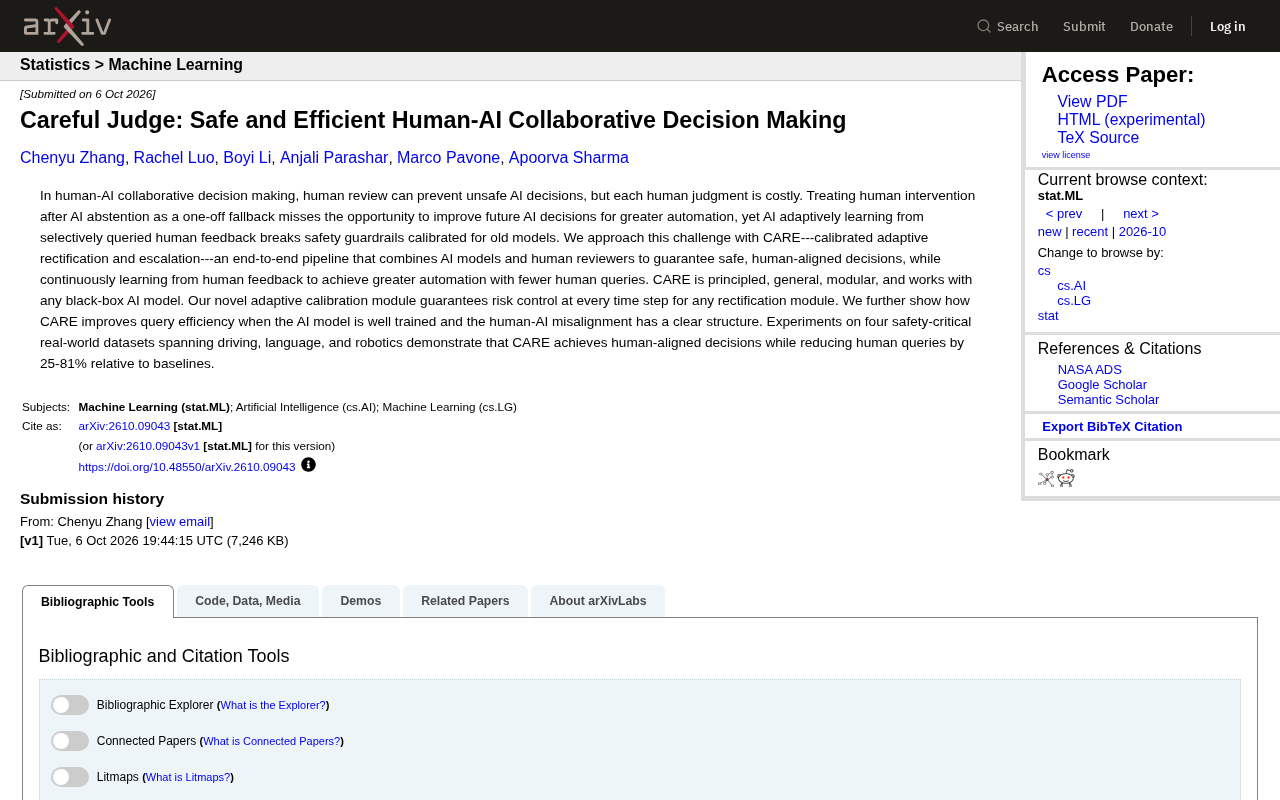
In safety-critical domains like autonomous driving and robotics, AI decisions often require costly human review — yet that feedback is rarely used to improve the AI itself. Worse, allowing adaptive learning from human input invalidates existing safety calibrations, creating a "safety vs. learning" paradox. The CARE (calibrated adaptive rectification and escalation) framework resolves this with an adaptive calibration module that dynamically maintains risk control guarantees at every time step as the model learns. Designed to be modular and compatible with any black-box AI model, CARE reduces human queries by 25%–81% across driving, language, and robotics benchmarks while preserving human alignment.
In safety-critical applications like autonomous driving, medical diagnosis, and robot control, every AI decision can carry enormous consequences. A common safeguard is to route uncertain AI decisions to human reviewers — but this human oversight is expensive, and typically treated as a one-off fallback rather than an opportunity to improve the AI going forward. A new arXiv paper introduces an end-to-end pipeline called CARE that aims to let AI continuously learn from human feedback while maintaining safety guarantees, dramatically reducing reliance on human intervention.
The Core Tension in Human-AI Collaborative Decision Making
Human-AI collaborative decision making faces a fundamental dilemma. On one hand, human review acts as a safety valve that catches unsafe AI decisions — but every human judgment carries a cost, in both time and labor that cannot be ignored.
On the other hand, treating human intervention purely as a passive fallback after the AI "abstains" wastes a valuable opportunity: the cases corrected by humans could instead be used to train the AI and improve its automation rate. But this creates a new problem — if the AI adaptively learns from selectively queried human feedback, the model continuously changes, and the safety guardrails calibrated for the old model become invalid.
In other words, "safety" and "continuous learning" are conflicting goals under traditional approaches. Learning undermines safety guarantees, while rigidly preserving those guarantees prevents any improvement in automation. CARE is designed specifically to resolve this tension.
In engineering practice, safety guardrails are typically implemented as threshold rules: when the AI's output confidence falls below a calibrated critical value, human review is triggered. Setting this threshold requires statistical calibration on historical data to ensure that a risk metric — such as false positive or false negative rate — stays within a preset bound. The problem is that this calibration is a snapshot tied to a specific model state. Once model weights change through online learning, the correspondence between the original threshold and the new model breaks down, and actual risk can quietly exceed the promised upper bound. This is the technical root of the "safety vs. learning" tension: nearly all traditional safety certification methods assume a static, known model.
How CARE Resolves the Dilemma
CARE stands for calibrated adaptive rectification and escalation. It combines an AI model with a human reviewer into a complete closed-loop pipeline. Its three design objectives are: guarantee safe, human-aligned decisions; continuously learn from human feedback; and achieve higher automation with fewer human queries.
The paper emphasizes four desirable engineering properties of CARE: it is principled, general, modular, and compatible with any black-box AI model. This means users do not need to open up the model's internals or customize it for a specific architecture — CARE can be applied as an outer safety and learning framework on top of any existing system.
The Adaptive Calibration Module Is the Key
CARE's core innovation is its adaptive calibration module. Its role is to ensure risk remains controlled at every time step, regardless of how the underlying rectification module changes.
This is the critical insight that resolves the tension described above. Traditional safety calibration is set once for a fixed model — once the model changes through learning, the calibration becomes outdated. CARE's adaptive calibration dynamically adjusts as the model evolves, maintaining strict risk control guarantees while the AI continues to learn.
In machine learning, calibration refers to the process of making a model's output confidence match its actual accuracy. An uncalibrated model might output 90% confidence on a wrong prediction, rendering safety thresholds ineffective. Conformal prediction is a mainstream distribution-free calibration method that provides statistically valid prediction sets for any black-box model, guaranteeing that the true label falls within the set with a specified probability. CARE's adaptive calibration module likely draws on similar ideas from online calibration: whenever the model updates due to learning, calibration parameters adjust accordingly, so that risk control coverage guarantees hold at every time step — not just as a static snapshot after training ends. This "anytime-valid" guarantee is something traditional one-shot calibration cannot provide, and it is the technical foundation enabling CARE to simultaneously support continuous learning and safety commitments.
Conditions for Improved Query Efficiency
The paper further analyzes the conditions under which CARE improves query efficiency: when the underlying AI model is well-trained and the "misalignment" between humans and AI has clear structure, CARE can more effectively reduce the number of human queries.
This is a pragmatic insight — it shows that CARE's benefits don't come from nowhere, but depend on the AI's baseline capability and the learnability of misalignment patterns. When the disagreements between humans and AI exhibit recognizable regularities, the system can more quickly learn which situations it can handle autonomously and which still need to be escalated to a human.
Cross-Domain Experimental Validation
To evaluate CARE's real-world performance, the research team ran experiments on four safety-critical real-world datasets spanning driving, language, and robotics.
Results show that CARE reduces human queries by 25% to 81% compared to various baseline methods, while achieving human-aligned decisions. The wide range reflects meaningful variation across different tasks and data characteristics — but even the lower bound of 25% is significant for high-cost human review scenarios, while the upper bound of 81% represents near-complete automation of human effort under favorable conditions.
Significance and Implications
CARE's significance lies in providing a reconcilable framework for two long-opposing goals: safety and automation. As more AI systems enter high-stakes decision-making contexts, the question of how to maintain safety floors without turning human review into a bottomless resource drain is a universal engineering challenge.
Its black-box compatibility and modular design lower the barrier to deployment: organizations don't need to rebuild their existing AI models to add a layer that both ensures safety and continuously optimizes automation rates. For autonomous driving companies, content moderation platforms, robotics manufacturers, and other organizations that rely on human-AI collaboration as a quality gate, this type of framework has direct practical value.
Of course, the paper also implies limits on applicability — query efficiency gains depend on the quality of the underlying model and the clarity of the misalignment structure. In other words, CARE is not a universal solution; it is best suited for mature scenarios where AI already has substantial capability and simply needs to collaborate with humans on edge cases. As more follow-up research emerges, this direction is worth continued attention.
Related articles

Gemini 4 Argon Hands-On: AI Builds Board Games, Constructs Temples, and Trains Robots Autonomously
Gemini 4 Argon hands-on roundup: AI autonomously builds a desk racetrack and temple in Blender, writes a ray tracing engine, trains a humanoid robot to sink 7 shots, plus API pricing and developer access.

The Magic Octagonal Coin: Why Only 9% of People Can Predict Its Flip?
Only 9% of people can correctly predict the Magic Octagon coin flip. This article explains its spatial rotation mechanism, common cognitive pitfalls, and a new hypothesis based on Relevance Theory, exploring the limits of human spatial reasoning.

Sam Altman: AI Is Entering the Era of Scientific Discovery — Math Breakthroughs Will Replicate in Biology and Energy
Sam Altman says AI is entering the era of scientific discovery — math breakthroughs will replicate in biology, materials science, and energy to help develop new drugs and energy sources.