The "Collision" Between AI and the Human Brain: Professor Eric So on How Technology Is Reshaping Our Thinking

Professor Eric So warns AI is causing a "collision" between the human brain and society, urging conscious cognitive management.
USC professor Eric So argues in his new book that a "collision" is occurring between AI, the human brain, and society. The article examines three dimensions: cognitive offloading, educational impact, and social stratification. Unlike earlier tools, AI takes over higher-order thinking such as writing and reasoning, potentially accelerating the decline of deep thinking. Education should shift toward abilities AI lacks, such as questioning, evaluation, and value judgment. Socially, cognitive stratification may form between critical AI users and those who rely on it entirely, while algorithmic bias may be subtly amplified. So calls for "cognitive management" — using AI for efficiency while preserving independent judgment — and warns that passive acceptance is the most dangerous choice.
When ChatGPT can write a paper, generate a business report, or even pass a professional exam in seconds, an unsettling question surfaces: are our own brains still being fully used?
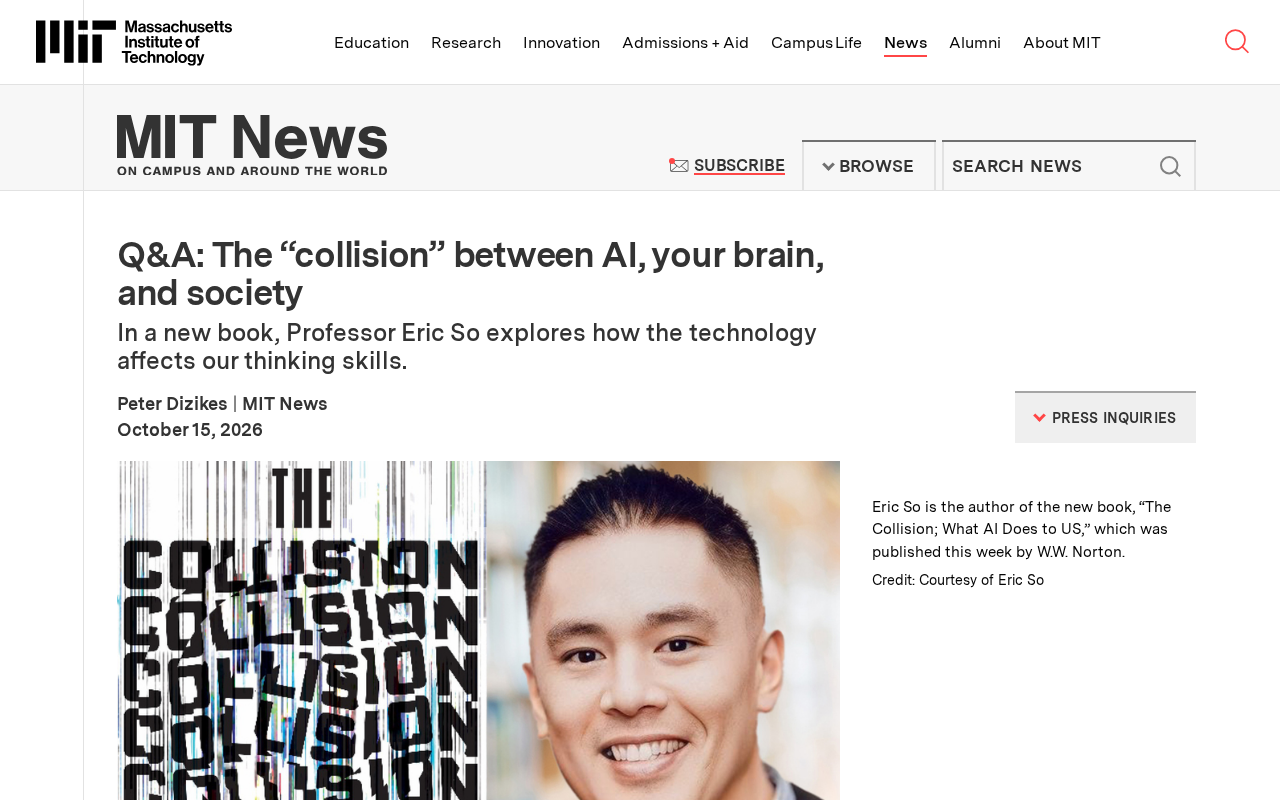
In his new book, Eric So, a professor at the USC Marshall School of Business, defines this phenomenon as a "collision" between AI, the human brain, and society. The metaphor is not alarmist — it describes three forces competing for dominance in the same space, and the friction between them has already begun to produce visible consequences.
Cognitive Offloading: The Cost Behind Convenience
AI tools' biggest selling point is "saving effort." Writing gets polished by AI, analysis gets done by AI, decisions get supported by AI suggestions. Professor So's research points to an easily overlooked side effect: when we habitually outsource cognitive tasks to machines, the "muscles" in the brain responsible for deep thinking and critical judgment gradually atrophy.
This is not a purely hypothetical concern. Psychology has a long tradition of research on "cognitive offloading" — from calculators to GPS navigation, every time a thinking task is transferred to an external tool, it improves efficiency while reducing how often humans use the corresponding ability themselves. What makes AI different is that it no longer offloads just calculation or memory, but writing, reasoning, and creative generation — higher-order cognitive activities once considered uniquely human.
Professor So's core concern is speed: it took GPS decades for people to realize their sense of direction was deteriorating, whereas AI's penetration may cause such decline to happen in a much shorter time — and make it harder to notice.
Cognitive offloading is a core concept in cognitive psychology, first proposed by psychologist Daniel Wegner and others. It refers to individuals transferring thinking tasks such as memory, calculation, and decision-making to external tools or the environment to reduce their own cognitive load. Classic studies include: relying on calculators weakens mental arithmetic, relying on GPS navigation degrades spatial memory and sense of direction, and relying on search engines reduces active memory of information (the so-called "Google effect"). Cognitive offloading itself is not bad — it is an extension of human intelligence and one of the drivers of civilizational progress. But researchers generally focus on its trade-off: the immediate efficiency gains from offloading often come at the cost of long-term atrophy of unused abilities. What makes AI special is that, for the first time on a large scale, it offloads tasks at the "metacognitive" level — namely judgment, reasoning, and creation — which may cause the traditional "use it or lose it" rule to manifest in more subtle and rapid ways.
Education: The First Area to Feel the Impact
If AI's effect on cognition is a slow tide, then education is the first mudflat to be submerged.
Students using AI to complete homework is hardly news, but Professor So is concerned with more than academic integrity. In his book, he argues that one of education's core goals is to train the "friction" of thinking — that is, to tolerate uncertainty and cognitive discomfort when facing complex problems, and to build understanding through repeated trial and error. AI happens to eliminate this friction: it directly provides answers, skipping the most valuable part of the thinking process.
This does not mean education should reject AI. Professor So's view is closer to "redesign" — if AI can take over information retrieval and basic calculation, then classrooms should devote more energy to what AI is not good at: asking good questions, evaluating whether AI's answers are reliable, and making value judgments among multiple seemingly reasonable options.
Desirable difficulty is a concept from cognitive psychologist Robert Bjork's research, referring to the idea that moderate difficulty, delay, and uncertainty in the learning process can instead promote long-term memory and deep understanding. For example, spaced repetition, active recall, and "guess before learning" are more effective than directly reading answers, because these processes force the brain to engage in deeper encoding. The "tolerance of uncertainty and cognitive discomfort" emphasized by Professor So is an extension of this theory in the AI era: when AI gives answers instantly, learners bypass the key link that produces "desirable difficulty," potentially gaining short-term efficiency while sacrificing the construction of long-term thinking ability. Educational design therefore faces a fundamental question — how to preserve necessary cognitive friction while using AI to improve efficiency.
The Social Level: New Risks of Cognitive Stratification
Professor So's analysis does not stop at the individual level. He raises a social trend worth watching: AI may intensify the "stratification" of cognitive abilities.
The gap will grow wider between those who can consciously use AI as a thinking aid while maintaining their own critical thinking, and those who rely entirely on AI output and lose independent judgment. This stratification is not as visibly intuitive as income inequality, but its impact on the quality of social decision-making and the level of public discussion may be even more profound.
One specific scenario is this: as more and more people obtain information and form opinions through AI, the biases and blind spots in AI output will be amplified in more subtle ways — because users lack sufficient ability to identify and question that output.
Algorithmic bias refers to AI systems systematically favoring certain groups or viewpoints in their output, rooted in imbalanced training data, annotators' subjective tendencies, and one-sided model optimization objectives. Unlike human bias, algorithmic bias often has hidden and scaled characteristics: it is hard for an individual user to notice, yet it can influence the cognition of millions through recommendation systems and generated content. When users lack the ability to critically evaluate AI output, these biases are accepted as "objective answers," creating an echo chamber effect in public discussion and increasing the risk of social cognitive stratification.
Cognitive Strategies for Coexisting with AI
Professor So is not a technological pessimist. In his book, he acknowledges the enormous efficiency gains brought by AI and recognizes that AI surpasses humans in certain cognitive tasks. What he truly calls for is a conscious form of "cognitive management."
Specifically, this means maintaining a kind of "deliberate discomfort" when using AI: let AI provide options, but make the final judgment yourself; use AI to accelerate information collection, but retain your own process of digesting and questioning; free up time on tasks AI can handle, but invest that time in higher-order thinking activities rather than mere entertainment.
These strategies sound simple, but executing them requires continuous self-discipline — because the convenience of AI itself constantly tempts us to abandon that discipline.
A Collision That Is Not Over Yet
Professor So uses "collision" rather than "impact" or "revolution" to describe the relationship between AI and human cognition. The wording itself reveals a judgment: this is not a one-way process, but a dynamic game in which multiple forces shape one another. While AI changes how we think, the way humans use AI also shapes the direction of AI's development in turn.
The outcome of the collision is not yet determined. But Professor So's research at least reminds us of one thing: in this game, passive acceptance is the most dangerous choice.
One-line Summary
Professor Eric So warns that AI is triggering a "collision" between the human brain and society, and calls for conscious cognitive management.
Paragraph Summary
In his new book, USC professor Eric So argues that a "collision" is occurring between AI, the human brain, and society. The article unfolds across three levels: cognitive offloading, educational impact, and social stratification. Unlike previous tools, AI takes over higher-order thinking such as writing and reasoning, potentially accelerating the decline of deep thinking; education should be redesigned to focus on abilities AI is not good at, such as questioning, evaluation, and value judgment; socially, cognitive stratification will form between those who use AI critically and those who rely on it entirely, while algorithmic bias may be amplified in hidden ways. Professor So is not a pessimist; he calls for "cognitive management" strategies — using AI to improve efficiency while preserving independent judgment and questioning — and stresses that passive acceptance is the most dangerous choice in this game.
Related articles

Why Does the Tesla Roadster Need to Fly? A Deep Dive into Musk's Wild Demo
Tesla's Roadster launch showed wall-climbing, upside-down driving, and flying stunts—but The Vergecast notes the demo car may lack a battery, the Rocket version is invite-only and not street-legal, and the website terms don't guarantee delivery. After nine years of delays, why does this car still need to exist?

AI Is Not a Replacement: Human-AI Collaboration Through the Lens of Factory Root Cause Analysis
Starting from factory root cause analysis, this article explains how AI accelerates evidence chain construction rather than replacing human experts, exploring the pragmatic implementation logic and business value of 'AI supporting people rather than replacing them.'

AI Agent Decision Auditing: Building an Evidence Chain in Regulated Workflows
Starting from a Reddit discussion, this article analyzes three core issues in AI agent decision auditing within regulated workflows: what fields audit records should contain, how to handle feedback latency for erroneous decisions, and how to continuously calibrate LLM judge consistency with human judgment.