The Complete Guide to Agent Skills: Principles, Structure, and Real-World Examples

A complete guide to Agent Skills — structure, core elements, real-world examples, and how they differ from prompts.
Agent Skills are reusable, structured capability modules for AI agents, far more powerful than standalone prompts. This guide explains the four core elements (SKILL.md, references, scripts, assets), walks through a real restaurant marketing case study, and clarifies why Skills — combining Prompt Engineering with software modularity — are becoming essential for AI power users.
What Are Agent Skills?
As Claude Code and various Agent tools continue to surge in popularity, Skills have become an indispensable part of the intelligent agent ecosystem. Yet many newcomers still find the concept unfamiliar: What exactly is a Skill? And how does it differ from the Prompts we already know?
This article is based on a beginner-friendly Agent Skills tutorial, covering three dimensions — "Understanding Skills," "Customizing Skills," and "Recommended Skills" — to give you a thorough grasp of this technology.
The Rise of the Agent Ecosystem
An Agent (intelligent agent) is an AI system capable of perceiving its environment, making autonomous decisions, and executing tasks. Unlike traditional single-turn Q&A AI, Agents can break down complex goals, invoke external tools, retain context, and iterate continuously to complete multi-step automated tasks. Claude Code is Anthropic's coding agent, capable of reading and writing files, running commands, and debugging programs within a real development environment. The Skills framework emerged precisely to give these Agents reusable, standardized professional capability modules — much like handing a new employee a complete "job operations manual."
In the simplest terms, a Skill is exactly what the word implies: a capability. This concept is very close to everyday life — every person and every profession has corresponding expertise. A student writes essays, solves math problems, and completes English assignments; a programmer understands requirements, writes code, and debugs issues.
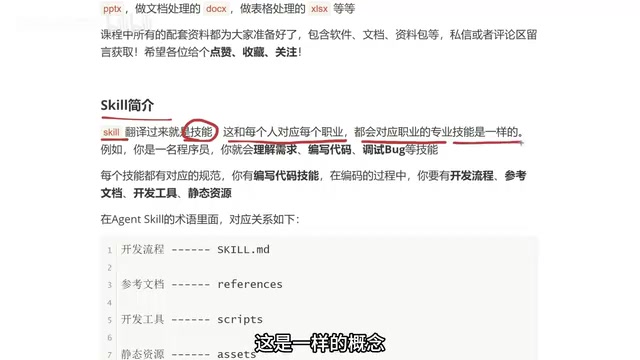
The skills associated with human professions map directly onto the Skills an Agent possesses in the AI world. In other words, a Skill is the "professional capability" we give to an intelligent agent. Once you grasp this analogy, the technical details that follow become much clearer.
The Four Core Elements of a Skill
Every skill has a corresponding specification. Take "writing code" as an example. Before a programmer starts actual development, they need four types of supporting elements:
Development Workflow
Before writing code, the developer needs to fully map out the business logic — what comes first, what comes next, and how different pieces relate to each other. This planning process is the "development workflow."
Reference Documentation
Writing code requires reference materials — perhaps API docs or a requirements document — that tell you "how to implement this feature."
Development Tools
Nobody writes complex projects in Notepad. Java developers often use IntelliJ IDEA; frontend and Python developers might prefer VS Code. The right tools make every task more efficient.
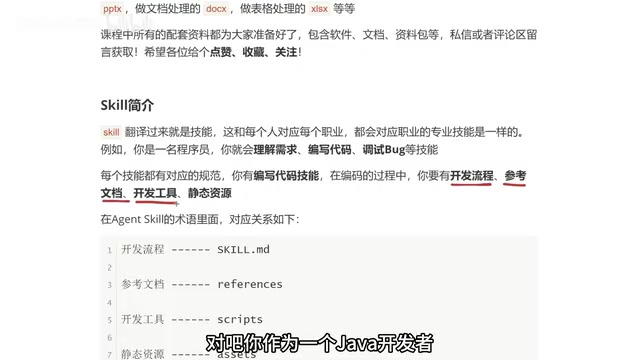
Static Assets
Images, audio, video, and other files used when building a webpage are all static assets. With them, you can truly deliver a complete, finished project.
Skill Directory Structure: From Concept to Files
The four elements above have clear counterparts in the Agent Skill terminology:
| Real-World Concept | Skill Equivalent |
|---|---|
| Development Workflow | SKILL.md file |
| Reference Documentation | references directory |
| Development Tools | scripts directory |
| Static Assets | assets directory |
Bundle these together into a single folder, and you have a complete Skill.
SKILL.md: The Neural Center of a Skill Package
SKILL.md is a Markdown-format file and the core descriptor of the entire skill package. It typically follows a hybrid structure of YAML Front Matter plus natural-language instructions: the metadata at the top uses structured fields to describe the skill's name, version, and trigger conditions; the body contains natural-language instructions that tell the Agent the task logic, constraints, and output format. This design balances machine parseability with human readability and represents an important step in the evolution of Prompt Engineering toward a more engineering-oriented discipline.
The scripts directory typically holds executable files such as Python scripts, shell commands, or Node.js programs. This gives Skills the ability to "break beyond the pure-text boundary" — the Agent can not only generate content but also invoke scripts to handle file format conversion, API requests, data processing, and other real operations. This is closely related to the concept of Tool Use / Function Calling: a large language model triggers external functions through structured output, combining language capability with computational capability — a core mechanism in today's mainstream Agent frameworks such as LangChain, AutoGPT, and Claude Tool Use.
One key point deserves emphasis: not every file and directory is required — only SKILL.md is mandatory. The references, scripts, and assets directories should be added flexibly based on actual needs — sometimes none are needed, sometimes all three are required.
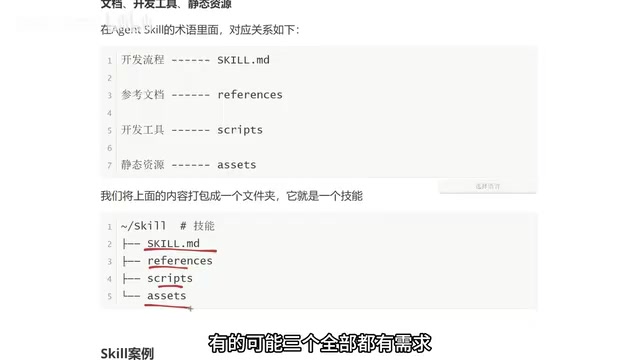
This "assemble on demand" design is what makes Skills so flexible, allowing developers to freely determine the richness of a skill package based on task complexity.
Real-World Case Study: A Restaurant Marketing Materials Design Skill
To understand the composition of Agent Skills more concretely, let's walk through a complete example: a "Restaurant Marketing Materials Design" skill. All the content lives in a single SKILL.md file.
Metadata
The section at the top of the file is called "metadata," which includes the skill's name and description. For example, this skill's description reads: "Generate brand-consistent marketing material concepts for a restaurant. When the user requests a specific type of material (poster, pull-up banner, packaging box, etc.), output the corresponding design concept."
Metadata defines the identity and primary function of a skill and is the key basis on which the Agent determines "when to invoke this skill." In complex Agent systems with multiple coexisting skills, the quality of the metadata description directly affects the skill's recall accuracy — the more precise the description, the better the Agent can select the right skill at the right moment.
Instructions
The content below the metadata is called "instructions" — just like the natural language we send when chatting with a large language model.

In this example, the instructions define in detail:
- Core brand elements: brand name, style, IP mascot, primary color palette, slogan
- Task definition: when the user requests a specific type of material, output a design that matches the brand style
- Output format: thematic concept, visual style, composition, detailed suggestions, etc.
The more detailed the instructions, the more the output matches expectations. This is critical in practice — vague instructions yield vague results. The underlying technical reason comes from a core insight in Prompt Engineering: the quality of a large language model's output is highly correlated with the degree of structure in the input and the clarity of the constraints. Techniques like Chain-of-Thought prompting work precisely by providing richer context to guide the model toward more precise reasoning.
The Core Difference Between Agent Skills and Prompts
At this point, many readers will wonder: doesn't this look a lot like a prompt?
There are indeed similarities. Prompt Engineering is the practice of carefully designing input text to guide large language models toward desired outputs, evolving through multiple generations from single instructions to few-shot prompting and Chain-of-Thought. However, prompts are inherently stateless, unstructured, and difficult to version-control. The capability of a Skill far exceeds that of a standalone prompt, and the core differences manifest across three dimensions:
- Structured: A Skill is not just a single
SKILL.mdfile — it can includereferences,scripts,assets, and other files and directories, forming a complete capability system. - Extensible: By attaching scripts and resources, a Skill can achieve complex functionality that a prompt alone cannot, such as invoking tools, processing files, and loading assets.
- Reusable: A packaged skill can be invoked repeatedly across different scenarios, forming a standardized capability module that significantly reduces the cost of repetitive configuration.
Simply put, a prompt is "a one-sentence capability," while a Skill is "a complete capability system." Agent Skills combine the best practices of Prompt Engineering with the modular design philosophy of software engineering, making it possible to encapsulate, distribute, and reuse AI capabilities. This is precisely why Agent Skills are playing an increasingly important role in the intelligent agent ecosystem.
Practical Directions: High-Frequency Skills Worth Bookmarking
Once you understand the principles, you can start customizing Skills for your own use cases. Here are some practical, high-frequency skill directions that cover most everyday work scenarios:
- Frontend Page Skill: Rapidly generate web interfaces
- PPT Creation Skill: Automate presentation production
- Document Processing Skill: Batch-process various document types
- Spreadsheet Processing Skill: Data organization and analysis
Using the restaurant marketing materials example: simply input "Help me make a promotional poster for Wellington steak at only ¥38, first come first served," and the Skill will automatically generate a poster concept aligned with the brand style, positioning, and target audience.
Summary
At its core, Agent Skills systematically transfer the operational logic of human professional skills onto AI agents, while integrating the modular design philosophy of software engineering with the language-guidance techniques of Prompt Engineering. The key to understanding it lies in three points: SKILL.md is the only required component, all other resources are assembled on demand, and the more detailed the instructions, the better the results.
From understanding to customization, Agent Skills are becoming an essential capability for every power user of AI. Rather than passively relying on existing tools, take the initiative to write Skills tailored to your own business scenarios — and let Agents truly work for you.
Key Takeaways
Related articles

The Truth Behind Codex 'Build a Website in 5 Minutes': AI Isn't Creating Sites—It's Helping You Copy Them
Exposing the truth behind viral Codex 5-minute website videos: creators aren't building original sites with AI—they're copying shared prompts or scraping others' work. Learn AI coding tools' real limits.

Getting Started with AI Agent Development: A Complete Guide from Concept to Practice
A comprehensive guide to AI Agent architecture and development, covering automated marketing, intelligent customer service, and investment analysis scenarios with single and multi-agent collaboration.

The Truth Behind Codex 'Build a Website in 5 Minutes': AI Isn't Creating Sites — It's Helping You Copy Them
Exposing the truth behind viral Codex 5-minute website videos: creators aren't building original sites with AI — they're copying shared prompts or scraping others' work.