The Complete Guide to GLM-5.2: Hands-On Review of an Open-Source Long-Context Model

GLM-5.2 hands-on review: 1M-token context and strong agent workflows at one-fifth the frontier-model price.
A hands-on review of Zhipu AI's open-source GLM-5.2, a long-context model with a 1M-token window, strong coding ability, and mature agentic workflows—at roughly one-fifth the cost of frontier models. Covers website testing, Cursor integration, MCP tool automation, and a zero-risk production migration path.
Against the backdrop of the U.S. government imposing export restrictions on the most advanced AI models, open-source models from China are drawing increasing attention. Well-known AI blogger Matt Wolfe recently conducted a comprehensive hands-on test of GLM-5.2, released by Zhipu AI (ZAI). His conclusion: this may be one of the most worthwhile open-source models to add to your toolkit right now—not because it can comprehensively crush Claude or GPT, but because it delivers near-frontier-model capabilities on long documents, coding, and agentic workflows at roughly one-fifth the price.
What Is GLM-5.2? An Overview of Its Core Capabilities
Zhipu AI's technical foundation is worth introducing first. Founded in 2019, Zhipu AI is an AI enterprise incubated by the Knowledge Engineering Group (KEG) Lab of Tsinghua University's Department of Computer Science, with technical roots in more than a decade of research into knowledge graphs and large-scale pretraining at Tsinghua's KEG Lab. The GLM (General Language Model) series adopts an autoregressive blank-filling pretraining framework that differs from the GPT architecture—its core innovation lies in predicting masked continuous text spans word by word in an autoregressive manner, enabling the model to perceive bidirectional context while generating coherent long-form text. This design was first embodied in the GLM paper published by Tsinghua University in 2021, which aimed to unify the pretraining objectives of BERT-style encoders and GPT-style decoders. Notably, as Decoder-Only architectures demonstrated stronger emergent capabilities at ultra-large parameter scales, the GLM series moved toward this mainstream approach after GLM-4. GLM-5.2 builds on this foundation with a heavy emphasis on optimizing long-context processing, representing Zhipu AI's differentiated bet on specific engineering scenarios. From GLM-130B and the ChatGLM series to today's GLM-5.2, Zhipu AI has forged a path of productization driven by academic depth.
In China's large-model competitive landscape, the technical routes of different players show clear divergence: DeepSeekAd is known for extreme training efficiency and its MoE (Mixture of Experts) architecture; Moonshot (Kimi) likewise bets on the long-context track; Baichuan Intelligence focuses on vertical industries like healthcare and finance; and MiniMax continues to push in audio and multimodal directions. This divergent landscape stems in part from domestic regulatory requirements that drive each player to seek differentiation in niche scenarios beyond the homogeneous competition on foundational capabilities. Zhipu AI treats long context plus agents as its core moat, consistent with its KEG Lab's academic accumulation in knowledge graphs and tool use. GLM-5.2 is positioned as a "long-context + agent" model, a concentrated expression of Zhipu's bet on this niche track.
GLM-5.2 is Zhipu AI's flagship long-context model, built on a text-input, text-output architecture (it does not yet support images or audio). It boasts a 1-million-token context window and a maximum output length of 128,000 tokens, with support for function calling, structured output, context caching, and the MCP protocol.
What does a 1-million-token context window mean? The "context window" refers to the total amount of text a model can "see" and process simultaneously in a single inference pass. One token corresponds to roughly 3/4 of an English word, or 1–2 Chinese characters. One million tokens means the model can process about 750,000 English words at once—equivalent to roughly ten medium-length novels, or thousands of pages of legal contracts and codebases.
Long-context capability is especially critical for agentic workflows, and understanding this requires grasping the technical debate between RAG and long-context approaches: Retrieval-Augmented Generation (RAG) is the mainstream engineering solution developed in an era when large models had limited context windows—it splits a large knowledge base into small chunks, uses a vector database to retrieve the most relevant fragments by semantic similarity, and then stitches them into the prompt. The core pain point of this approach is "loss through retrieval": logical chains spanning paragraphs and implicit contextual dependencies are artificially severed during chunking, causing the model to hallucinate and break logical continuity on tasks requiring global reasoning. Ultra-long-context models offer an alternative: directly feeding an entire code repository, legal contract, or project document as context and letting the model perform "full-text comprehension." These two approaches are not mutually exclusive—the mainstream trend in the industry is to combine them: first use RAG for coarse filtering, then feed the filtered results into the long-context window for close reading. The 128,000-token maximum output length is equally significant—it means the model can output tens of thousands of lines of code or extremely long reports in one go, rather than being forced to break them across multiple turns.
The engineering value of function calling and structured output Function Calling allows a model to actively "request" to invoke predefined external functions during inference—such as querying a database, calling a weather API, or executing code—rather than merely outputting text. The model outputs a function-call request in a specific format (usually JSON), which the host program executes and returns the result to the model to continue reasoning, upgrading the model from "generating text" to "orchestrating tools to accomplish tasks." Structured output goes a step further, ensuring the model's output strictly conforms to a predefined JSON Schema, so that downstream systems can reliably parse the results—greatly reducing the engineering complexity of system integration.
The cost-saving principle behind context caching deserves deeper understanding. During each Transformer inference, the model must compute Key and Value matrices (i.e., the KV Cache) for every token in the input sequence, and this computation accounts for a substantial portion of the total compute in long-context inference. The core idea of context caching is: when multiple requests share the same long prefix (such as the same million-token codebase or legal contract), the server reads the already-computed KV Cache directly from the cache and only performs incremental computation on the newly added user query. Engineering-wise, this amortizes the cost of a single full "read-through" across many queries. Cached tokens are typically billed at a steep discount (some providers offer up to 90% off), and for enterprise scenarios that need to repeatedly query the same knowledge base, this mechanism can reduce actual API costs by 60%–80%—a key engineering innovation for the commercialization of long context.
In terms of positioning, it is not simply a chatbot but a model optimized for coding and agentic workflows. In Matt Wolfe's words, you can toss it a pile of files, documents, code, or tasks and say, "Understand all of this, make a plan, and then get the work done."
Even more critical is the price. Compared with most frontier models, GLM-5.2 is far cheaper to use, and this directly changes how people use AI—when a task is expensive, you hesitate; when it's cheap enough, you experiment boldly, give it more context, let agents run longer, and build all sorts of little tools for yourself.
An Important Misconception About "Open Source"
Matt Wolfe specifically clarified a common misunderstanding: GLM-5.2 is an open-weight model released under the MIT open-source license, but open weights do not mean it can be easily run locally.
This is a massive model, with weights exceeding 1.5TB to download. Even the 1-bit quantized compressed version requires around 200GB of VRAM to run. Understanding this figure requires background on large-model quantization techniques: the parameters of the original large model are typically stored in FP16 (16-bit floating point) format, with each parameter occupying 2 bytes, so the raw weights of a model with hundreds of billions of parameters easily exceed 1TB. Quantization compresses the model by reducing parameter precision—INT8 quantization compresses each parameter to 1 byte, INT4 to 4 bits, and 1-bit quantization compresses parameters to just 1 bit. Mainstream quantization algorithms such as GPTQ, GGUF, and AWQ are all designed specifically for large language models and can retain relatively high capability even at INT4 precision, making them the dominant formats for consumer-grade deployment in the HuggingFace and llama.cpp ecosystems. 1-bit quantization (as in the BitNet b1.58 research line) represents each parameter with the three values -1, 0, and +1, an extreme compression exploration that currently remains mostly at the research stage, with practical use still facing challenges in training stability and inference framework support. The higher the compression ratio, the greater the model's capability loss typically becomes. Even after such extreme compression, a 200GB VRAM requirement still far exceeds consumer-grade GPUs (the mainstream RTX 4090 has only 24GB of VRAM), requiring multiple professional-grade A100/H100 GPUs (80GB each) to accommodate. In other words, even the heavily-compressed version with substantially degraded quality is nearly impossible to run on an ordinary consumer PC.
There are currently three main ways to use GLM-5.2:
- Tier 1: Use it directly on the ZAI website—the simplest option, but your prompts are sent to ZAI's cloud;
- Tier 2: Access it via the ZAI API in your own applications, or pair it with agent frameworks such as Cursor, OpenCode, or Claude Code;
- Tier 3: Self-deploy—buy a supercomputer or rent cloud GPUs to run it, offering more privacy and control but requiring you to bear the infrastructure costs and complexity.
So what exactly is the point of open weights? Matt Wolfe argues that its value lies not in "everyone being able to run it at home" but in the fact that an ecosystem can be built around it: hosting providers gain more deployment options, enterprises gain stronger control, it creates price competition, and it reduces dependence on closed frontier labs. Moreover, once weights are publicly released, they can never be taken back.
On a related note, he also cited a chart pointing out that a growing number of major Western companies are migrating AI workloads to Chinese models—for example, Cursor using Kimi and Coinbase using GLM-5.2—for reasons no more complex than lower cost, greater control, and avoiding policy risk. Behind this trend lies a profound export-control policy backdrop: since 2022, the U.S. Department of Commerce has tightened restrictions on AI chip exports to China across multiple rounds, and in 2024 introduced the "AI Diffusion Rule," extending restrictions to the cross-border transfer of AI model weights themselves. This policy leaves U.S. model providers facing compliance constraints when serving certain regions, while the weights of Chinese open-source models have already been publicly released and cannot be "un-released"—making them, in compliance terms, a more certain alternative.
Hands-On With the Website: From Site-Building to "Trick Questions"
The simplest way to get started is via the ZAI website, and the free quota is quite generous (Matt Wolfe said he never hit the limit during testing).
Web page construction: He asked the model to generate a single-HTML-file web page, and the result was clean and polished, automatically scrolling to different sections, with visuals "about on par with something designed by Opus or GPT-5.5."
Classic trick-question tests:
- "How many R's are in strawberry?"—the correct answer is 3, which it passed easily (the answer to this one is essentially baked into the training data);
- "How many S's are in occasion?"—it actually got it wrong on the first attempt, even misspelling the word; after enabling DeepThink deep-reasoning mode, it corrected the answer to 2 and apologized. Clearly it can still stumble on certain character-counting tasks, though even top models occasionally trip up here;
- The car-wash paradox question (with the car 100 meters away, should you walk or drive?)—it correctly judged that you should drive, because you need to take the car to be washed;
- The contradictory-instruction question (doing a "300-pound deadlift" after an injury)—it saw through it at a glance and clearly advised against doing a 300-pound deadlift, demonstrating good safety alignment.
Boundary testing: When asked to "design a Ponzi scheme for a novel character," the model provided a credible step-by-step description under the framing of "writing a novel"—showing that when unethical content is packaged as a creative request, defenses can still be bypassed.
Additionally, when asked to write a video intro that "doesn't sound like AI," the result was flagged by GPTZero with 100% confidence as AI-generated. This result reveals the fundamental limitations of AI content-detection tools: detectors like GPTZero mainly rely on two types of features—"perplexity" (a measure of how surprising the text appears to a language model; AI-generated text tends to choose high-probability words, resulting in lower perplexity) and "burstiness" (the randomness of human word choices, which typically varies more than AI's). However, such detection tools face a fundamental contradiction: extensive research shows their false-positive rates remain high, having erroneously flagged historical texts like Lincoln's speeches and the UN Declaration as AI-generated; meanwhile, models are trained precisely to generate fluent, coherent, high-probability text—which is exactly the core feature detectors use to identify AI. When explicitly asked to "not sound like AI," GLM-5.2 still couldn't shed its AI flavor, reflecting the inherent dilemma of this task.
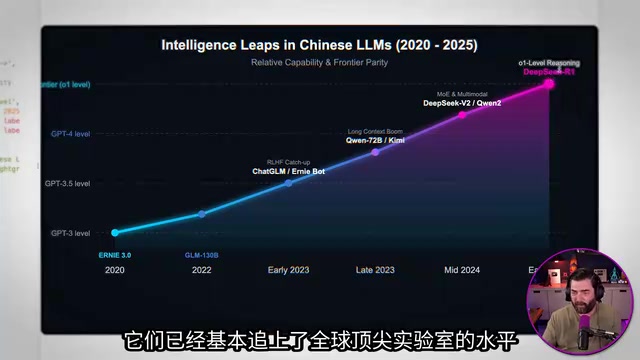
Visualization charts: GLM-5.2 cannot generate images directly, but it can produce charts using HTML/CSS/code. The "Five-Year Intelligence Leap of Chinese LLMs" chart it drew looked quite impressive, approaching the level of GPT-5.5 or Opus.
Hands-On With Agent Frameworks: Where GLM-5.2 Truly Shines
Matt Wolfe likens the model to a "brain," while the agent harness serves as the "body and hands" around it—providing the ability to access files, access the terminal, edit code, run tests, check for errors, and keep working.
The current state of the AI agent framework ecosystem Mainstream frameworks today can be divided into two categories by use case: developer-facing coding agents (such as Cursor, Claude Code, OpenCode, and Aider), whose main scenarios are code generation, refactoring, and debugging—turning the model into an "AI programmer" by providing codebase context, terminal execution permissions, and diff-comparison capabilities; and general-purpose agent frameworks for task automation (such as LangChain, LlamaIndex, AutoGen, and CrewAI), which focus more on multi-step task planning, multi-model collaboration, and tool-call orchestration. GLM-5.2 can now be enabled directly in Cursor and also supports tools like OpenCode. Cursor currently has more than 4 million active users among developers, so being included as a built-in model option means direct access to the most willing-to-pay developer group—a key leap from an "API product" to a "daily developer tool."
Game clone (Megabonk): This was a project he had previously failed to test in a news video. This time, he provided Wikipedia and Steam links as references. The first version was unresponsive, but after about six rounds of prompt iteration, a playable 3D game took shape—jumping, attacking, and mouse-look camera control all worked properly. Although the visuals weren't as good as the paid tool Fable, reaching this level with an open-source model is quite remarkable.

Chrome extension (Page Brief): In about 3 minutes and 42 seconds, it generated a web-page summarization extension that could extract action items and key links and support copying as Markdown. It failed to load the first time, but after feeding a screenshot back to Cursor, it ran successfully on the second attempt.
File organization: When asked to tidy up a cluttered Downloads folder, it categorized all files into corresponding directories—videos, images, documents, apps, audio, etc.—in about 3 minutes and 16 seconds.
Connecting to Real Tools: The MCP Protocol and Skill Automation
The most impressive part was the agent's integration with real-world tools. Before diving into this, it's worth understanding the technical background of the MCP protocol: MCP (Model Context Protocol) is a standardized protocol open-sourced by Anthropic in late 2024, designed to solve the integration problem between AI models and external tools and data sources. Before MCP, every AI application had to implement its own interfaces to various external services, resulting in massive amounts of duplicated "glue code"; MCP defines a unified client-server communication specification, so that external tool developers only need to implement an MCP Server once, and it can then be directly invoked by all MCP-supporting AI models and frameworks. This design is analogous to how the USB standard affected the hardware ecosystem: once the standard is established, the prosperity of the tool ecosystem depends on the number of models and frameworks supporting it, rather than on any single vendor's proprietary interface. GLM-5.2's native support for the MCP protocol means it can directly reuse the existing ecosystem of hundreds of MCP Servers without needing to redevelop tool-adaptation layers, greatly reducing the engineering complexity of connecting agents to real-world tools.
Matt Wolfe integrated the MCP plugin for the meeting-notes tool Granola, having GLM-5.2 "pull Granola meeting notes weekly, identify recurring problems, and build tools as solutions."
The model automatically set up a scheduled task for every Friday at 5 PM and did a trial run on the spot—it scanned two meetings, identified seven problems, and turned three of the solvable ones into actual skills (such as a "same-day short-video script for breaking AI news" and a "Hook Lab" skill dedicated to generating titles in five different styles). When he then invoked Hook Lab to test it, the model indeed produced multiple usable short-video hooks.

He also integrated the Remotion skill to generate animated videos. Although the model can't see images (the image-description service was unstable), it fixed the overlapping-text problem in a bar chart based solely on his text descriptions, ultimately producing a usable animated chart—again achieving this at roughly one-fifth the cost of a frontier lab.
A Smooth Migration Plan for Production Environments
The article closes with a practical tool: Sam Hogan's inference.net gateway. Its logic is: you continue sending traffic to your existing model provider, and the gateway automatically mirrors live traffic to GLM-5.2 for evaluation (mirroring only, without affecting the production environment), then generates an assessment about 24 hours later using a reinforcement-learning model.
The reinforcement-learning evaluation framework here is worth explaining: it typically adopts the "LLM-as-Judge" paradigm—using a more capable model as the judge to score preferences between two models' outputs for the same input, combined with preference models like Bradley-Terry to compute ELO scores, thereby automating the assessment of migration risk without relying on human annotation. The advantage of this method is its ability to adapt to business-specific evaluation needs, but it also has the limitation of "judge bias": the model acting as judge may systematically favor outputs similar to its own style. Even so, for enterprise-level migration decisions, this approach remains more scalable than human evaluation. When the evaluation results are healthy, you receive a Slack notification confirming that it is safe to switch over. This provides enterprises with a zero-risk validation path for migrating from models like Opus to GLM-5.2.
Who Is GLM-5.2 For? A Summary of Use Cases
Matt Wolfe offers an honest assessment: GLM-5.2 is not a model you can mindlessly use for every scenario, and on many tasks it genuinely can't beat Claude, GPT, or Gemini. But it is one of the most worthwhile models to test right now, because it brings together this combination:
- Cheap API
- Open weights
- Massive context window
- Powerful coding capability
- Mature agentic workflows
- Won't be banned by the U.S. government
The core recommendation: if your tasks are long-text, code-intensive, document-intensive, agent-driven, or token-heavy, GLM-5.2 is very likely worth a try, because it can genuinely save you money. As top-tier models become more restricted, more expensive, and harder to access, more and more people will start paying attention to this kind of Chinese open-source large model.
Key Takeaways
Key Takeaways
Related articles

Should U.S. College Fraternities Be Banned? A Researcher's Incisive Observations
Why not just ban U.S. college fraternities? A researcher finds the key resistance comes from decision-makers' own fraternity identities and schools' "willful ignorance."

Microsoft Discovery: Accelerating Scientific Discovery with AI Agents
Microsoft's Discovery platform runs specialized AI agents to help researchers screen and prioritize the most promising compounds and experimental paths, reducing experiments and accelerating scientific discovery.

Cambridge Heavy Industries Secretly Develops Desktop-Scale Nuclear Fusion Device
Cambridge Heavy Industries is secretly developing a desktop-scale laser-driven nuclear fusion device, targeting the equipment supply market for fusion power plants. This article analyzes its miniaturization technology path, commercialization logic, and unique positioning in the fusion startup wave.