The Complete Guide to Prompt Engineering: High-Quality Prompt Design from Beginner to Expert
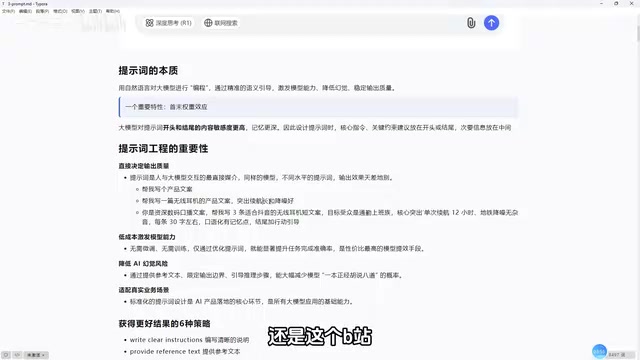
Prompts are the core means of programming large models with natural language, and strategies must be adjusted by model type.
The article systematically explains the nature and value of prompts: prompts are natural-language programming of large models, using precise semantic guidance to elicit capabilities, reduce hallucinations, and stabilize output. Their importance lies in directly determining output quality, eliciting model capabilities at zero cost, reducing hallucination risk, and adapting to real business scenarios. It covers the lasting applicability of OpenAI's six strategies and analyzes the essential differences between reasoning and general models in prompt design—reasoning models favor concise, goal-focused prompts, while general models require explicit reasoning-step guidance. As unified architecture plus adaptive reasoning becomes mainstream, prompt strategies must adjust accordingly. Finally, it proposes five principles for high-quality prompts: specific not vague, complete context, avoid ambiguity, logical coherence, and concise not redundant.
What Is a Prompt? Starting from a Single Sentence
A prompt is essentially the text you send to a large model. Its purpose is to provide the model with task context so it can accurately understand your intent and generate a relevant response. This definition sounds simple, but not many people truly understand it.
In the most straightforward terms: the sentence you send to the model is the prompt. You ask "How do I make braised pork?" and the model replies with cooking steps—that's the simplest possible prompt interaction. But when the task becomes more complex, the prompt needs to become correspondingly more complex, because you need to give the model enough information to understand the full picture of the task.
The essence of prompting is to "program" a large model using natural language. Note that "program" is in quotes—it's not about modifying the model through Python code, but about using precise semantic guidance to elicit model capabilities, reduce hallucinations, and stabilize output.
There's a widely verified characteristic here: the primacy and recency effect. Large models are more sensitive to the beginning and end of a prompt. So you should place core instructions and key constraints at the beginning or end, with secondary information in the middle. However, as model capabilities improve, this effect is weakening—according to observations by a Bilibili creator in a tutorial, the primacy and recency effect was significant on early models, but is no longer as pronounced on today's flagship models.
The primacy and recency effect stems from the attention mechanism of large language models and the distributional characteristics of training data. In the Transformer architecture, the model allocates higher attention weights to the beginning and end positions of a sequence, and key information in training corpora (such as titles and conclusions) often appears at the beginning or end of paragraphs, making the model sensitive to boundaries. This effect was very pronounced on early models like GPT-3.5, where placing core instructions at the end of a prompt significantly improved compliance. But with the development of instruction tuning and long context windows, flagship models have greatly improved their utilization of middle positions, and the strength of the primacy and recency effect has noticeably diminished. Therefore, this technique should be treated as an auxiliary reference rather than an iron rule.
Why Prompts Matter: Four Core Values
Directly Determines Output Quality
Many people use the same model but get vastly different results. The problem often lies in the prompt. For example, if you only write "Help me write some product copy," the model can certainly write something, but will it meet your needs? Most likely not. If you change it to "Help me write product copy for wireless earbuds, highlighting battery life and noise cancellation," the result will be better, but still lacks key information: is the publishing platform Douyin, Bilibili, or Xiaohongshu?
A high-quality prompt should look like this: "You are a seasoned digital voiceover copywriting master. Help me write three short wireless earbud scripts suitable for Douyin. The target audience is commuters. Core highlights are 12-hour battery life and subway noise cancellation with no static. Each script should be around 30 characters, conversational, with a memorable hook, and end with a call to action." The copy written this way is on a completely different level in terms of relevance and usability.
Elicit Model Capabilities at Zero Cost
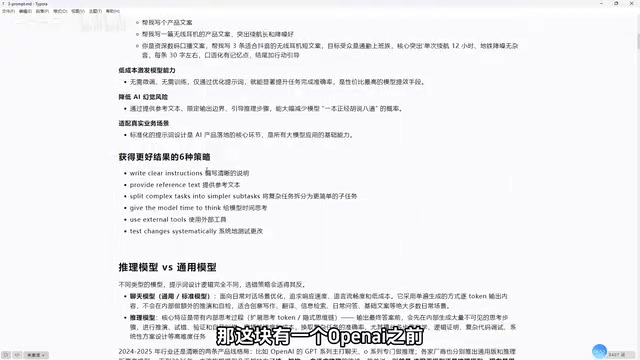
Training a model from scratch can cost tens of millions, fine-tuning a 7B-8B small model still requires GPU resources, and fine-tuning a 70B-level model requires considerable investment in graphics cards alone. Optimizing prompts costs almost nothing—you just need to tweak the text you send to the model to significantly improve task accuracy. This is currently the most cost-effective way to boost model performance.
Reduce Hallucination Risk
By providing reference text, limiting output boundaries, and guiding reasoning steps, you can greatly reduce the probability of the model "confidently making things up." But you must clearly recognize: hallucinations can only be reduced, not completely eliminated. No model currently claims to have completely solved the hallucination problem.
Hallucination refers to a large model generating content that seems plausible but is inconsistent with facts or lacks basis. Its root cause is that the model generates text based on probability distributions rather than verifying against a knowledge base. Hallucinations are divided into factual hallucinations (such as fabricating incorrect dates for historical events) and faithfulness hallucinations (such as deviating from user instructions or reference text). Prompt engineering primarily mitigates hallucinations on three levels: first, providing reference text to anchor the model to given materials; second, limiting output boundaries, such as requiring "if information is insufficient, answer that you don't know"; third, guiding reasoning steps so the model explicitly shows its derivation process, reducing skipped steps and speculation. But note that these methods can only reduce probability, not eliminate it, because the model itself does not have a fact-verification mechanism.
Adapt to Real Business Scenarios
Standardized prompt design is a core part of deploying AI products and a foundational capability for all large model applications. Only by writing good prompts can the model better adapt to real business needs.
OpenAI's Six Strategies: Still Applicable Today
OpenAI once proposed six prompt design strategies: write clear instructions, provide reference text, split complex tasks into simpler subtasks, give the model time to think, use external tools, and systematically test changes. According to the tutorial's analysis, these strategies remain applicable today.
Among them, "provide reference text" corresponds to the few-shot prompting technique, and "use external tools" extends to later function calling and the MCP protocol. These foundational frameworks are not outdated; it's just that improved model capabilities have changed the implementation details.
Key Insight: Prompt Differences Between Reasoning Models and General Models
The Essential Difference Between the Two Types of Models
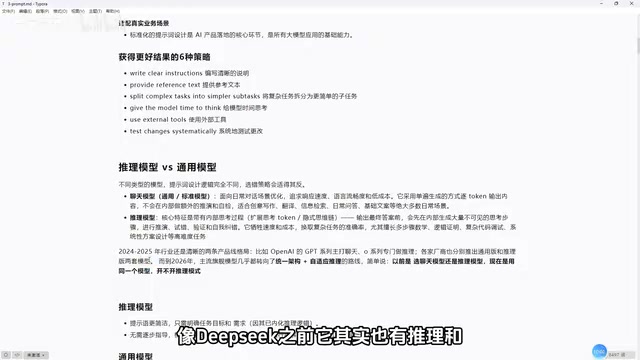
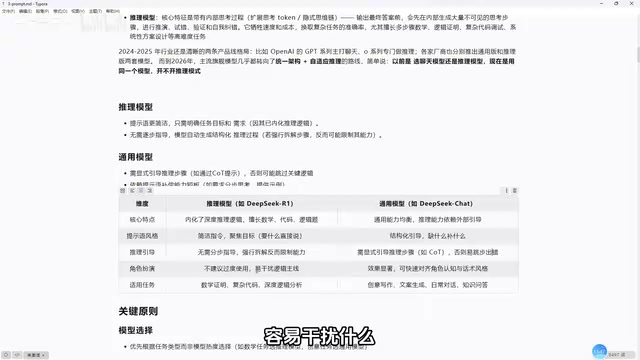
General models (chat models) are optimized for everyday conversation, pursuing speed, language fluency, and low cost. They use single-pass generation, outputting token by token without additional internal reasoning and self-checking, making them suitable for writing, translation, information retrieval, and everyday Q&A.
Reasoning models, on the other hand, have an internal thinking process—an internalized chain of thought (CoT). Before outputting the final answer, they generate a large number of invisible thinking steps, performing deduction, trial and error, verification, and correction. The cost is speed and expense, in exchange for accuracy on tasks like multi-step mathematical reasoning, logical proofs, and complex code debugging.
Chain-of-Thought (CoT) is a technique that lets models explicitly show step-by-step reasoning. By adding "let's think step by step" to the prompt or providing step-by-step examples, it guides the model to generate intermediate reasoning steps before outputting the final answer. CoT can significantly improve accuracy on math, logic, and multi-hop reasoning tasks for general models, because it forces the model to externalize implicit computation as sequence generation, reducing skipped steps and intuitive errors. Reasoning models, however, internalize CoT as an invisible thinking process, automatically generating a large number of internal reasoning tokens before output. Users no longer need to explicitly request step-by-step reasoning. Therefore, using CoT prompts on reasoning models may instead cause redundancy or limit their adaptive reasoning capabilities.
New Changes in the Era of Unified Architecture
The boundary between the two types of models is blurring. According to the tutorial's analysis of API documentation, models from vendors like DeepSeekAd already support switching between thinking/non-thinking modes via parameters, with adjustable thinking intensity (low/medium/high), rather than releasing two separate models as in the past. Judging from information from two independent sources—the tutorial author's API screenshots and model update logs—this trend is certain: unified architecture plus adaptive reasoning is becoming mainstream.
This means prompt strategies must adjust accordingly: for reasoning models, prompts should be more concise, simply specifying the task and requirements without forcibly breaking down steps, as step-by-step guidance may actually limit their reasoning capabilities; for general models, reasoning steps need to be explicitly guided, otherwise they tend to skip steps and make errors—role-play alignment and CoT techniques are both necessary.
The actual cases cited in the tutorial show: for mathematical proof tasks, reasoning models can be directly told "prove the Pythagorean theorem," while general models need "please derive the Pythagorean theorem in three steps." This difference is very obvious in real use.
MCP (Model Context Protocol) is an open protocol proposed by Anthropic, aimed at standardizing how large models connect to external tools and data sources. It allows models to call external resources such as file systems, databases, and APIs through a unified interface, similar to a "USB-C port for AI applications." MCP engineers and standardizes the early OpenAI strategy of "using external tools," so tool calls in prompts no longer depend on vendor-specific proprietary formats. For prompt design, MCP means the model can dynamically obtain context during reasoning, reducing reliance on pre-loading large amounts of reference information in the prompt, but it also requires prompts to clearly describe the intent and constraints of tool usage.
Five Principles of High-Quality Prompts
Be specific, not vague. Avoid abstract expressions; clarify boundaries and requirement standards. "Write a poem" is not as good as "Write a four-line seven-character quatrain on the theme of AI development, in a bold and heroic style."
Complete context. Clearly explain the task background, user identity, and usage scenario. "How do I improve my English score" is not as good as "I'm the parent of a five-year-old kindergartener who can't write yet. How can I make English learning fun for them?"
Avoid ambiguity. Key concepts must be clearly defined. Chinese is rich in synonyms, and the same word may have different meanings in different contexts, so use precise expressions whenever possible.
Logical coherence. The specified order should follow cognitive logic: role first, then task, then requirements, and finally examples. Not every item is necessary, but a clear structure helps the model understand priorities.
Concise, not redundant. Put core information first and remove irrelevant content. Overly long context distracts the model's attention, and since the model's context window is limited, redundant information dilutes the weight of key instructions.
Final Thoughts
The barrier to entry for prompt engineering is low, but the ceiling is high. With the same model, the difference in results from prompts of different quality levels can exceed imagination. When choosing a model, base your decision on task requirements rather than model popularity; when designing prompts, adjust your strategy based on the model type. These two principles are more important than remembering any specific technique.
Related articles
Google's Satellite AI Server Reaches Orbit: Gemma Model Generates First Reply in Space
Google's TPU-equipped satellite powers up in orbit, with the onboard Gemma 4 model generating the first reply from space. This article analyzes the technical path, real-world constraints, and implications for edge computing and satellite remote sensing.
AI Agents for Flight Booking Customer Support: Real Needs and Implementation Challenges
Starting from a real Reddit question, this article breaks down four needs for introducing AI Agents into flight booking call centers: basic Q&A, agent assist, call summarization, and quality inspection, and analyzes accuracy concerns and handoff boundary design.
Vercel Unifies Runtime Cache: Data Cache Merges into Runtime Cache
Vercel merges Data Cache into Runtime Cache, unifying storage quotas and billing for Next.js fetch cache, unstable_cache, getCache, and use cache: remote. Pro and Enterprise projects get more storage, and cache reads/writes are now billed at Runtime Cache pricing.