The Computational Dilemma of Tracking a Small Set of Experts in Online Convex Optimization
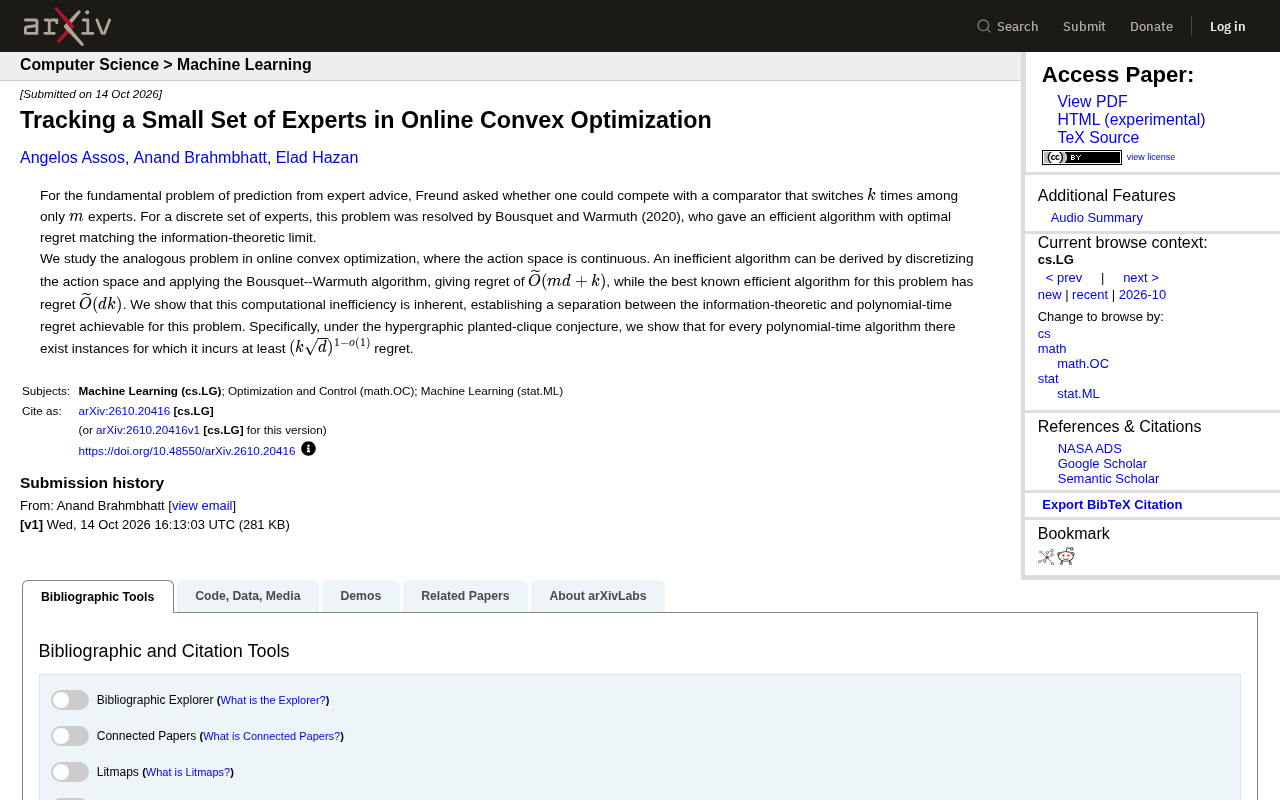
Study proves inherent separation between information-theoretic and computational complexity in tracking switching experts in online convex optimization.
This article examines the core problem of tracking switchable expert sequences in online learning. In discrete settings, the Bousquet-Warmuth algorithm achieves information-theoretic optimal regret $\widetilde{O}(md+k)$ in polynomial time, but continuous action spaces require exponentially many grid points for discretization, and known efficient algorithms have $\widetilde{O}(dk)$ regret. New research under the hypergraphic planted clique conjecture proves a regret lower bound of $(k\sqrt{d})^{1-o(1)}$ for any polynomial-time algorithm, showing the gap is inherent to computational complexity, not algorithm design. The conclusion advises balancing computational and statistical efficiency.
The Computational Dilemma of Tracking a Small Set of Experts in Online Convex Optimization
In online learning, there is a classic question: when a predictor needs to dynamically switch among a set of experts, can it achieve near-optimal predictions with low regret? Freund proposed early on whether an efficient algorithm could compete with a comparator that switches among m experts k times. For discrete expert sets, Bousquet and Warmuth provided an elegant answer in 2020—an efficient algorithm whose regret matches the information-theoretic lower bound. However, when the action space shifts from discrete to continuous in the online convex optimization setting, the problem becomes thorny. A recent study delves into this computational complexity, revealing an essential separation between information-theoretic optimality and polynomial-time achievable regret.
From Discrete Experts to Continuous Actions: The Challenge of Problem Migration
In the discrete expert advice framework, the learner selects an action from m experts each round and aims to compete with the best "switch k times" expert sequence in hindsight. The Bousquet-Warmuth algorithm uses an elegant combinatorial structure to control regret at $\widetilde{O}(md+k)$, matching the information-theoretic lower bound, with polynomial-time computational efficiency.
When the action space becomes a continuous convex set, the natural approach is to discretize the action space and apply the discrete algorithm. This indeed yields $\widetilde{O}(md+k)$ regret, but the number of grid points required grows exponentially with dimension d, making the algorithm infeasible in polynomial time. The best previously known polynomial-time algorithm achieves $\widetilde{O}(dk)$ regret—far above the information-theoretic limit. This leaves a question: is there a smarter polynomial-time algorithm that can bridge the gap?
Online Convex Optimization (OCO) is a core subfield of online learning: each round the learner selects a decision $w_t$ from a convex set $\mathcal{K} \subseteq \mathbb{R}^d$, then suffers a convex loss function $f_t(w_t)$, with the goal of minimizing cumulative regret $\sum_t f_t(w_t) - \min_{w \in \mathcal{K}} \sum_t f_t(w)$. Unlike the discrete expert framework where only a finite number of candidate actions are available, OCO allows continuous values and gradient information, bringing both the convenience of mature algorithms like online gradient descent and follow-the-regularized-leader, and new complexities—the learner must not only choose points but also handle non-stationary environments. The "tracking expert sequences that switch $k$ times" discussed in the article is a typical setting of non-stationary OCO: the comparator can switch among $m$ base expert trajectories $k$ times, corresponding to a piecewise-stationary environment.
Computational Inefficiency is Inherent: Lower Bounds under the Hypergraphic Planted Clique Conjecture
The new research provides a negative answer. The authors prove that, assuming the hypergraphic planted-clique conjecture holds, any polynomial-time algorithm inevitably suffers at least $(k\sqrt{d})^{1-o(1)}$ regret. This means the gap between the information-theoretic optimal regret $\widetilde{O}(md+k)$ and the polynomial-time achievable regret is inherent to computational complexity, not due to insufficient algorithm design.
This lower bound is built on a deep analysis of the problem structure. The hypergraphic planted clique conjecture is a core assumption in average-case complexity theory, often used to prove computational lower bounds for certain statistical estimation and optimization problems. The researchers reduce the expert tracking problem in online convex optimization to this conjecture, thereby establishing computational hardness.
Hypergraphic Planted Clique Conjecture is one of the core assumptions in average-case complexity theory. The classic planted clique problem involves hiding a clique of size $k$ in a random graph $G(n, 1/2)$, requiring an efficient algorithm to recover the clique; substantial evidence suggests that when $k = o(\sqrt{n})$, the problem is unsolvable in polynomial time. The hypergraph version generalizes this to $r$-uniform hypergraphs: planting a $k$-vertex clique in a random $r$-uniform hypergraph (where each $r$-edge appears independently with probability $p$), meaning all possible $r$-edges exist among them. This assumption is often used as a reduction benchmark to prove computational lower bounds for statistical estimation, sparse PCA, tensor decomposition, etc. The logic is: if a polynomial-time algorithm exists that breaks a lower bound, then it can also solve the planted clique problem, thus contradicting the widely accepted conjecture.
Difference between information-theoretic and computational lower bounds: Information-theoretic lower bounds characterize the optimal performance any algorithm (even exponential time) can achieve without computational resource limits, only constrained by data volume, corresponding to $\widetilde{O}(md+k)$ in this problem. Computational lower bounds further assume the algorithm must run in polynomial time, yielding typically larger bounds. If a gap exists between them, it is called the information-computation gap. This concept has been widely used in average-case complexity theory for high-dimensional statistics, matrix recovery, community detection, etc. The result proved in the article shows that under the hypergraphic planted clique conjecture, the OCO problem of tracking switching experts also has an essential gap, i.e., the gap between statistical optimality and computational feasibility is not an algorithm design flaw but due to the problem's inherent computational hardness.
Significance and Implications of the Separation Result
This separation result has important implications for online learning theory. It shows that even in seemingly simple continuous convex optimization settings, pursuing competition with the best switching strategy may face computational barriers. This reminds practitioners: when dimension d is large and switching times k is non-negligible, methods relying on discretization or exact optimization may be unrealistic, requiring a reassessment of the trade-off between algorithm efficiency and regret.
Moreover, this conclusion echoes a series of recent computational lower bound works in online learning and online convex optimization, further confirming the widespread phenomenon that "statistical optimality does not necessarily imply computational feasibility." For designing practical algorithms, accepting $\widetilde{O}(dk)$-level regret or seeking additional structural assumptions may be more pragmatic directions.
Key Points
- In online convex optimization, tracking expert sequences that switch k times exhibits a separation between information-theoretic and computational complexity.
- Discretization methods can achieve $\widetilde{O}(md+k)$ regret but with computational cost growing exponentially with dimension.
- Under the hypergraphic planted clique conjecture, the polynomial-time algorithm regret lower bound is $(k\sqrt{d})^{1-o(1)}$, proving inherent computational inefficiency.
- Known efficient algorithms have $\widetilde{O}(dk)$ regret, significantly gap from the information-theoretic limit.
- This result provides theoretical boundaries for online learning algorithm design, suggesting the need to balance computational and statistical efficiency.
One-line Summary
Research proves an inherent separation between information-theoretic and computational complexity in tracking switching experts in online convex optimization.
Paragraph Summary
This article explores the core problem of tracking switchable expert sequences in online learning. In the discrete expert setting, the Bousquet-Warmuth algorithm achieves information-theoretic optimal regret $\widetilde{O}(md+k)$ and is polynomial-time feasible. However, when the action space becomes continuous, discretization methods maintain this regret but require exponentially many grid points; known efficient algorithms have $\widetilde{O}(dk)$ regret, far inferior to the information-theoretic limit. New research under the hypergraphic planted clique conjecture proves a regret lower bound of $(k\sqrt{d})^{1-o(1)}$ for any polynomial-time algorithm, indicating this gap is inherent to computational complexity, not due to insufficient algorithm design. The conclusion reminds practitioners to balance computational and statistical efficiency, echoing the widespread phenomenon that "statistical optimality does not necessarily imply computational feasibility."
Related articles

iPhone Duo Hands-On: Is the $2,000 Small-Screen Foldable Worth It?
YouTube's Allison shares her iPhone Duo hands-on: dual-screen multitasking doubles efficiency, great video viewing, nice matte finish—but thick body, small outer screen, and a $2,000 luxury price.

Sentry's Ad Cracks Up Developers: Can On-call Actually Be Fun?
Sentry's ad short film taps into developers' on-call anxiety, using humorous dialogue to showcase its observability platform—errors, logs, traces, metrics, replays, and releases in one place.

LLM App Getting Worse With Every Change? Build an Effective Evaluation System in Three Steps
How do you know if your LLM app is getting better or worse? A Reddit-based guide to test sets, automated regression evaluation, LLM-as-judge scoring, and structured agent tracing.