The Control-Flow Tax: How Specialized Decision Models Cut Costs and Boost Efficiency for LLM Agents

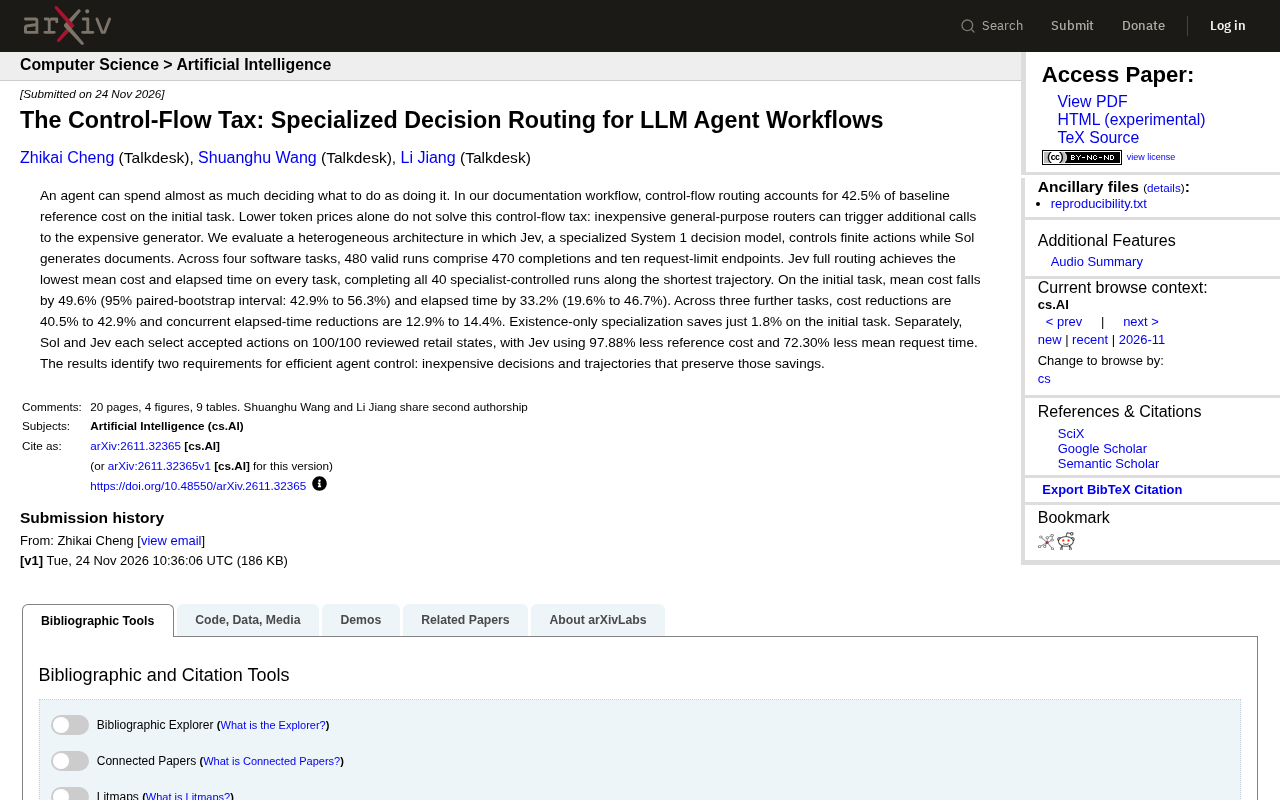
Research shows control-flow routing accounts for 42.5% of agent costs; specialized decision model Jev nearly halves costs without hurting decision quality.
The article covers research on LLM agent cost structure, finding that control-flow routing—deciding "what to do next"—accounts for 42.5% of baseline cost in document workflows, forming a structural "control-flow tax" that lower token prices cannot fix. Inspired by dual-process theory, researchers propose a heterogeneous architecture where specialized model Jev handles routing and generative model Sol handles content. Across 480 runs on four tasks, full routing achieved the lowest cost and latency, cutting initial-task cost by 49.6% and latency by 33.2%; specialized models not controlling routing saved only 1.8%. Retail tests showed comparable accuracy (100/100) with 97.88% lower cost.
The Control-Flow Tax: How Specialized Decision Models Cut Costs and Boost Efficiency for LLM Agents
When building LLM agents, we tend to focus on the quality of generated content while overlooking a hidden cost sink: deciding what to do next. Recent research reveals that in document workflows, control-flow routing accounts for a staggering 42.5% of the baseline reference cost for initial tasks. This means agents spend nearly half their compute on "thinking about the process" rather than "executing the task."
The Control-Flow Tax: The Hidden Killer of Agent Efficiency
The research team calls this phenomenon the "Control-Flow Tax." In a traditional single-model architecture, the same large language model is responsible for both generating documents and deciding the next action. This design looks clean but causes expensive generative models to be invoked repeatedly for simple routing judgments.
Worse, simply lowering token prices doesn't solve the problem. On the contrary, a cheap general-purpose router may trigger more calls to the expensive generator—like a money-saving navigation app that keeps steering you onto higher-toll routes. According to the study, the cost waste under this architecture is structural, not a pricing issue.
Control Flow in the context of LLM agents refers to the decision process by which the agent determines "what to do next" at each step, including which tool to call, which subtask to enter, and whether to terminate the loop. It is the counterpart of "content generation": the former is process orchestration, the latter is actual output. In typical ReAct or Plan-and-Execute paradigms, each routing decision requires a full LLM forward inference, and generative models have large parameter counts and long contexts, so a single call consumes far more tokens than a simple classification task. Thus, when routing steps recur throughout a trajectory, their cumulative cost quickly amplifies, forming the so-called "tax." Understanding this distinction is a prerequisite for evaluating agent cost structure: optimizing generation quality only affects the execution segment, whereas the control-flow tax acts on every loop iteration and has a multiplier effect.
Baseline Reference Cost is the cost benchmark used in the paper for cross-comparison, typically referring to the average token cost or converted dollar amount recorded when a single generative model performs all control-flow and generation tasks without any architectural optimization. The 42.5% mentioned in the study is the proportion of the control-flow routing portion relative to this baseline. The use of "paired bootstrap" interval estimation is to provide confidence intervals for cost differences when the sample size is limited (480 runs), avoiding the chance of single-point estimates. When interpreting reductions such as 49.6%, readers should recognize that these numbers are relative values against the baseline architecture, not absolute dollar amounts; actual savings will vary with model pricing and task length.
Heterogeneous Architecture: Dividing Labor Between System 1 and System 2
Inspired by dual-process theory in cognitive science, researchers propose a heterogeneous architecture: a specialized decision model Jev (System 1) handles control-flow routing over a limited action space, while the generative model Sol (System 2) focuses on document generation.
The core insight of this division of labor is that control-flow decisions are usually bounded, repetitive pattern-recognition tasks that don't require a massive generative model. As a dedicated "decision routing expert," Jev can make these judgments at extremely low cost.
The experiment covered four software tasks with 480 valid runs in total, including 470 completions and 10 request-limit endpoints. Results show that the Jev full-routing mode achieved the lowest average cost and latency on every task, completing all 40 expert-control runs with the shortest trajectories.
Dual-Process Theory originates from cognitive psychology and was popularized by Daniel Kahneman: System 1 refers to fast, automatic, intuitive pattern recognition, while System 2 refers to slow, deliberate reasoning that requires working memory. In LLM agent design, this metaphor is used to distinguish two types of computation: routing decisions are often high-frequency, low-complexity, and enumerable (e.g., "should the current state call retrieval or writing?"), suitable for a small model to complete quickly; whereas document generation and multi-step reasoning require the capacity and contextual understanding of a large model. The key to a heterogeneous architecture is not simply making the model smaller, but allocating computation according to task nature, so that the System 1 model only handles classification over a limited action space, thereby avoiding waste of large models on low-value judgments. This idea resonates with engineering practices such as Mixture of Experts (MoE) and cascading inference, but places greater emphasis on the separation of responsibilities between control flow and generation flow.
Existence-Only Specialization refers to a system that, although deploying a specialized small model, does not actually let it take over routing decisions—it serves only as an existence check or auxiliary component. In the study, this mode saved only 1.8%, indicating that the source of benefit is not "having a small model" per se, but that the small model must be on the critical path of control flow and genuinely replace the large model in making routing judgments. This controlled experiment rules out the naive explanation that "smaller models save money" and emphasizes the importance of architectural role allocation: specialization must occur at the decision point, otherwise its impact on total cost is negligible.
Significant Cost Reduction and Efficiency Gains
The data speaks for itself. On initial tasks, average cost dropped by 49.6% (95% paired bootstrap interval: 42.9% to 56.3%), and latency decreased by 33.2% (interval: 19.6% to 46.7%). On the other three tasks, cost reductions ranged from 40.5% to 42.9%, and concurrent latency decreased by 12.9% to 14.4%.
A key finding: existence-only specialization saved only 1.8% on initial tasks. This shows that merely "having a specialized model" is not enough; the specialized model must genuinely control routing decisions to unlock the full benefit.
Retail State Validation: Decision Quality Does Not Suffer
Does cost reduction come at the expense of decision quality? The research team gives a negative answer in the retail state test. Sol and Jev both selected accepted actions on 100/100 evaluated states, but Jev used 97.88% less reference cost and reduced average request time by 72.30%.
This set of data reveals an important fact: in specific decision scenarios, a specialized small model can not only drastically reduce costs but also maintain decision accuracy comparable to a large generative model.
Retail State Evaluation is a controlled evaluation scenario used in the paper to test decision quality. It typically constructs a series of states (such as orders, inventory, customer-service dialogue context) and requires the agent, given a state, to choose from a candidate action set an action that is accepted by expert review. A 100/100 pass rate means Jev and Sol made consistent and approved choices across all evaluated states, thereby proving that the cost reduction is not at the expense of decision correctness. Note that the action space in such tests is finite and predefined, which is precisely the precondition for a specialized decision model to be competent; in scenarios with open action spaces requiring creative judgment, the generalization ability of specialized models still needs additional validation. Therefore, this result should be understood as evidence of effectiveness under the specific condition of "limited-action control flow," not as a universal guarantee for all agent tasks.
Two Necessary Conditions for Efficient Agent Control
The study ultimately distills two major requirements for efficient agent control:
- Cheap decisions: Control-flow routing must be handled by a specialized, low-cost model to avoid invoking the expensive generator.
- Savings-preserving trajectories: The agent's execution path must maintain these cost advantages, avoiding additional expensive calls triggered by poor routing.
These two conditions complement each other. If decisions are cheap but trajectory design is poor, the savings will be consumed by subsequent extra calls; if trajectories are excellent but decision costs are high, overall efficiency remains limited.
Implications for Agent Architecture Design
This research offers new ideas for the architecture design of LLM agents. While pursuing stronger generation capabilities, we may need to re-examine the paradigm of "one model does it all." Decoupling control-flow decisions from content generation and using specialized models for the former may be the necessary path to efficient agents.
For teams building agent applications, this means the cost structure of control flow should be considered early in architecture design, rather than seeking optimization only when the bill skyrockets. After all, deciding what to do and actually doing it should not be handled by the same expensive "brain."
One-line Summary
Research reveals control-flow routing accounts for 42.5% of agent costs; specialized decision model Jev can nearly halve costs without compromising decision quality.
Paragraph Summary
The article introduces research on the cost structure of LLM agents, pointing out that in document workflows, control-flow routing—deciding "what to do next"—accounts for 42.5% of the baseline reference cost for initial tasks, forming a structural "control-flow tax" that simply lowering token prices cannot solve. Inspired by dual-process theory, researchers propose a heterogeneous architecture: a specialized decision model Jev handles routing over limited actions, while the generative model Sol focuses on content generation. Across 480 runs on four software tasks, the full-routing mode achieved the lowest average cost and latency, cutting initial-task cost by 49.6% and latency by 33.2%; merely deploying a specialized model without letting it control routing saved only 1.8%. In retail state tests, Jev and Sol had comparable decision accuracy (100/100), but Jev's reference cost was 97.88% lower. The article thereby distills two necessary conditions for efficient agent control: cheap decisions and savings-preserving trajectories.
Related articles

Nothing CMF Buds 2A Drops to $17.89 on Black Friday: A New Low for ANC Earbuds
Nothing CMF Buds 2A wireless earbuds Black Friday deal: just $17.89 on Amazon, about $11 off retail and a record low. ANC earbuds at an entry-level price.

When AI Creation Gets Accused of "Spitting": Hacker News Heats Up Over the Glaude Controversy
A Hacker News post, "Spitting in the Face of Glaude," sparks debate on AI creation transparency and attribution ethics. This analysis examines the blurred creator identity behind the controversy and offers practical advice for AI content production.

Akai Embraces Custom Firmware: MPC Sample 1.4 Lets Users AI-Program Their Sampler
Akai embraces the modding community with MPC Sample 1.4 firmware, supporting vibe-coded custom firmware and effects. We analyze the impact of this open strategy on music hardware and AI-assisted programming.