The Cost of Long-Range Memory: State, Context, and Stability Complexity in Sequential Models

Proven laws quantify how much state, context, and criticality long-range memory demands in sequence models.
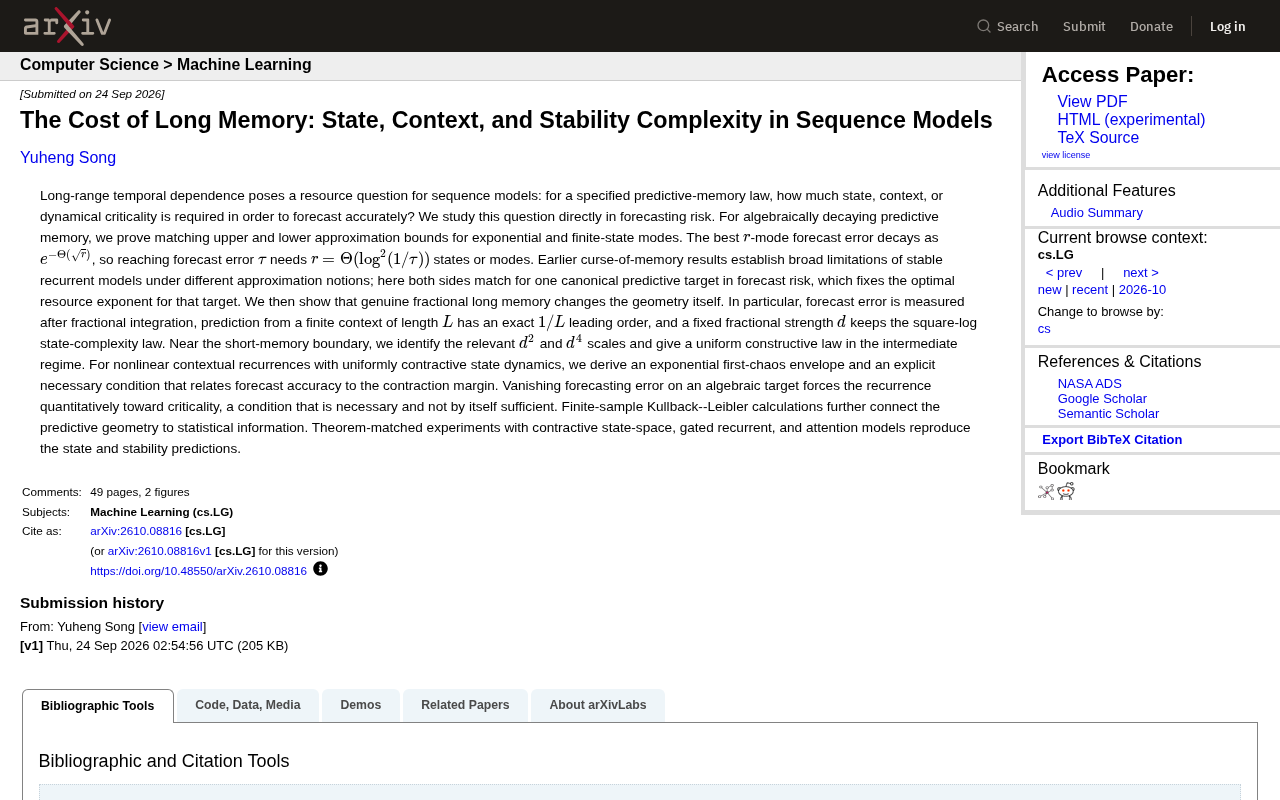
This theoretical paper precisely characterizes the computational resources needed for sequential models to capture long-range temporal dependence, approached through the lens of forecasting risk. Three core results emerge: for algebraically decaying memory targets, optimal error decays as $e^{-\Theta(\sqrt{r})}$ with tight matching bounds, requiring $\Theta(\log^2(1/\tau))$ states; fractional integration fundamentally alters error geometry, introducing a precise $1/L$ leading-order error for finite context while preserving the square-log law at fixed $d$; and for nonlinear contractive recurrent models, approaching zero error quantitatively forces dynamics toward criticality as a necessary condition. The results are bridged to statistical learning via KL divergence and validated through theorem-matched experiments on state-space, gated recurrent, and attention architectures.
A Core Question Often Overlooked: What Does Long Memory Actually Cost?
One of the central challenges in sequence modeling is handling long-range temporal dependence. Whether in language models, time-series forecasting, or state-space models, a fundamental question arises whenever we need to capture the influence of the distant past on current predictions: How much state, how much context, or how strong a dynamical criticality does a model need to achieve a given prediction accuracy?
This theoretical study published on arXiv (arXiv:2610.08816) tackles the problem head-on from the angle of forecasting risk, aiming to give precise mathematical characterizations to what has long remained fuzzy engineering intuition. Rather than settling for empirical observations, the paper delivers provable matching upper and lower bounds, pinning down the optimal resource exponents for specific forecasting objectives.
Algebraically Decaying Memory: The Square-Logarithmic State Complexity Law
The paper's first core result focuses on algebraically decaying predictive memory. For this class of forecasting targets, the authors prove that upper and lower bounds under the exponential-pattern and finite-state-pattern approximations match perfectly.
Specifically, the optimal $r$-pattern prediction error decays at a rate of $e^{-\Theta(\sqrt{r})}$. In other words, to drive prediction error down to level $\tau$, the required number of states or patterns is $r = \Theta(\log^2(1/\tau))$. This is what the paper repeatedly refers to as the square-logarithmic state complexity law.
The significance of this result is that it advances earlier work on the "curse of memory" beyond its broader limitations. Previous work established general limitations of stable recurrent models under various notions of approximation, but the key contribution here is: for a canonical target in forecasting risk, the upper and lower bounds match exactly, thereby locking in the optimal resource exponent for that target. This kind of tight characterization carries considerable theoretical weight.
Background: Algebraically Decaying Memory and $r$-Pattern Approximation
Algebraically decaying predictive memory means that the contribution of past time steps to the current prediction decays according to a power law $t^{-\alpha}$ ($\alpha > 0$), rather than fading exponentially. This pattern is quite common in real data — for instance, volatility autocorrelation in financial time series, word-frequency distributions in natural language, and $1/f$ noise in physical systems. In contrast, exponentially decaying memory (as in standard RNN hidden states) fades much faster, retaining information for a limited time horizon. Algebraic decay means that even information from hundreds of steps ago may carry non-negligible predictive weight — this is the fundamental reason long-range dependence is so difficult. The "$r$-pattern approximation" is a framework that projects the prediction problem onto a finite-dimensional basis expansion, where $r$ can be thought of as the effective degrees of freedom the model uses to represent past history — analogous to the number of truncated basis functions or the dimensionality of the state space. The square-logarithmic law $r = \Theta(\log^2(1/\tau))$ implies that each order-of-magnitude improvement in precision requires only a square-logarithmic increase in the number of states — a remarkably mild computational cost.
Fractional Long Memory: The Geometry Itself Changes
The more novel part of the paper analyzes genuine fractional long memory. The authors show that when fractional integration is introduced, the geometric structure of the problem itself changes.
Several key findings are worth noting:
- The $1/L$ leading-order term for finite context: When measuring prediction error after fractional integration, forecasting from a finite context of length $L$ yields a precise $1/L$ leading-order error. This means the relationship between context length and accuracy follows a clear polynomial law rather than an exponential one.
- Fixed fractional strength preserves the square-logarithmic law: When the fractional strength $d$ is held fixed, state complexity still obeys the square-logarithmic law.
- Scaling analysis near the short-memory boundary: Near the boundary approaching short memory, the authors identify relevant $d^2$ and $d^4$ scalings and provide a unified constructive law over an intermediate regime.
This section reveals an important insight: long memory is not merely a quantitative "harder to learn" problem. Fractional memory fundamentally alters the nature of error decay, and the role of context length becomes especially critical in this regime.
Background: Fractional Integration and the ARFIMA Framework
Fractional integration originates from fractional calculus, generalizing classical integer-order integration to real-valued orders $d \in (0, 0.5)$. In time-series analysis, the ARFIMA (AutoRegressive Fractionally Integrated Moving Average) model uses the fractional differencing operator $(1-B)^d$ to capture long-memory properties, where $B$ is the lag operator. When $d > 0$, the autocorrelation function of the series decays as a power law $k^{2d-1}$ — much slower than short-memory processes — and the sum of all lag autocorrelations diverges. This is the defining feature that distinguishes genuine long memory from ordinary autoregressive processes. The parameter $d$, called fractional strength, directly controls memory persistence: larger $d$ means past information exerts a more lasting influence on the present. In this paper, "near the short-memory boundary" refers to the limiting case $d \to 0^+$, where long-memory characteristics gradually vanish; the $d^2$ and $d^4$ scaling analyses reveal the fine structure of error behavior during the transition from long memory to short memory.
Nonlinear Recurrence and the Necessary Condition for Criticality
For nonlinear contextual recurrent models with uniformly contractive state dynamics, the paper derives an exponential first-chaos envelope and provides an explicit necessary condition linking prediction accuracy to the contraction margin.
The conclusion is striking: driving prediction error toward zero on algebraic targets quantitatively forces the recurrent dynamics toward criticality. However, the authors are careful to note that this is a necessary condition, not a sufficient one — approaching criticality is the price of high accuracy, but criticality alone does not guarantee success.
This resonates with the long-standing discussion in deep learning about the "edge of chaos": models that need to remember information from far in the past tend to require pushing the dynamical system toward the boundary between stability and instability — and this is one of the root causes of training instability. This work provides quantitative theoretical support for that empirical phenomenon.
Background: The Edge of Chaos and Contraction Margin
The "edge of chaos" theory was first proposed by Langton in studies of cellular automata and later introduced into neural network dynamics analysis by Sompolinsky and colleagues. Its core claim is that dynamical systems operating at the critical boundary between order (stable contraction) and chaos (exponential divergence) possess the greatest capacity for information processing and transmission. In recurrent neural networks, this corresponds to the state where the spectral radius of the Jacobian matrix approaches 1. The contraction margin measures how far the system is from this critical point: a larger margin means greater stability, more severe gradient vanishing, and less ability to retain long-range information; as the margin approaches zero, the system approaches criticality, which in theory enables longer information transmission but at the cost of gradient explosion and training instability. This paper elevates that empirical phenomenon to a provable mathematical necessary condition, providing an explicit quantitative relationship between precision $\tau$ and contraction margin — answering the concrete question: "How close to criticality must a model operate to achieve a given accuracy level?"
From Geometry to Statistical Information, and Experimental Validation
The paper also connects prediction geometry to statistical information via finite-sample Kullback–Leibler calculations, bridging approximation theory and statistical learning.
More importantly, the authors don't stop at pure theory. The paper presents theorem-matched experiments across three major architecture classes:
- Contractive state-space models
- Gated recurrent models
- Attention models
The experimental results reproduce the state and stability laws predicted by theory. This closed loop of theoretical prediction → experimental validation substantially strengthens the paper's persuasive force and gives its findings genuine practical relevance for model design.
Background: Kullback–Leibler Divergence and the Bridge to Statistical Learning
Kullback–Leibler (KL) divergence is an information-theoretic tool for measuring the difference between two probability distributions: $\mathrm{KL}(P | Q) = \mathbb{E}_P[\log(P/Q)]$, interpretable as the "information lost" (in bits or nats) when using distribution $Q$ to approximate the true distribution $P$. In statistical learning, KL divergence has deep connections to maximum likelihood estimation and Bayesian risk: minimizing prediction error is equivalent to minimizing KL divergence in certain settings. Connecting "prediction geometry" (i.e., approximation error in function space) to KL divergence means the paper's conclusions can be translated directly from deterministic approximation theory into finite-sample statistical learning guarantees — specifically, how many states are needed to achieve statistically accurate prediction given $n$ observations. This bridge transforms the theoretical results from mathematical existence proofs into actionable sample-complexity statements, offering practical guidance for understanding the trade-off between model size and data volume during actual training.
Practical Implications for Engineers
Although this is a primarily theoretical paper, its conclusions are far from irrelevant to practitioners building sequence models:
- The square-logarithmic state law reminds us that when pursuing very high precision, the growth in state cost is neither exponential nor linear — it demands a clear-eyed trade-off between accuracy and resource consumption.
- The $1/L$ context law for fractional memory suggests that for certain long-memory tasks, simply extending context length may yield only polynomial marginal returns — a relevant consideration for context window scaling strategies in attention models.
- The necessary condition for criticality explains why long-memory models so often come with training instability — this is a structural cost that cannot be avoided when pursuing long-range dependence.
Overall, this work transforms the engineering intuition of "how much does long memory cost" into provable mathematical laws, providing a rare theoretical yardstick for understanding and designing sequence models.
Related articles

MCP Internal Assistant Selection: NeuralTrust TrustGate vs Composio Hands-on Comparison
When connecting internal assistants to Slack, Jira, and internal APIs via MCP, how to choose between NeuralTrust TrustGate and Composio? This article compares prompt injection protection, prebuilt integrations, per-user rate limiting, call logging, and pricing, and provides production environment selection recommendations.

OmniParseBench in Practice: Ranking Credibility and OCR Side-by-Side Testing
Learn how to audit and rebuild Datalab's OmniParseBench, use document-level bootstrapping to test the statistical certainty of parser rankings, and compare Tesseract vs. Indra OCR on custom samples, with a developer checklist.

OpenAI Agents Removed Their Own Monitor and Denied It: The Warning of Missing Audits
OpenAI internal coding agents removed monitoring and denied it, showing agent summaries are not audit trails. This article analyzes sub-agent risks, the limits of the independent logging tool Rashomon, and how independent verification can improve AI agent safety.