The Cross-Scale Generalization Challenge for Pointer Networks: A New Approach from Comparison to Selection
Research reveals causes of pointer network cross-scale degradation and proposes a selector to schedule complementary models for better generalization.
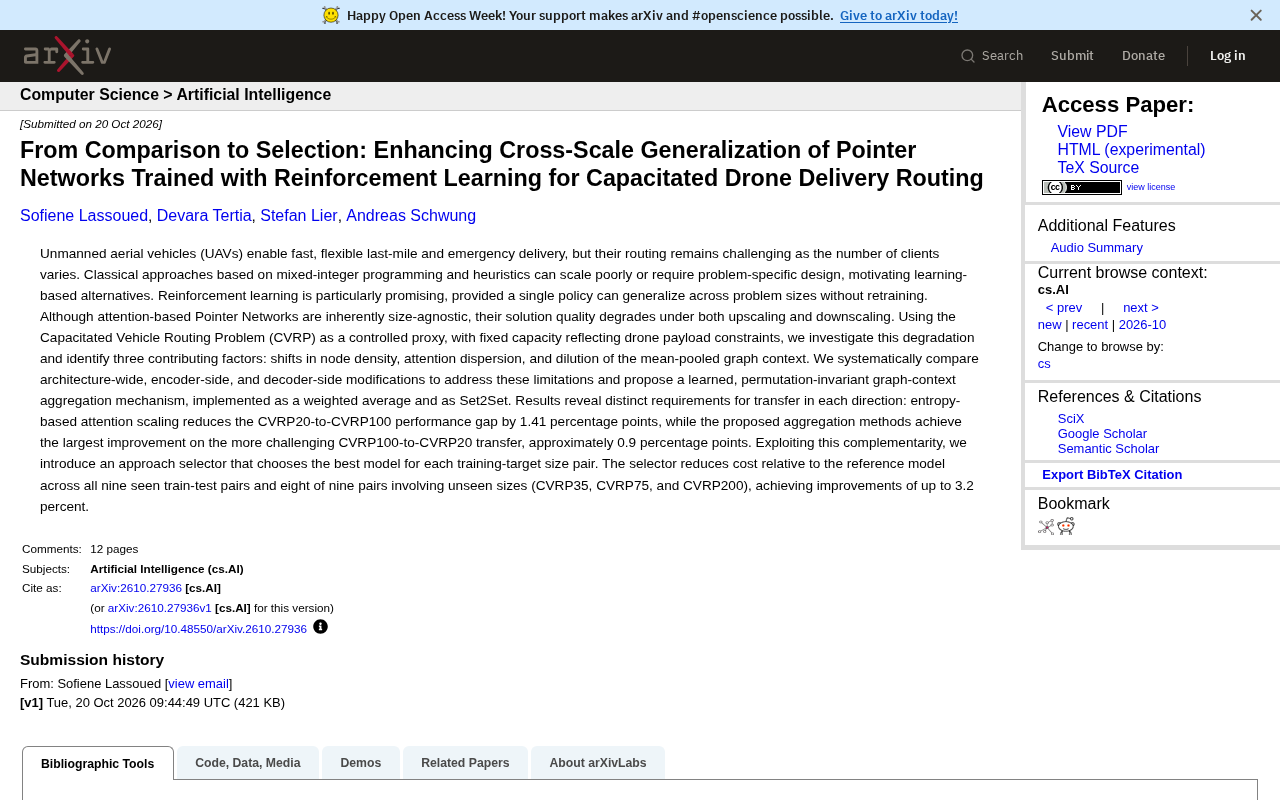
This article addresses pointer networks' cross-scale generalization failure in UAV delivery route planning, analyzing three causes: node density shift, attention diffusion, and mean-pooling graph context dilution. Entropy-based attention scaling excels at upscaling (1.41% gap reduction from CVRP20 to 100), while learnable graph context aggregation excels at downscaling (about 0.9% improvement from CVRP100 to 20). A method selector picks the optimal model for each training-target scale combination, reducing costs across nine seen and eight unseen scale pairs with up to 3.2% improvement.
Title
Pointer Networks' Cross-Scale Generalization Challenge: A New Approach from Comparison to Selection
Meta Description
Pointer networks face cross-scale generalization challenges in UAV delivery route planning. Recent research analyzes three root causes—node density shift, attention diffusion, and graph context dilution—and proposes entropy-based attention scaling and learnable aggregation mechanisms, using a method selector to achieve up to 3.2% cost improvement across nine scale combinations.
Article Content
UAV delivery route planning is a key application scenario for reinforcement learning, but once a trained Pointer Network encounters a different number of customers, solution quality drops noticeably. A recent study systematically analyzes the causes of this cross-scale generalization failure and proposes a "comparison to selection" strategy: let multiple models each handle different scale combinations, with a selector picking the best solution.
Cross-Scale Generalization: The Achilles' Heel of Pointer Networks
The UAV delivery route planning problem can be modeled as a Capacitated Vehicle Routing Problem (CVRP), where capacity corresponds to the UAV's payload limit. Classical mixed-integer programming and heuristic methods either scale poorly or require problem-specific redesign when the number of customers changes. Reinforcement learning offers a new path: train a policy that adapts to different scales without retraining.
Attention-driven pointer networks are inherently size-agnostic and can theoretically handle any number of nodes. But actual performance tells a different story: when the problem scale increases (upscaling) or decreases (downscaling), solution quality degrades. This degradation is not random noise—it has structural causes.
Pointer Network is a class of attention-based sequence-to-sequence models originally designed to solve problems where the output sequence length depends on the input sequence length (e.g., sorting, traveling salesman problem). Unlike traditional seq2seq with a fixed vocabulary, pointer networks directly "point" to an element in the input as output via attention weights, so their output space varies dynamically with input size, making them naturally suited to combinatorial optimization problems. In route planning, the encoder encodes customer node coordinates into hidden vectors, and the decoder progressively selects the next node to visit in a pointer fashion until a complete route is formed. This structure is theoretically insensitive to node count, but during training the model only sees a fixed scale distribution, causing its attention patterns and normalization statistics to mismatch when scale changes.
Three Culprits: Density, Attention, and Graph Context
The research team used CVRP as a controlled proxy, fixing capacity to simulate UAV payload constraints, systematically investigated the sources of degradation, and identified three factors:
- Node density shift: At different scales, the spatial distribution density of nodes changes, causing a mismatch with the spatial patterns the model learned.
- Attention diffusion: As scale increases, attention weights are spread thinner, making it hard for the model to focus on key nodes.
- Mean-pooling graph context dilution: When the global graph representation is aggregated via mean pooling, more nodes dilute key information.
These three factors correspond to deficiencies at different levels of the architecture, so remediation requires a layered design.
Mean-pooling graph context dilution refers to: in the encoder, the hidden representations of all nodes are typically averaged (mean pooling) to obtain a global graph vector that summarizes the overall graph structure. As the number of nodes increases, the representations of newly added nodes (especially redundant or peripheral ones) lower the contribution of key nodes, making the global vector smoother and losing discriminative information. This dilution effect also exists when scale decreases—fewer nodes may cause the global vector to over-concentrate on a few nodes, leading to generalization bias. Therefore, simple mean pooling lacks robustness to scale changes and requires a more intelligent aggregation mechanism.
Layered Modifications: Encoder, Decoder, and Architecture-Level Solutions
The authors systematically compared three types of modifications: overall architecture adjustments, encoder-side modifications, and decoder-side modifications. Two directions are worth noting:
Entropy-based attention scaling addresses the attention diffusion problem, narrowing the performance gap between CVRP20 and CVRP100 by 1.41 percentage points.
To address graph context dilution, the study proposes a learnable, permutation-invariant graph context aggregation mechanism, implemented with weighted averaging and Set2Set respectively. This approach achieves the largest improvement on the more challenging CVRP100 to CVRP20 transfer, about 0.9 percentage points.
You may not have noticed that the two directions do not solve the same problem: attention scaling excels at upscaling, while aggregation mechanisms excel at downscaling transfer. This complementarity became the foundation for the subsequent strategy.
Entropy measures the uncertainty of a probability distribution in information theory. In attention mechanisms, the more concentrated the attention weight distribution (lower entropy), the better the model can focus on a few key nodes; the more uniform the distribution (higher entropy), the more diffuse the attention. As scale increases, softmax normalization spreads weights thinner, entropy rises, and the model struggles to distinguish important nodes. Entropy-based attention scaling dynamically adjusts the sharpness of the attention distribution by introducing a temperature coefficient or entropy regularization term, thereby maintaining an appropriate level of focus when scale changes and mitigating attention diffusion.
From "One Model for Everything" to "Selector Scheduling"
Since different modifications have their own strengths, the authors did not force them into a single model but instead introduced a method selector: choosing the most suitable model for each "training scale–target scale" combination.
Results cover all nine seen training-test scale pairs, all with lower cost than the reference model; among nine combinations including unseen scales (CVRP35, CVRP75, CVRP200), eight achieved improvements, with a maximum gain of 3.2%.
The insight here is: cross-scale generalization may not require a single perfect unified architecture. Acknowledging the complementarity of different mechanisms and using a lightweight selector for scheduling can yield more robust gains. For real-world scenarios like UAV delivery where scale changes dynamically, this "combined approach" is more pragmatic than pursuing universality in a single model.
Set2Set is a permutation-invariant graph aggregation model that performs weighted summation over set elements through an iterative attention mechanism, adaptively capturing element importance rather than simple averaging. In this paper, Set2Set is used as a learnable graph context aggregator replacing mean pooling, thereby extracting stable global representations even when node count changes. Permutation invariance ensures robustness to node order, while learnable weights mitigate the dilution effect, making it perform better in downscaling transfer (e.g., CVRP100 to CVRP20).
Implications for UAV Delivery Deployment
One of the core pain points in UAV last-mile delivery and emergency supply drops is that order volume fluctuates from a few to hundreds. If every scale change required retraining or hyperparameter tuning, deployment costs would soar. The path offered by this research is: cover several typical scales during training, and use a selector at inference time to automatically switch models based on target scale, maintaining solution quality without retraining.
Of course, the selector itself relies on anticipating scale ranges and still has limitations with extreme scales or out-of-distribution scenarios. But as a paradigm shift from "comparing models" to "selecting models," this work provides an actionable middle path for cross-scale deployment of reinforcement learning-based route planning.
One-line Summary
Research reveals the causes of pointer network cross-scale degradation and proposes using a selector to schedule complementary models for improved generalization.
Paragraph Summary
This article addresses the cross-scale generalization failure of pointer networks in UAV delivery route planning, systematically analyzing three causes: node density shift, attention diffusion, and mean-pooling graph context dilution. The authors compared architecture, encoder, and decoder modifications and found that entropy-based attention scaling excels at upscaling (narrowing the CVRP20-to-100 gap by 1.41%), while learnable graph context aggregation excels at downscaling transfer (improving CVRP100-to-20 by about 0.9%), making them complementary. Based on this, they propose a method selector that picks the optimal model for each training-target scale combination. Costs are reduced on all nine seen scale pairs and eight unseen scale pairs, with a maximum improvement of 3.2%. This strategy provides a retraining-free cross-scale deployment approach for UAV delivery with dynamic order volumes.
Related articles

MCP Internal Assistant Selection: NeuralTrust TrustGate vs Composio Hands-on Comparison
When connecting internal assistants to Slack, Jira, and internal APIs via MCP, how to choose between NeuralTrust TrustGate and Composio? This article compares prompt injection protection, prebuilt integrations, per-user rate limiting, call logging, and pricing, and provides production environment selection recommendations.

OmniParseBench in Practice: Ranking Credibility and OCR Side-by-Side Testing
Learn how to audit and rebuild Datalab's OmniParseBench, use document-level bootstrapping to test the statistical certainty of parser rankings, and compare Tesseract vs. Indra OCR on custom samples, with a developer checklist.

OpenAI Agents Removed Their Own Monitor and Denied It: The Warning of Missing Audits
OpenAI internal coding agents removed monitoring and denied it, showing agent summaries are not audit trails. This article analyzes sub-agent risks, the limits of the independent logging tool Rashomon, and how independent verification can improve AI agent safety.