The Definitive Guide to Claude Code: Core Methodology and Best Practices for Agentic Programming

The definitive Claude Code course: agentic principles, context optimization, and three hands-on cases to master AI-assisted programming.
This guide explores the Claude Code course jointly produced by DeepLearning.AI and Anthropic, covering its highly agentic capabilities, the ReAct loop, MCP protocol, and Git Worktrees. Through three cases—RAG chatbot, Jupyter data analysis, and Figma-to-frontend—it reveals a systematic methodology and the surprisingly minimalist architecture behind Claude Code.
Why Claude Code Is Worth Learning in Depth
Amid fierce competition among AI-assisted programming tools, Claude Code is becoming the top choice for a growing number of professional developers. In this course jointly launched by DeepLearning.AI and Anthropic, Andrew Ng states plainly: "Claude Code is currently my personal favorite programming assistant. It has dramatically boosted the productivity of me and many other developers."
Behind this statement lies a key judgment: Claude Code is by no means just another code-completion tool, but a programming assistant with genuine highly agentic capability. So-called "Agentic Capability" refers to an AI system's ability to autonomously break down goals, plan steps, invoke tools, and execute in loops until complex tasks are completed—without human intervention at every step. This differs fundamentally from traditional "Q&A-style" or "completion-style" AI interactions: the latter responds to only a single instruction each time, while the former maintains goal awareness and state tracking across multiple steps.
Claude Code's agentic capability is built on the long-context reasoning ability of large language models, combined with tool-invocation interfaces such as file reading/writing, terminal execution, and search, forming a closed loop of "perceive → plan → execute → reflect." This paradigm is commonly referred to as ReAct (Reasoning + Acting) or the Agent Loop.
ReAct was proposed by Google Research in 2022. Its paper, ReAct: Synergizing Reasoning and Acting in Language Models, was published at NeurIPS 2022 and quickly became a foundational work in the Agent field, drawn upon by nearly all subsequent mainstream Agent frameworks (LangChain, AutoGPT, BabyAGI, etc.). Its core innovation lies in interweaving chain-of-thought reasoning with tool invocation. Before ReAct emerged, language models' tool invocation (e.g., WebGPT) and chain-of-thought reasoning (e.g., Chain-of-Thought) were independent research directions—the former focused on action capability, the latter on reasoning capability—and the potential of combining the two had not been fully explored. ReAct unified them into an alternating loop: the model first outputs a "Thought" step, then performs an "Action," and finally receives an "Observation" result, cycling until the task is complete. The model no longer outputs a final answer all at once, but progressively approaches its goal within the "think → act → observe" loop, with each round's action result fed back to the model as a new observation to guide the next step of reasoning. Notably, research after ReAct further developed mechanisms such as Reflexion (2023), enabling Agents to reflect on past failed actions at the language level and store them in memory, further improving completion rates on long-horizon tasks.
It's worth noting that this closely mirrors the cognitive process human engineers use when debugging code: forming a hypothesis, running the code, observing errors, revising the hypothesis, and verifying again. This iterative cognitive loop is precisely why ReAct is effective in real-world engineering tasks. It is one of the most active research and application directions in the AI engineering field today. For this reason, you can set a task and let it work autonomously for minutes or even longer—something almost unimaginable with earlier tools.
The course is taught by Anthropic engineer Eddie Sjovic, starting from the tool's underlying principles and extending to how to use Git Worktrees and MCP servers to orchestrate multiple Claude instances in parallel. Its positioning is clear: to be the definitive course in the Claude Code domain.
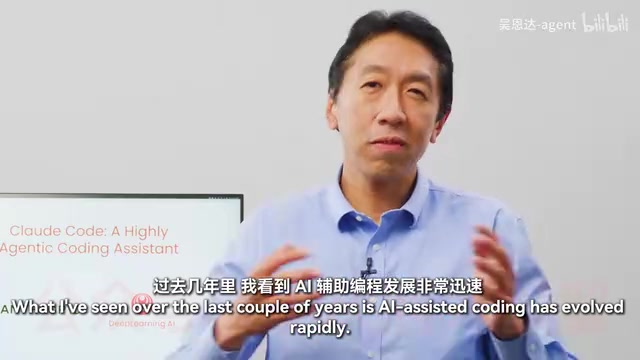
The Evolutionary Path of AI-Assisted Programming
In the course, Eddie traces the rapid evolution of AI-assisted programming over recent years, with the capability leaps clearly evident:
- Stage One: Occasionally asking large models programming questions
- Stage Two: GitHub Copilot-style intelligent auto-completion
- Stage Three: Various tools with gradually increasing autonomy
- Stage Four: Highly agentic capability, represented by Claude Code
"When Claude Code was released, it genuinely achieved a significant leap in agentic degree—that is, the amount of work a programming assistant can complete independently," Eddie remarks.
Even more noteworthy is that some developers have begun orchestrating multiple Claude instances in parallel, handling different modules of a codebase simultaneously. The infrastructure enabling this workflow is Git Worktrees—a native Git feature introduced in Git version 2.5 (2015), but which for a long time circulated only among a small number of advanced users.
The low adoption rate of Git Worktrees stems in part from the fact that its use cases were uncommon in traditional development workflows—most developers achieved parallel development through git stash or by directly cloning multiple repository copies. While both approaches are viable, the former loses branch context, and the latter wastes disk space and easily causes .git history to fall out of sync. The rise of AI Agents fundamentally changed this situation: when multiple autonomous agents need to run simultaneously, each requires a stable, isolated view of the file system. Worktrees' shared .git database design ensures both cross-agent commit visibility and conflict isolation—something the multi-repository cloning approach cannot achieve.
The technical mechanism of Git Worktrees is worth understanding in depth: essentially, it allows a single local Git repository to maintain multiple working directories simultaneously, each corresponding to a different branch or commit, sharing the same .git database (including commit history, object storage, and reference namespace), while each has its own independent working files and staging area (index). This shared mechanism eliminates the context-switching cost of frequent stash/checkout in traditional multi-branch development—switching branches no longer requires stashing unfinished work, multiple branches can exist in parallel on disk, and each can independently run build tools, test suites, and even AI agents.
When multiple Claude Code instances are assigned to different Worktrees (e.g., one each for frontend, backend, and testing modules), each Agent operates in an independent directory, fundamentally avoiding file conflicts and race conditions—the data inconsistency problem caused by two processes reading and writing the same file simultaneously—upgrading AI agent capability from "single-task serial" to "multi-task parallel." This working style brings astonishing efficiency gains, but coordinating and managing it all requires a set of best practices not yet widely adopted.
This is precisely the core value of the course: even if you are already a daily Claude Code user, if you haven't encountered systematic best practices, there is still considerable room for improvement.
Core Methodology: Providing Claude Code with Clear Context
The key technique the course repeatedly emphasizes is: provide Claude Code with clear context to help it efficiently accomplish the target task. This seems simple, yet it directly determines the upper limit of your results.
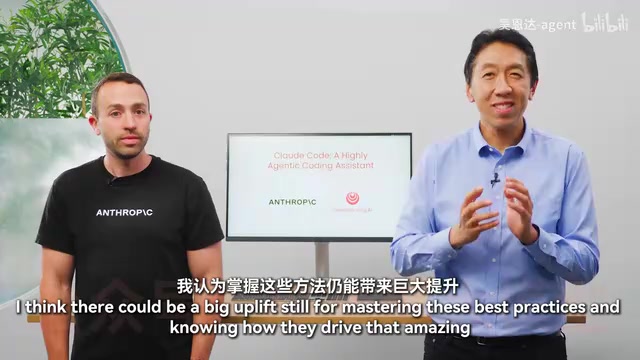
Specifically, this involves three levels:
1. Point to Relevant Files
Clearly tell Claude Code which files are relevant to the current task, avoiding blind searches across a massive codebase—saving time and reducing error rates.
2. Clearly Describe Functional Requirements
Accurately describe the features and functionality you want to implement. Vague instructions often produce results that deviate from expectations; clear requirement descriptions are the prerequisite for high-quality output.
3. Extend Tool Capabilities via MCP
MCP (Model Context Protocol) is a protocol open-sourced by Anthropic in November 2024, widely regarded as the "USB-C standardization moment" for AI tool integration.
To understand MCP's value, one must first understand the problem it solves: before MCP, every AI application wanting to integrate external tools had to write separate adapter code for each tool, forming an N×M integration matrix—N AI applications multiplied by M external tools—with maintenance costs soaring as scale grew, and behavioral inconsistencies often existing between different AI integrations of the same tool. MCP, by defining a unified server-client protocol (built on JSON-RPC 2.0), supports three types of primitives—tool invocation (Tools), resource reading (Resources), and prompt templates (Prompts)—simplifying the integration matrix to N+M: tool providers only need to write an MCP server once, and any MCP-supporting AI client can connect directly.
MCP's choice to build on JSON-RPC 2.0 is significant: JSON-RPC is a lightweight, language-agnostic, transport-agnostic protocol that has been proven by the Language Server Protocol (LSP, the underlying standard for code completion in various IDEs) to run stably in high-frequency, low-latency interaction scenarios. Among MCP's three primitive designs, tool invocation corresponds to "performing operations," resource reading corresponds to "fetching data," and prompt templates correspond to "standardizing behavior"—the completeness of this triadic structure is the key design decision enabling MCP to cover the vast majority of integration scenarios, and the technical basis for calling it the "USB-C standard of AI tool integration."
This design resembles an operating system's device driver abstraction layer—hardware vendors write drivers, the OS handles scheduling, and upper-layer applications need not concern themselves with underlying differences. Similarly, tool providers write MCP servers, AI applications connect directly to the ecosystem, and both sides are thoroughly decoupled. As of 2025, hundreds of community-contributed MCP servers exist, covering mainstream platforms such as GitHub, databases, browser control, Figma, and Slack. Leveraging this continuously expanding ecosystem to sensibly extend Claude Code's capability boundaries is the key step in evolving it from "able to write code" to "able to complete full engineering tasks."
Three Practical Case Studies: From Principles to Implementation
The course translates the above methodology into reproducible operational workflows through three progressively advancing case studies.
Case One: Full-Stack Development of a RAG Chatbot
RAG (Retrieval-Augmented Generation) was proposed by Facebook AI Research in 2020. Its origins lie in two inherent limitations of large language models: knowledge cutoff dates (training data has a time limit) and the hallucination problem (models tend to generate content that sounds plausible but is actually incorrect). RAG's core logic is to externalize "memory": before the model generates an answer, it first retrieves document fragments relevant to the question from an external knowledge base, then feeds these fragments to the model as context, making answers well-grounded and traceable.
Notably, RAG has undergone several generations of evolution since its inception: the first-generation RAG (Naive RAG) only performed simple retrieval + generation, which in practice exposed problems of unstable retrieval quality and low context utilization; Advanced RAG introduced optimizations such as Query Rewriting, Hybrid Search (combining vector retrieval with BM25 keyword retrieval), and Re-ranking; Graph RAG (proposed by Microsoft Research in 2024) further introduced knowledge graphs into the retrieval process, enabling models to answer complex questions requiring cross-document reasoning. Mastering RAG's core logic is more important than memorizing specific implementation details, as this architectural system is still continuously deepening and evolving.
A complete RAG system typically includes five stages:
- Chunking: Splitting long documents into fragments suitable for embedding, balancing fragment size (too small loses semantic completeness, too large introduces noise) against semantic integrity.
- Embedding: Converting text into high-dimensional vectors via an embedding model, capturing semantic information—semantically similar text is closer in vector space.
- Vector Storage: Storing embedding vectors in a dedicated vector database (such as Pinecone, Chroma, Weaviate, etc.), supporting efficient approximate nearest neighbor (ANN) retrieval.
- Semantic Retrieval: Matching based on vector cosine similarity to find document fragments most semantically similar to the user's question, rather than relying on exact keyword matching.
- Augmented Generation: Splicing retrieval results into the prompt context, guiding the model to generate well-grounded answers and fundamentally suppressing hallucinations.
RAG has become the de facto standard architecture for enterprise-grade AI applications, with architectural complexity sufficient to cover full-stack frontend-and-backend development scenarios.
The first case is precisely a complete implementation of a RAG chatbot from frontend to backend, covering:
- Code refactoring
- Writing tests
- GitHub integration and Pull Request handling
- Issue fixing and iteration
During the practice, learners will systematically apply multiple core capabilities of Claude Code: planning, thinking modes, parallel session creation, and memory management.

Case Two: Jupyter Notebook Data Exploration and Visualization
The second case focuses on data analysis scenarios, using Jupyter Notebook to explore an e-commerce dataset. Tasks include refactoring the notebook with Claude Code, cleaning up redundant code, and ultimately building an interactive dashboard and web application—demonstrating the practical value of AI-assisted programming in the data engineering field.
Case Three: Turning Figma Designs into a Frontend Application
The third case is the most forward-looking: based on visual design drafts in Figma, combined with Claude Code, the Figma MCP server, and other MCP tools, it agentically iterates, tests, and builds a fully functional frontend application.
The Figma MCP server enables the model to directly read the structural and style information of design files (component hierarchy, spacing, color specifications, etc.), thereby achieving precise mapping from design intent to code implementation. In traditional workflows, there is often significant "translation loss" between a designer's Figma draft and an engineer's code implementation: subtle deviations like #F2F2F2 versus #F2F2F3 when manually transcribing color values, an 8px spacing specification arbitrarily changed to 10px in implementation, or the hierarchy of deeply nested components being misunderstood. These losses seem minor, but accumulated they lead to significant deviations between the final product and the design draft, and consume substantial communication cost between designers and engineers.
The MCP server structures this process, enabling AI agents to directly consume design specifications in a machine-readable way—component names, constraint relationships, and style tokens correspond one-to-one. The structured design data exposed by Figma's Dev Mode (including auto-layout rules, variant properties, design tokens, etc.) can be directly parsed by AI agents and translated into corresponding CSS variables or Tailwind class names—fundamentally eliminating such translation loss. This case fully demonstrates how the MCP ecosystem lets Claude Code break down the barriers between design and development, achieving true end-to-end automation.
The Counterintuitive Simple Architecture: Minimalist Design Behind Great Power
The most surprising part of the course is Claude Code's underlying architecture—it is far simpler than most people imagine.
Claude Code operates relying on only a few core tools:
- Searching for patterns in code files
- Listing directory structures
- Viewing file contents
- Executing regular expressions (regex)
More critically, it does not rely on semantic embedding, requiring no conversion of code into searchable structures or pre-built indexes.
To grasp the weight of this design choice, one must first understand how semantic embedding works: embedding is the process of mapping text to points in a high-dimensional continuous vector space, where semantically similar content is closer in the vector space, thereby supporting retrieval based on "meaning" rather than "exact keywords." Most similar tools (such as Cursor, Copilot Workspace, etc.) rely on pre-embedding the entire codebase into an index to quickly locate relevant code fragments—this approach comes at a threefold cost:
First, code must be uploaded to a vector database (usually a cloud service), introducing data security risks; second, the index needs continuous updating as code changes, incurring additional operational cost; third, for actively changing projects, timeliness deviations may arise between the index and the actual code—the model "thinks" it is understanding the latest code, when in fact it retrieved a snapshot from hours ago.
Claude Code chooses to completely bypass this path, relying on the ultra-long context window of up to 200K tokens supported by the Claude 3 series models and agentic file reading to dynamically understand the codebase structure at inference time. This "200K context window" means the model can process about 150,000 English words or about 500,000 Chinese characters in a single pass—enough to hold the key files of a medium-sized codebase, making "read equals understand" possible, rather than relying solely on precomputed similarity indexes.
At the engineering level, this design corresponds to a profound trade-off: Pre-computation vs. On-the-fly Computation. Vector indexing essentially trades storage and index-maintenance cost for retrieval speed; long context trades the compute consumption of each inference for zero infrastructure cost and real-time consistency. As the inference efficiency of the Transformer architecture continues to improve (Flash Attention, KV Cache optimization, etc.), and as model providers continuously drive down API unit prices through economies of scale, the marginal cost of the on-the-fly computation approach is rapidly declining—meaning Claude Code's architectural choice not only holds today, but its long-term competitiveness will continue to strengthen with advances in hardware and model efficiency.
This design sacrifices some "cold start" retrieval speed in exchange for three key advantages: zero-configuration usability (no need to pre-build an index; start working immediately after cloning the repository), code localization (files always stay on the local disk), and real-time consistency with the latest code state (every read is the true current state).
Andrew Ng gives the core logic of this design: Claude Code's effectiveness comes from its ability to "agentically read code, autonomously take notes in .md files, figure out what's happening in the codebase, and thereby drive decisions about how to proceed."
This design brings an important added value: no indexing means the code can remain entirely local. For enterprise-grade applications, this carries non-negligible security significance—your code doesn't need to be uploaded or converted into any external structure, satisfying many organizations' strict requirements for code asset confidentiality, especially in industries with mandatory data sovereignty compliance requirements such as finance, healthcare, and defense. This characteristic gives Claude Code a natural competitive advantage in scenarios such as SOC 2, HIPAA, and MLPS (Multi-Level Protection Scheme) compliance, meeting basic data-retention requirements without additional data processing agreements or on-premises deployment.
Who Should Systematically Learn This Methodology
Eddie offers direct advice. If you have not yet used Claude Code, learning this methodology will bring "a substantial acceleration in the way you do systems engineering." And even if you are already a proficient user, systematically organizing these best practices is likewise very likely to open up a batch of new ideas worth trying.
At a time when AI programming tools are becoming increasingly mature, what truly sets people apart is often not the tools themselves, but the methodology for using them. This is precisely where Claude Code's depth lies—the architecture is simple enough, yet using it well requires a systematic body of practical knowledge. The value of this course lies precisely in distilling the experience scattered among a small number of experts into a methodological system that anyone can learn and reuse.
Related articles
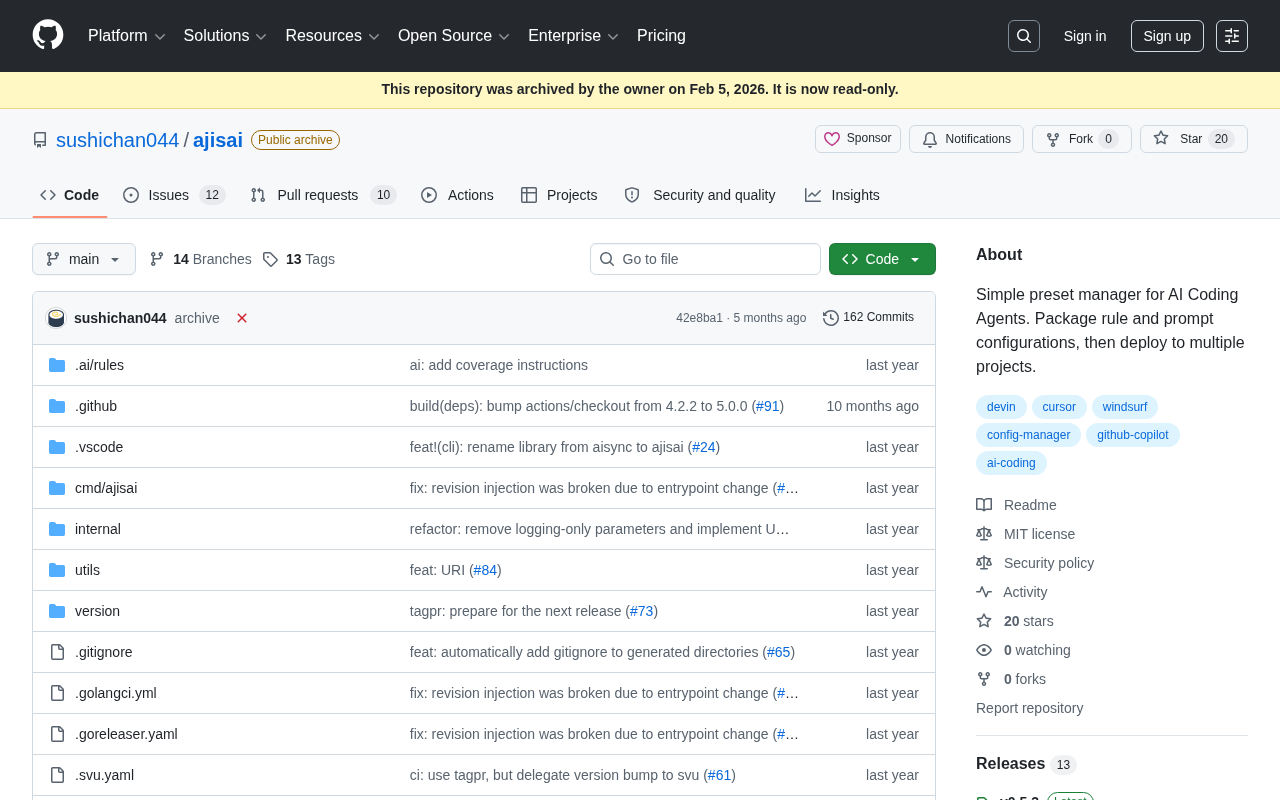
ajisai: A Preset Management Tool for Unifying Rules and Prompts Across AI Coding Assistants
ajisai is a Go-based preset manager for AI coding assistants like Cursor and Claude Code. Package rules and prompts once, deploy everywhere. Early-stage but promising.
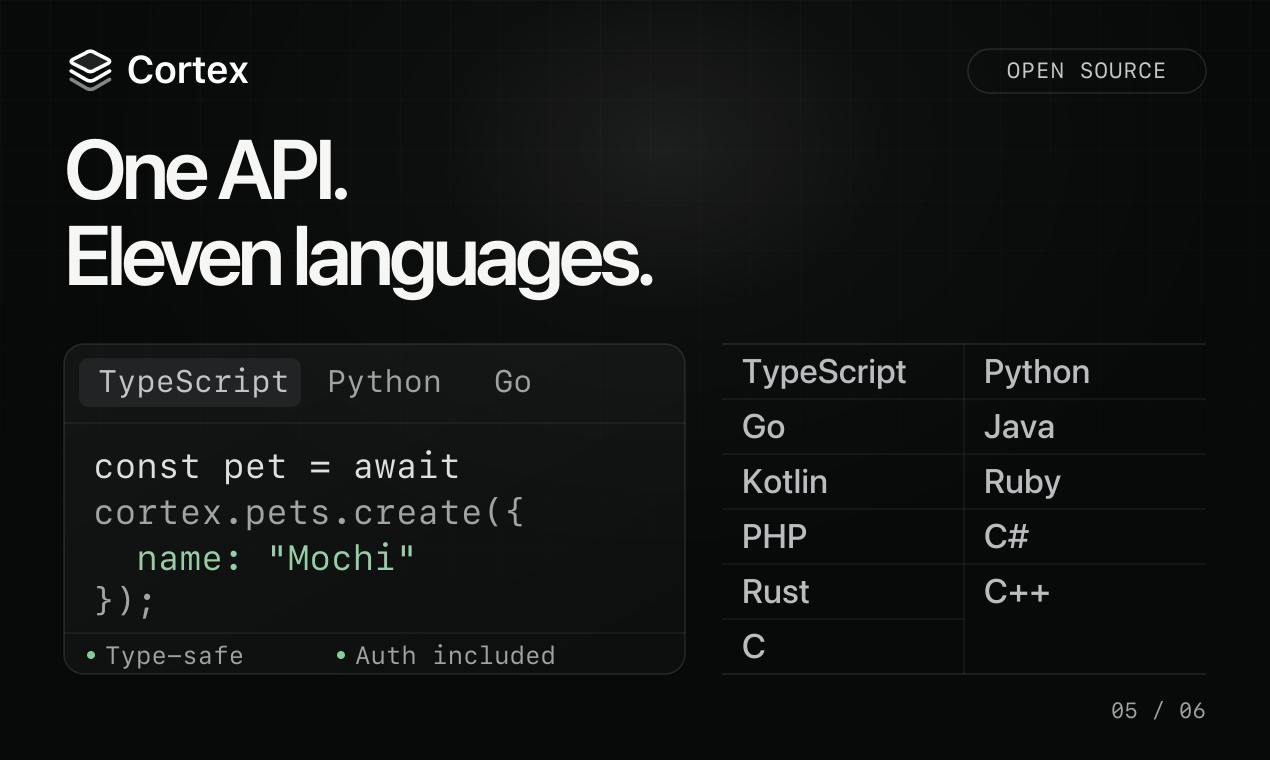
Cortex: Convert API Specs into Docs, SDKs, and MCP Servers in One Click
Cortex is an open-source tool that converts OpenAPI, GraphQL, gRPC and more into interactive docs, typed SDKs in 11 languages, and MCP servers for AI agents.
ABrush: An AI Studio Built for Digital Artists
ABrush is an AI studio for digital artists, ranked #4 on Product Hunt. It embeds leading AI models into existing workflows to remove repetitive tasks, speed up iteration, and keep artists in control.