The Economics of Immortality: How Will Value Be Reconstructed When Time Is No Longer Scarce?

When humanity achieves immortality, meaning and purpose become the ultimate economic frontier.
Drawing on an SFIA video, this article examines immortality's sweeping impact on economics and society. Immortality could be achieved via biomedicine, mind uploading, cryonics, or post-death reconstruction — each producing distinct economic landscapes. Patent law and compulsory licensing suggest life-extension therapies could eventually become cheap; digital immortality allows top talent to self-replicate, eliminating skilled-labor scarcity and shifting bottlenecks to computing and physical resources. As lifespans stretch from centuries to billions of years, career mobility stagnates, wealth consolidates in "immortal landlords," and ultra-long-horizon investments regain value. Even tiny annual mortality rates accumulate into high probabilities over millennia, making the long-lived extremely risk-averse. When physical survival is no longer scarce, meaning, purpose, and novel experience become the core economic commodities of an immortal society.
When the Scarcest Resource Stops Running Out
Economics begins with scarcity. And among all forms of scarcity, the most fundamental may be time — its countdown is merciless for everyone. But what if humanity one day breaks free from the shackles of death? When "time" is no longer a consumable, what happens to the entire value system of society?
This is the central question explored in a deep-dive video by SFIA (Science & Futurism with Isaac Arthur). When people talk about immortality, they tend to focus on the personal level — cheating death, witnessing the turn of centuries, watching the stars grow old. But once immortality shifts from myth to reality, it collides head-on with everything we know about society, wealth, labor, meaning, and progress.
This analysis is not a romantic fantasy. It is a serious thought experiment: if people no longer die, how will the rules of economics be rewritten?
Four Paths to Immortality
The video begins by clarifying what "immortality" actually means. In practical terms, it typically refers to three states: not aging, not dying, or resurrection after death. The path taken will shape radically different civilizations.
Biological Immortality: From Medicine to Nanobots
The first default path is biological — using medicine, genetic editing, cellular repair, or nanotechnology to indefinitely extend human lifespan. You could still die from trauma or disease, but no longer from time itself.
The video details a "hierarchical fabrication" concept built around nanobots: laboratories produce millimeter-scale machines, which are sent to regional centers to manufacture smaller versions, scaling down layer by layer until micrometer-scale repair bots enter cells, hijack ATP production, and rebuild the body from within. This tiered design deliberately avoids the runaway nightmare of "self-replicating" machines — any machine capable of self-replication should be strictly contained in a laboratory, ideally off-Earth and fitted with nuclear safeguards.

A key insight here is that the technology's goal isn't merely to extend lifespan, but to extend "vitality and youth." Maintaining a healthy body is far easier than repairing a failing one, so younger people will actually reach a stable, healthy state faster than the elderly.
Nanobots in a medical context typically refer to devices in the 1–100 nanometer range capable of performing specific tasks inside the human body. The field remains in early research stages, with existing achievements including nanoparticles for targeted drug delivery and in-vitro cell manipulation. The "hierarchical fabrication" scheme described in the video — producing progressively smaller machines from millimeter-scale devices — is designed to circumvent the "grey goo" risk: if nanobots could self-replicate and spread uncontrolled, they could theoretically convert all matter into copies of themselves within a very short time. This catastrophic scenario was proposed by physicist Eric Drexler in Engines of Creation (1986) and has since become a central topic in nanotech ethics. The logic of hierarchical fabrication is that each tier of machines can only produce the next, smaller tier — but cannot replicate itself — fundamentally breaking the chain of runaway replication. ATP (adenosine triphosphate) is the cell's primary energy currency; the video's mention of nanobots "hijacking ATP production" means directly tapping into the cell's metabolic system to power repair work without an external power source.
Digital Immortality: Mind Uploading and Subscription-Based Life
The second path is post-biological — copying, simulating, or transferring consciousness to a digital substrate, turning the mind into software. This path raises the sharpest economic and legal questions.
The video poses a clever dilemma: if you create a backup copy of yourself as a precaution, but it is accidentally activated due to a false report of your death while you are still alive — now there are two "yous," each with equal legal claims to all your assets. Regardless of whether it is philosophically "really you," from an economic standpoint it is definitely someone, requiring storage space, computing power, and technical maintenance.
This means the cost of digital immortality looks more like cloud hosting fees: you might pay "rent" for processor cycles, bandwidth, and memory allocation. Want to live at faster-than-real-time speeds? Pay for more CPU time. This is an "Immortality as a Service" subscription model.
Mind uploading faces the fundamental philosophical challenge of "personal identity." The mainstream debate centers on two positions: the "psychological continuity theory" holds that as long as memories, personality, and cognitive patterns are preserved, the uploaded digital entity is "you"; while the "biological continuity theory" insists that physical continuity of the body constitutes identity, and uploading merely creates a precise copy — the original "you" still dies with the body. Philosopher Derek Parfit analyzed fission and replication scenarios in depth in Reasons and Persons (1984), concluding that in certain cases, "identity" itself may not be the most important question — what matters is whether sufficient psychological continuity exists. The "two of you" legal dilemma raised in the video is a real-world manifestation of this philosophical problem: the existing legal system is built on the premise of a unique, continuous legal person, and was never designed for the possibility that the same consciousness could simultaneously exist in two substrates. Inheritance law, marriage law, and contract law would all face fundamental challenges.
Cryonics and Reconstruction: The Deferred Investment
Cryonics is about "skipping over time" rather than enduring it. The video astutely points out that from an economic perspective, cryonics is actually very familiar — it is essentially a long-term investment with deferred returns, carrying risks of market collapse, institutional bankruptcy, and unclaimed revival.
There is also a more radical "reconstruction" path: using memory backups, DNA, and personality profiles to reconstruct a "you" after death. This gives rise to a new service economy — immortality becomes a premium product purchased after death, provided by companies specializing in "resurrection," involving redundant storage, identity archiving, and memory forensics. This is effectively an "identity continuity industry."
How Immortality Rewrites the Rules of Economics
When lifespans break the boundaries of imagination, economics will shift its focus from quarterly growth and year-end reports to "cosmic-scale sustainability" spanning empires and eons.
Patents and Accessibility: Immortality Doesn't Have to Be Expensive
Dystopian sci-fi loves to depict life-extension therapies so expensive that ordinary people cannot afford them. But the video counters this "dramatization bias" with the practical logic of patent law: U.S. utility patents typically expire 20 years from the filing date, so even if life-extending therapies generate enormous profits, their inventors cannot monopolize the market forever.
More importantly, there is the mechanism of "compulsory licensing" — in emergencies such as pandemics or natural disasters, governments can authorize third parties to manufacture patented products without the patent holder's consent. A therapy that demonstrably extends life would almost certainly qualify. Therefore, beyond the first generation or two of prototype technologies, life-extension therapies could become as cheap as over-the-counter drugs or multivitamins.
The Collapse of the Labor Market: When Experts Can Copy Themselves
Digital immortality delivers the most profound shock to labor economics. The video points out: if the solar system's best engineer can legally make 100 copies of themselves, each copy possessing the same century of training and experience, then "skilled labor" will no longer be a scarce factor of production. The bottleneck will shift to computing power, electricity, machinery, reputation, and physical resources.
An exceptionally capable person could become an entire company overnight. The impact on the economics of education and wages goes far beyond simply "swapping salaries for server bills."
This scenario is directly related to the disappearance of the "skill premium" in economics. A core finding of current labor economics is that automation more readily replaces routine labor, while the wage premium for high-skill, creative work continues to rise because such abilities are hard to replicate. Digital immortality breaks the premise of this logic — scarcity itself. If a top engineer can legally create 100 copies of themselves, their scarcity plummets and their marginal value approaches zero (analogous to a commodity suddenly experiencing a massive production increase). A deeper question is whether "reputational capital" can be copied in tandem: each copy shares the same memories and abilities, but has not yet built a credit history in new working relationships. Markets might develop differential pricing between "originals" and "copies," or give rise to entirely new identity authentication and reputation-tracking infrastructure to handle the reality of a single consciousness running as multiple simultaneous instances.
The Scale of Lifespan Changes Everything
Immortality is not black and white. The video uses a progressive scale to show how lifespan reshapes existence itself:
- Hundreds of years (1–300 years): This is the near-term vision. People might have multiple careers and multiple families. Retirement becomes optional or cyclical — more like "taking a few years off" than stopping altogether. The video does the math: if lifespans reach two or three hundred years while childhood and old age each last only a few decades, more than 80% of a person's life will be spent as an active producer, dramatically reducing the social cost of education and elderly care. The downside is that the labor market may become clogged: if no one retires, promotions stall, and entire industries could be monopolized by long-lived elites who never leave — creating a gerontocracy.
- Thousands of years (1,000–10,000 years): Individuals become "living institutions," able to witness the rise and fall of civilizations. Memory management becomes critical, and culture may stagnate as generational turnover slows.
- Millions to billions of years: Individuals may no longer resemble humans, existing in synthetic substrates, with civilizations becoming "geological features" reshaping planets and harvesting stars. At this scale, the biggest bottleneck is no longer matter or energy — it is time itself: how to fill it, and how to stay sane.
The Risk Paradox of the Long-Lived
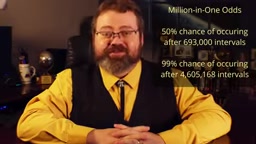
The video offers a striking piece of math: even if the annual probability of death is just one in a million, after approximately 693,000 years the cumulative probability of death reaches 50%. This means that someone who expects to live another million years will become extraordinarily cautious about traffic, dangerous work, war, and experimental technology — it might take an astronomical sum to convince an immortal to test an unproven spacecraft. Digital beings with reliable backups, by contrast, face the opposite calculus: the cost of physical risk drops dramatically.
When Delayed Gratification Becomes an Art Form
Perhaps the most interesting economic transformation from extended lifespans is that "ultra-long return cycles" become meaningful to individuals. A forest that takes a century to harvest, an orbital habitat that takes generations to break even, even interstellar colonization that pays off over hundreds of years — all of these become viable if the original investor is still alive to see them mature.
The video also warns: maintaining wealth without erosion over a thousand years is extraordinarily difficult. Corporate failures, currency collapses, regime changes, technological obsolescence, wars, and divorces... Consistently outpacing inflation by 5% over a millennium is mathematically astounding, but the institutional structures and judgment required to sustain it are the real challenge. And with no one retiring and no assets released through natural turnover, economic mobility could hit a hard ceiling, giving rise to eternal, unchanging "immortal landlords."
To address this, immortals might be compelled to periodically "start over" — erasing parts of themselves, or surrendering assets and identities to "reincarnate" in society under a new persona. This would not only be a matter of fairness, but might become a psychological necessity to avoid economic and existential stagnation.
Meaning Becomes the New Scarce Resource
The video's ultimate conclusion is thought-provoking: economics begins with scarcity, and while immortality eliminates the scarcity of time, it replaces it with other constraints — constraints on purpose, on progress, on endurance.
When physical survival is no longer scarce, meaning becomes the new economic frontier. Immortals might spend fortunes on simulated adventures, emotional depth, or carefully curated novel experiences — paying not to "be alive," but to "feel alive." Entire industries might emerge around selling catharsis, awe, and a sense of purpose, just as we today sell entertainment and therapy.
This might even explain the Fermi Paradox: civilizations that have conquered death may become more inward-looking, less inclined to explore. The universe may be full of minds that have passed their survival tests and now prefer silence.
Immortality does not make you safe — it simply gives you more time to wrestle with meaning. As the video concludes: the heart of the immortality economy may not lie in how long we can live, but in how much meaning we can carry, and how wisely we spend a resource that was once irreplaceable.
The video's interpretation of the Fermi Paradox is a variant of the "post-Great Filter" hypothesis. The core puzzle of the Fermi Paradox is: the universe is so vast and ancient that by the laws of probability it should be teeming with intelligent civilizations — so why have we detected no signals? Common explanations include civilizations self-destructing before achieving technological breakthroughs (the Great Filter lies ahead) or the prohibitive cost of interstellar communication. The "inward turn" hypothesis the video proposes belongs to a different category: civilizations, after overcoming existential threats, turn toward internal complexity, substituting simulations, virtual experiences, or pure information processing for physical expansion. Astronomer Milan Ćirković calls such civilizations "post-scarcity" civilizations — they may invest all their resources in refined internal experience rather than broadcasting outward. This also resonates with the economic concept of the "hedonic treadmill": regardless of how much objective conditions improve, subjective well-being tends to return to baseline, compelling individuals to continuously seek new sources of stimulation. For an immortal civilization, this process would unfold on a cosmic scale.
Related articles

A Single Prompt Triggers a Global PHP Security Storm: Is AI a Savior or a Hidden Risk?
A single AI prompt triggered a global PHP security crisis affecting Wikipedia and the Internet Archive. This article reviews the incident, analyzes the OpenAI-Amazon controversy, and explores the security paradox of lowered vulnerability discovery barriers in the AI era and developer response strategies.

When AI Is Taken Away: How Reliance on Shortcuts Undermines Your Problem-Solving Resilience
A study of 1,222 people found that after using AI to answer questions, once AI was removed, people gave up on more problems than a control group that never used AI. The article analyzes the impact of AI reliance on learning resilience and metacognition, and explores design implications for AI learning tools.

Carta and NewView Partner to Let Startup Employees Cash Out Equity Early
Carta and NewView Capital partner to simplify startup tender offers, helping employees sell equity early. Analysis of the mechanism, liquidity pain points, and impact.