The End of Free Cloud Models: Pay-as-You-Go Starts November 9

A platform's Free accounts switch to pay-as-you-go in November 2026, local execution stays free.
Based on an official email shared on Reddit, a platform will automatically switch Free plan accounts to pay-as-you-go on November 9, 2026: users pre-load credits and are billed by actual usage, with no subscription or service fees, while other plans and local execution remain unaffected. The email lists cloud models that will require payment, including gemma4:31b, gpt-oss:120b/20b, and several nemotron-3 versions. The article analyzes why free inference is unsustainable and offers three paths: small top-ups, local migration, and evaluating alternative cloud services.
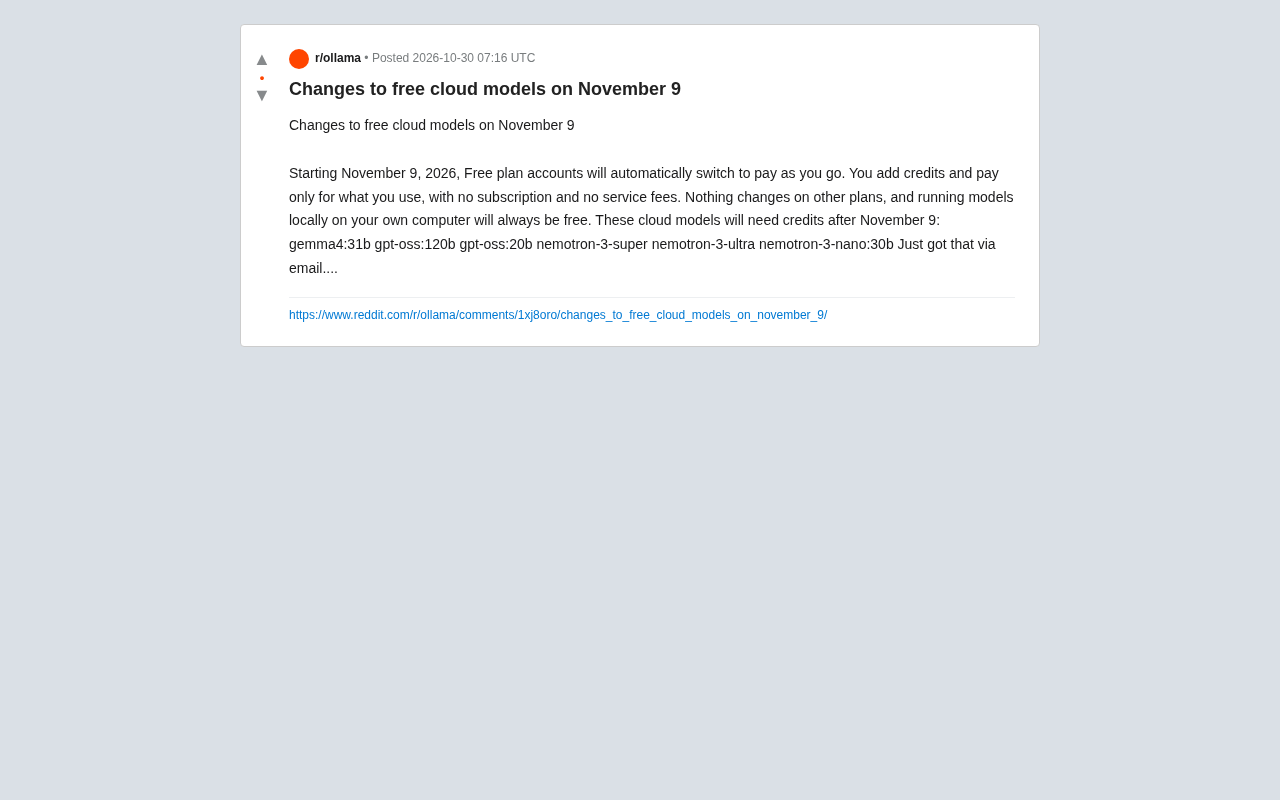
According to an official email shared in the Reddit community, a certain platform has announced that starting November 9, 2026, Free plan accounts will automatically switch to a pay-as-you-go model. Users will need to pre-load credits and be billed based on actual usage, with no subscription fee and no service fee. Other subscription plans are unaffected, and running models locally on your own computer will always remain free.
Which Models Will No Longer Be Free
The email explicitly lists the cloud models that will require credits to call after November 9: gemma4:31b, gpt-oss:120b, gpt-oss:20b, nemotron-3-super, nemotron-3-ultra, nemotron-3-nano:30b.
This list covers open-weight models ranging from 20b to 120b parameters, including both general-purpose chat models and versions aimed at reasoning and long-context scenarios. For developers accustomed to using these models as free APIs, the impact is direct: either top up credits or migrate workloads back to local hardware.
Open-weight models refer to models whose parameters (weights) are released under a public license, allowing anyone to download and deploy them independently, as opposed to closed-source models accessible only via API. The gemma4, gpt-oss, and nemotron series listed here all fall into this category: they are trained by different organizations and released with open weights, so third parties can run them on their own hardware or host them on any cloud platform. This property directly determines migration feasibility—as long as another hosting provider offers the same model, developers can theoretically switch to a different endpoint without rewriting their business logic. However, open weights do not mean fully open: each license has different provisions regarding commercial use, redistribution, and output usage, so the corresponding model's license terms should be checked before migrating.
The Real Dilemma of the Free-Tier Model
Operating large models as a free public service is inherently unsustainable from a cost-structure perspective. Cloud inference requires continuous GPU resources; even when users make no requests, model weights must remain resident in VRAM. The more free accounts there are, the greater the waste between idle capacity and peak scheduling.
Moving from "free" to "pay-as-you-go" is a relatively gentle adjustment—it preserves the no-subscription, no-service-fee structure and keeps the path of permanently free local execution. The platform is essentially transferring the marginal cost of the cloud to the users who actually generate calls, without cutting off anyone's access.
Pay-as-you-go is a cloud billing model that sits alongside subscription-based pricing: users do not pay a fixed periodic fee but are billed per unit of resources actually consumed, typically pre-loaded in the form of credits. The key difference from subscriptions is that costs scale linearly with usage—low usage means low spending, while a sharp spike in calls drives the bill up accordingly, with no "monthly cap." For the platform, this model passes marginal costs directly to callers and avoids the resource idling caused by free users; for users, it means taking on the responsibility of monitoring usage and controlling budgets themselves, especially since long-context requests significantly amplify the billed amount per call.
Three Response Paths for Developers
Path 1: Top up a small amount and use on demand. Pay-as-you-go suits scenarios with highly fluctuating call volumes. For developers who occasionally need large-parameter models for validation, loading a small amount of credits is more cost-effective than maintaining a fixed subscription. The key is to monitor usage carefully so that long-context requests don't silently drain your balance.
Path 2: Migrate to local execution. The email repeatedly emphasizes that local execution is always free. For teams with suitable hardware and low sensitivity to latency, deploying a mid-sized model like gemma4:31b on a local workstation is a complete overhaul of the cost structure. The trade-off is bearing the hardware investment and operations yourself.
Path 3: Evaluate alternative cloud services. The gpt-oss and nemotron series on the list are open-weight models, so equivalent services can theoretically be found on other hosting platforms. However, migration involves concrete differences such as API compatibility, context length limits, and rate limits, which need to be checked item by item.
API compatibility is the most commonly underestimated obstacle when migrating to alternative cloud services. Even when different hosting platforms run the same open-weight model, they may differ in request format, authentication method, streaming responses, tool-calling fields, context length limits, and rate limits. If existing code relies directly on the original platform's SDK or specific parameter names, switching endpoints often requires an adaptation layer. In practice, start with a small-scale canary rollout: run the same batch of prompts on the target platform, compare output formats and billing rules, and then decide whether to migrate wholesale.
Timeline and Details to Confirm
There is still some time before November 9, but a few things are worth confirming in advance: whether the automatic switch means calls will simply fail when the account balance is insufficient; whether API keys and integrations already in use need to be reconfigured with billing information; and whether credits have an expiration date or a minimum top-up threshold.
The original email does not cover these operational details. Affected users are advised to consult the official billing documentation or contact support directly before the switch to avoid service interruptions on the day of the change.
Industry Signal: The Era of Free Inference Is Shrinking
This adjustment is not an isolated event. The free window for large-model inference is gradually narrowing worldwide, with platforms generally shifting from "trading free quotas for user growth" to "trading pay-as-you-go billing for sustainable unit economics."
For developers, this means model invocation costs must be factored into architecture design early on: which requests can go to small local models, which must call large-parameter models in the cloud, and how many duplicate calls caching and batching can save. Inference costs that could once be ignored are becoming an engineering variable that requires careful management.
One-line Summary
A platform announces that Free accounts will switch to pay-as-you-go starting November 2026, while local execution remains free.
Paragraph Summary
Based on an official email shared on Reddit, the article reports that a certain platform will automatically switch Free plan accounts to a pay-as-you-go model on November 9, 2026: users pre-load credits and are billed by actual usage, with no subscription or service fees, while other subscription plans and local execution are unaffected. The email lists the cloud models that will require payment, covering gemma4:31b, gpt-oss:120b/20b, and multiple versions of nemotron-3. The article analyzes why free inference is unsustainable given resident GPUs and scheduling waste, offers three paths—small top-ups, local migration, and evaluating alternative cloud services—and reminds users to confirm details in advance such as behavior when balances are insufficient, key configuration, and credit expiration, noting that the free inference window is narrowing worldwide.
Related articles

The Touchscreen MacBook and Apple's Delightful Mess: A Deliberate Gamble
The Vergecast unpacks the touchscreen MacBook Pro's launch logic, the ProLed naming controversy, the iPad squeezed between iPhone and Mac, and how Apple stays competitive with premium hardware in the AI era.

Fifty Years Studying Power: Robert Caro's Writing and Insights on Power
Robert Caro reflects on 50 years studying power: Lyndon Johnson's persuasion and leverage, Robert Moses's transformation from idealist to ruthless builder, the dilemmas of large-scale construction, and his methods of compressing themes and solitary focus in biography writing.

Can a $20,000 Robot Do Your Chores? The Test Results Are Surprising
A YouTube test video shows how a $20,000 robot responds to commands like washing dishes, turning off lights, taking out trash, and feeding the dog. This article analyzes its real capability boundaries, the state of voice interaction technology, and how far household robots are from mainstream adoption.