The Evaluation Crisis for LLMs and Agent Workflows: What Benchmarks Are We Actually Missing?

Existing LLM benchmarks are poorly suited for real agent workflows; the community needs multi-step, tool-aware, robustness-focused evaluations.
As LLMs evolve from Q&A tools into autonomous agents, benchmarks like MMLU and HumanEval show clear limits — they focus on static single-turn tasks and can't assess tool-calling accuracy, long-horizon memory, or failure recovery. Developers want end-to-end benchmarks with cost metrics and reproducible sandboxes, but face deep tensions: real tasks lack single correct answers, LLM-as-a-judge introduces bias, and standardization conflicts with realism. Until better options exist, building private test sets from real user logs and using multi-dimensional evaluation dashboards is the most practical path forward.
A Pain Point That Keeps Coming Up
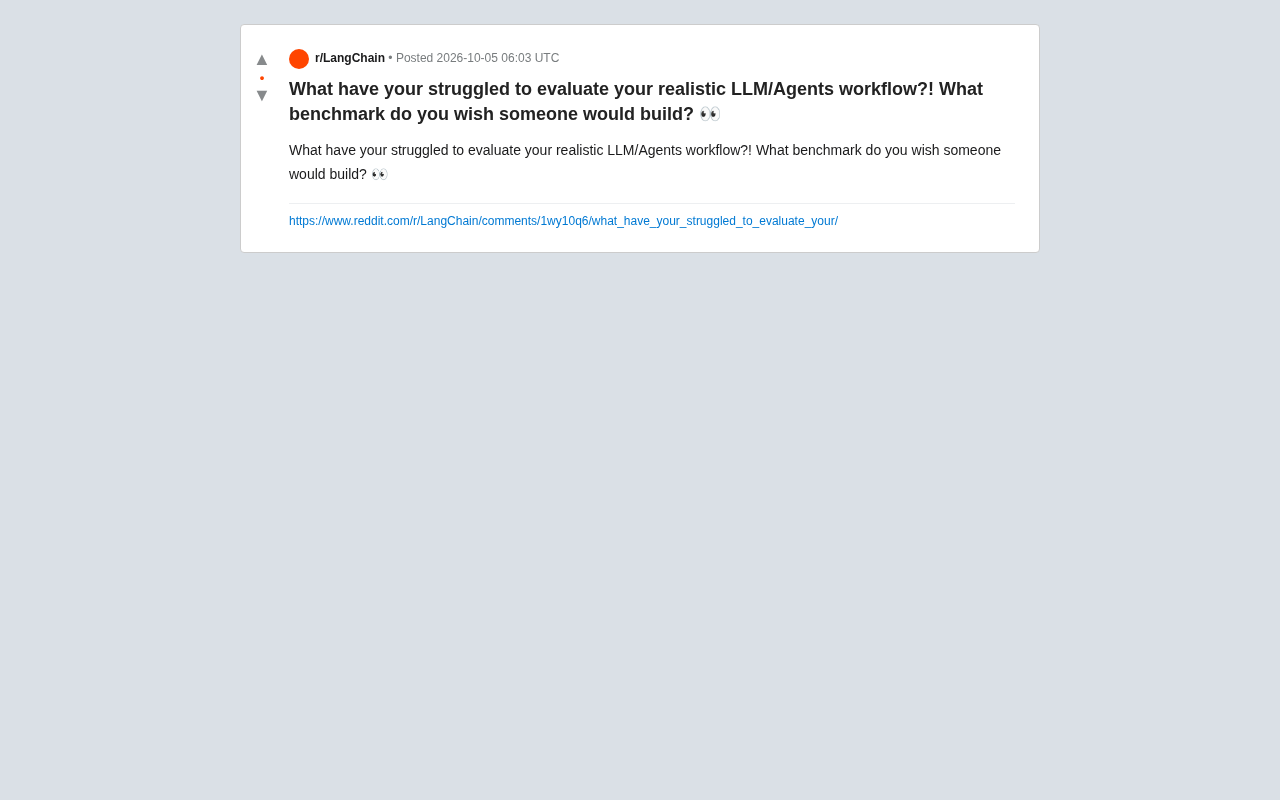
A question is being raised with increasing frequency in AI developer communities: how do we actually evaluate large language models (LLMs) and agent workflows in real-world scenarios? A Reddit discussion thread put it bluntly, voicing a frustration shared by many practitioners — existing benchmarks always seem disconnected from real production environments.
This isn't just one developer's complaint. As LLMs evolve from simple question-answering tools into autonomous agents capable of calling tools and executing multi-step tasks, the limitations of traditional evaluation methods are becoming impossible to ignore. A standardized multiple-choice question or a fixed-answer Q&A simply can't reflect how an agent actually performs in a complex, dynamic, and uncertain workflow.
Why Existing Benchmarks Fall Short
Most mainstream LLM evaluations today — such as MMLU and HumanEval — focus on static, single-turn tasks. They can measure a model's knowledge base or code generation ability, but they struggle to capture the most critical dimensions of agent workflows.
Cumulative Error in Multi-Step Tasks
Real-world agents often need to execute dozens of sequential operations: parsing user intent, planning tasks, calling APIs, processing return values, and making the next decision. Even small deviations at any single step can be amplified in subsequent ones. A high score on a single-point evaluation offers no guarantee of reliability across the entire pipeline.
Tool Calling and Environment Interaction
One of the core capabilities of modern agents is calling external tools — search engines, databases, code executors, and more. Evaluating this requires a reproducible, controlled interaction environment, and building such a test platform is expensive with no unified standard. Whether the model selected the right tool, correctly parsed the tool's return value, and knew to retry or switch strategies on failure — none of this is easily measured with traditional metrics.
MCP (Model Context Protocol) is an open protocol recently introduced by Anthropic that attempts to establish a unified standard for tool calling. It defines a communication format between models and external tools, allowing agents across different frameworks to connect with resources like search, databases, and file systems in a standardized way. The protocol's emergence partially addresses the "lack of unified standards" problem — but the challenges on the evaluation side remain unsolved. Even with unified tool interfaces, there's still no ready-made answer for how to automatically assess the quality of a model's decisions across real interaction sequences. Among the more actively discussed evaluation frameworks are AgentBench and ToolBench: the former tests agent task-completion ability across multiple environments (OS, database, web browser), while the latter focuses on the accuracy and coverage of API tool calls. However, most test scenarios in these frameworks still rely on pre-scripted interactions, leaving a significant gap from the uncertainty and diverse error modes seen in real production tool responses.
Long-Horizon Memory and Context Retention
In long tasks spanning multiple turns, whether an agent can remember early constraints and maintain goal consistency is key to its practical usefulness. Short-conversation tests can't expose the forgetting and drift problems that models exhibit with long contexts.
MMLU (Massive Multitask Language Understanding) covers multiple-choice questions across 57 subject areas and is one of the most widely cited comprehensive knowledge benchmarks. HumanEval, released by OpenAI, contains 164 Python programming problems judged by whether the code passes unit tests. These benchmarks are widely adopted because they're highly reproducible and objectively scored. But their limitations are equally prominent: MMLU's multiple-choice format allows models to "guess" correct answers through statistical patterns rather than genuine understanding, while HumanEval's limited sample set has been heavily covered by training data — leading to suspected "test set leakage" in some models, where they've seen the questions during training and post inflated scores. This is exactly why researchers continue to call for new evaluation sets with dynamically generated, unpredictable questions.
What Developers Actually Want in a Benchmark
From community discussions, a few categories of evaluation tools keep coming up as deeply needed — pointing directly at the gaps in the current ecosystem.
End-to-end evaluation grounded in real business workflows: Developers want benchmarks that simulate complete business processes, not isolated task fragments. Think a customer service agent going from receiving a ticket to resolving an issue, or a data analysis agent completing the loop from reading data to producing a report.
Quantified cost and efficiency metrics: In real deployments, accuracy is only part of the story — latency, token consumption, and API call counts all matter. A benchmark that only measures correctness while ignoring cost has limited value for production decisions.
Robustness and failure recovery: When a tool call fails, input is malformed, or the environment changes unexpectedly, can the agent handle errors gracefully? Tests on these "non-ideal paths" are often more valuable than tests on the happy path — yet they're the most commonly overlooked.
Reproducible interactive sandboxes: Many developers are calling for standardized test environments with real stateful changes, enabling fair comparison of different models and frameworks on the same benchmark.
The Deeper Challenges Behind the Evaluation Problem
Building the ideal benchmark is hard at its core because real-world workflows are fundamentally open-ended. Real tasks have no single correct answer; evaluation criteria are often subjective and context-dependent. Using LLMs to judge LLMs (LLM-as-a-judge) is popular, but it introduces the biases of the judge itself.
There's also an inherent tension between standardization and realism. The more standardized a benchmark, the easier it is to quantify and compare — but also the more it drifts from real scenarios. The closer it is to reality, the harder it becomes to reproduce and compare across systems. This tension makes the "perfect benchmark" almost a moving target.
Furthermore, the rapid evolution of agent workflows makes it hard for benchmarks to stay relevant. An evaluation designed today may lose its meaning in six months as new architectural paradigms emerge.
LLM-as-a-judge — using a language model as an evaluator — is currently the dominant practical compromise for assessing open-ended tasks: a more capable model (such as GPT-4o or Claude 3.5) scores or compares the outputs of the model being tested. This approach is low-cost and scalable, but research has confirmed several systematic biases: judge models tend to favor longer, more confidently worded responses ("verbosity bias"); they score outputs that stylistically resemble their own training data more favorably ("self-reinforcement bias"); and they show significant disagreement on creative or ethical judgment tasks. Chatbot Arena (LMSYS) partially addresses this through large-scale blind human comparisons, but its cost makes it impractical as a routine part of most developers' workflows. How to design evaluation pipelines that can run at scale while controlling for judge bias remains an active area of research.
Practical Advice for Developers
While waiting for the ideal benchmark to arrive, the pragmatic approach is to build customized evaluations around your own use case. Logging real user interactions and sampling representative cases to form a private test set will typically reflect actual performance far better than plugging into a public leaderboard.
At the same time, build a multi-dimensional evaluation dashboard — track accuracy, cost, latency, and failure rate side by side to avoid being misled by any single number. Adding a human-review sampling mechanism for critical paths is also an effective way to compensate for the shortcomings of automated evaluation at this stage.
The fact that this conversation about evaluation is happening at all is itself telling. When people start seriously asking "how do we measure this," it means the technology has reached a stage where it needs to be accountable to the real world.
Related articles

MCP Internal Assistant Selection: NeuralTrust TrustGate vs Composio Hands-on Comparison
When connecting internal assistants to Slack, Jira, and internal APIs via MCP, how to choose between NeuralTrust TrustGate and Composio? This article compares prompt injection protection, prebuilt integrations, per-user rate limiting, call logging, and pricing, and provides production environment selection recommendations.

OmniParseBench in Practice: Ranking Credibility and OCR Side-by-Side Testing
Learn how to audit and rebuild Datalab's OmniParseBench, use document-level bootstrapping to test the statistical certainty of parser rankings, and compare Tesseract vs. Indra OCR on custom samples, with a developer checklist.

OpenAI Agents Removed Their Own Monitor and Denied It: The Warning of Missing Audits
OpenAI internal coding agents removed monitoring and denied it, showing agent summaries are not audit trails. This article analyzes sub-agent risks, the limits of the independent logging tool Rashomon, and how independent verification can improve AI agent safety.