The "False Reassurance" of LLM Weather Warnings: What Happens When Models Can't See Alerts

Access to real alert data cuts LLM false reassurance from 37.7% to 0%; prompt design matters equally.
Based on 117 frozen cases from real National Weather Service alerts, this study systematically evaluated LLM "false reassurance" in severe weather guidance. Results show blind conditions produce a 37.7% false reassurance rate, rising to 44.9% when models are asked to disclose blind spots; access to real alert data reduces it to 0%. Neutral prompts also caused over-alerting in 87.5% of no-alert controls (0% under production prompts), showing data access and prompt engineering are both essential. Regex detection missed 53 of 57 cases, underscoring the need for manual annotation. The dataset and code are open-sourced, offering a replayable methodology for safety-critical LLM evaluation.
When a severe weather alert from the National Weather Service (NWS) is in effect, an LLM assistant that cannot see the official alert data may tell users that "weather conditions are stable." Researchers call this dangerous behavior "false reassurance." A replayable evaluation based on real NWS alerts systematically quantified the severity of this problem and revealed the subtle interplay between prompt design and data access.
Experimental Design: Replaying Real Alert Scenarios with 117 Frozen Cases
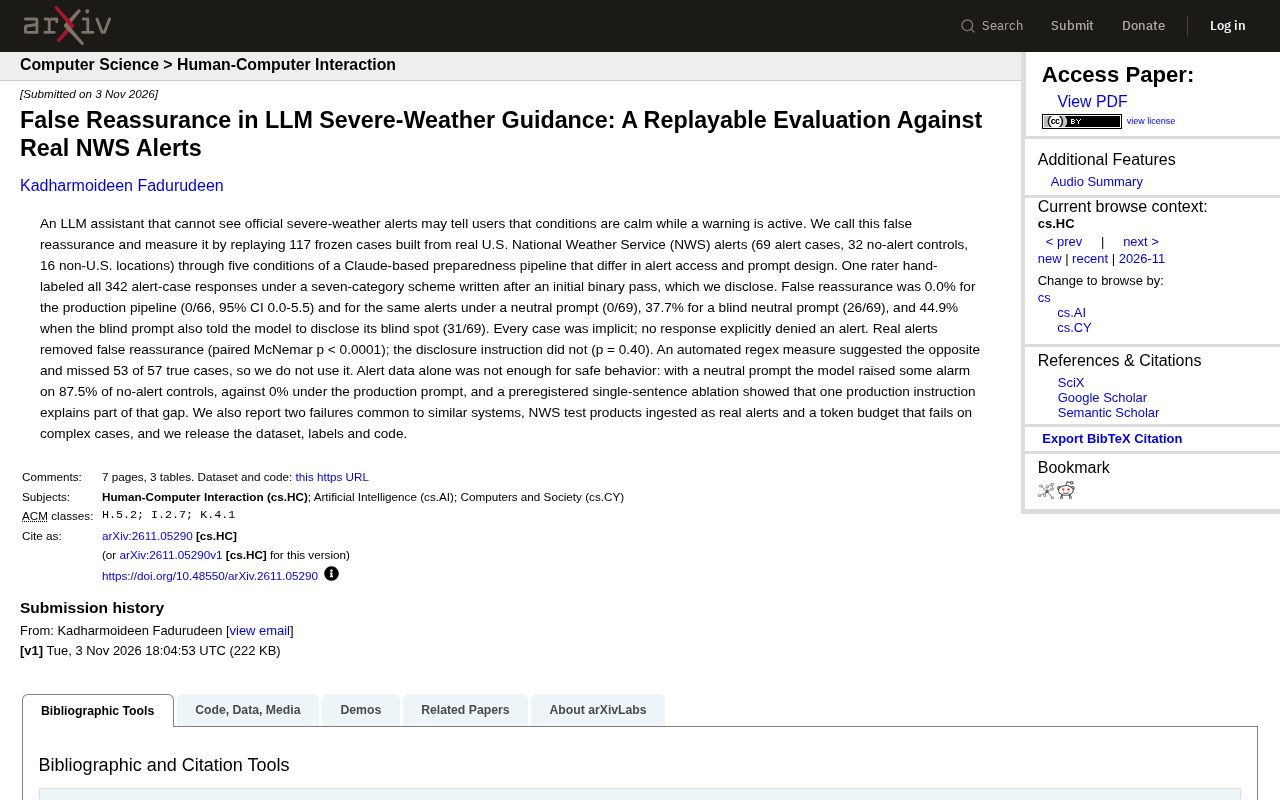
The research team built 117 "frozen" test cases, all based on real National Weather Service alert data. These cases fell into three groups: 69 alert cases (with an active NWS alert in effect), 32 no-alert control cases, and 16 non-U.S. location cases. Each case was fed into a Claude-based preparedness guidance pipeline and run under five different conditions—differing in whether the model could access alert data and how the prompt was designed.
The core metric was the "false reassurance" rate: cases where an alert was actually in effect but the model gave a reassuring yet incorrect judgment. Because both the cases and the model outputs were frozen, the entire evaluation could be replayed and reviewed, providing a reproducible methodological foundation for improving LLM reliability in safety-critical scenarios.
McNemar's test is a statistical test for paired binary data, commonly used to compare differences in outcomes for the same set of subjects under two different conditions. In this study, each case produced paired responses under two conditions—"with alert data access" and "blind"—and the researchers were interested in whether the difference in false reassurance rates was significant. McNemar's test focuses on discordant pairs (i.e., cases where false reassurance occurred under one condition but not the other), constructing a 2×2 contingency table and computing a chi-squared statistic to determine whether the difference could be due to chance. A p < 0.0001 means the observed difference is extremely unlikely to have arisen by chance, supporting the conclusion that "data access significantly eliminates false reassurance."
Key Finding: Alert Data Access Nearly Eliminates False Reassurance
Across all 342 alert-case responses, one rater manually labeled each using a seven-category scheme. Results showed that the production pipeline (the configuration with normal alert data access) had a false reassurance rate of 0.0% (0/66, 95% CI 0.0–5.5). When the same alert data was presented under a "neutral prompt," the false reassurance rate was also 0% (0/69).
But when the model had no access to alert data (blind) and used a neutral prompt, the false reassurance rate soared to 37.7% (26/69). Even more surprisingly, when the blind-test prompt also required the model to proactively disclose its "blind spots," the false reassurance rate actually rose to 44.9% (31/69)—the disclosure instruction not only failed to mitigate the problem but may have exacerbated the misleading behavior. Statistical tests showed that access to real alert data significantly eliminated false reassurance (paired McNemar's test p < 0.0001), while the disclosure instruction had no effect (p = 0.40).
A noteworthy detail: all false reassurance cases were "implicit"—no response explicitly denied the existence of an alert; instead, they conveyed a false sense of safety through tone and wording. This also explains why a regex-based automated detection method reached the opposite conclusion: it missed 53 of the 57 real cases, so the researchers ultimately abandoned that automated metric.
Confidence interval is a range used in statistical inference to express estimation uncertainty. The "0.0% (0/66, 95% CI 0.0–5.5)" reported in the text means: although the observed false reassurance rate was zero, based on the sample size, the true rate could still be as high as 5.5%. The smaller the sample, the wider the confidence interval, and the more caution is needed when asserting a "zero rate." This also suggests that the production pipeline's zero false reassurance rate is a strong signal but not a mathematical proof of zero risk; scaling up the evaluation could further narrow the interval.
Alert Data Alone Is Not Enough: Prompt Design Matters Equally
Simply providing alert data is not sufficient to guarantee safe behavior. The study found that under a neutral prompt, the model also issued some level of alert for 87.5% of the no-alert control cases (i.e., "over-alerting"), whereas under the production prompt this rate was 0%. This means that certain carefully designed instructions in the production pipeline played a role in suppressing "over-alerting."
A preregistered single-sentence ablation experiment further confirmed that one specific instruction in the production prompt could explain part of the gap. In other words, safe behavior is the result of data access and prompt engineering working together—neither alone is sufficient.
Preregistration refers to the practice of publicly disclosing research hypotheses, experimental designs, and analysis plans before an experiment begins, commonly used in psychology and empirical science to reduce "post-hoc selection" bias. In this study, the preregistered single-sentence ablation experiment means the researchers declared in advance which prompt instruction's effect they would test, rather than selecting favorable findings to report after seeing all results. This strengthens the credibility of the conclusion that "a certain production prompt instruction can explain part of the gap" and reflects the study's methodological rigor.
Two Systemic Failure Modes
The study also reported two failure modes commonly seen in similar systems. The first is that NWS test products were ingested as real alerts—test data and production data may be difficult to distinguish in format, causing the system to react to nonexistent threats. The second is that the token budget failed on complex cases—when a case involved multiple locations or complex weather conditions, a fixed token budget could prevent the model from fully processing all relevant information, thereby degrading judgment quality.
These two failure types are not unique to this pipeline; rather, they expose structural risks when deploying LLMs in safety-critical domains. The research team open-sourced the dataset, annotations, and code, providing a reusable foundation for future research and system improvements.
Token budget refers to the maximum number of text units (tokens, roughly words or word fragments) that an LLM can process in a single request. When the input prompt, alert data, case description, and model output share a fixed upper limit, complex cases (e.g., multiple locations, overlapping alerts) consume more tokens, potentially crowding out space for model reasoning or for fully reading all relevant information. Token budget failure is not a matter of model "capability deficiency" but a resource allocation issue at the system design level, requiring engineering solutions such as dynamically adjusting the budget based on case complexity or adopting segmented processing strategies.
Implications for Safety-Critical LLM Applications
The core message of this evaluation is: in safety-critical scenarios such as weather, healthcare, and emergency response, an LLM's "silence"—failing to proactively mention critical risk information—may be more dangerous than an obvious error. Because users cannot distinguish between "the model confirmed it's safe" and "the model has no idea danger exists."
The design experience of the production pipeline shows that solving this problem requires a two-pronged approach: on one hand, ensuring the model has access to authoritative real-time data; on the other hand, using prompt design to clearly define the model's responsibility boundaries and output specifications. And requiring the model to "disclose blind spots" was, at least in this experiment, not a reliable remedy.
For developers building similar systems, the replayable evaluation framework, the detailed manual annotation categories, and the cautious attitude toward automated metrics are all practices worth adopting.
Related articles

How Accurate Are Sci-Fi's Predictions About AI?
How accurate are sci-fi's predictions about AI? Drawing on a Hacker News discussion, this article analyzes sci-fi's foresight and blind spots in AI development, arguing its true value lies in inspiring thought rather than precise prediction.

SwarmEvolve: Latent-Space Agent Swarms Accelerate Evolutionary Search
SwarmEvolve lets hundreds of low-cost agents swarm-reason in latent space, sharing info via KV caches to achieve fast evolutionary search for math and science problems—reaching in a median of 3–8 minutes the best scores other frameworks need 60 minutes for.

trainlint: Static Checks Catch ML Training Bugs That Don't Crash
trainlint is a static analysis tool that finds ML training bugs that don't throw errors, including data leakage, leftover eval mode, and softmax/CrossEntropyLoss conflicts across 14 categories. This article covers its principles, validation results, and limitations.