The Faster AI Generates, the Slower the Project? Review Is the Real Bottleneck

As AI generation accelerates, the project bottleneck shifts from generation to human review—speedups should start on the review side.
The article notes that as AI generation capabilities improve and multiple agents run in parallel, output speed far exceeds human review speed, shifting the project bottleneck from generation to review. Automated checks absorb some low-level errors, but judging business logic and plan soundness still depends on human experience. Choosing to use output without review means errors accumulate as generation accelerates, driving up rework costs over time. The author argues for speeding up on the review side: tiered review, more efficient review (diff views, structured output, summary-first), and clear acceptance criteria before generation. The core conclusion: once generation is no longer the bottleneck, engineering efficiency gains lie in helping people review faster and more accurately—a shift in how we work.
Generation Got Faster—So Why Hasn't the Project?
Many developers have had this experience: you open several AI conversations at once, let them each work on separate tasks, and after a while they all come back almost simultaneously—done. That's the moment you realize that the real queue is you. It's fast for AI to produce a version, but far slower for a person to understand one. Even with just a single conversation open, it hands back results faster than anyone can read them.
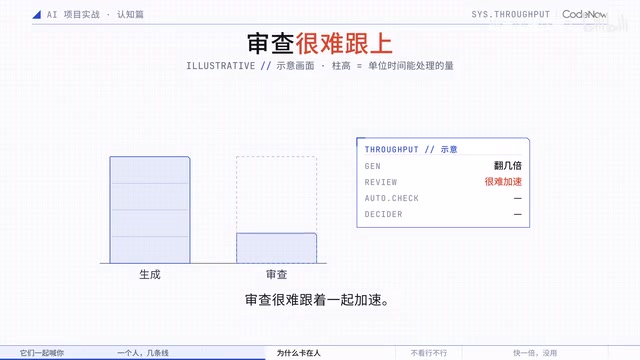
This reveals an overlooked structural problem: generation can be accelerated, but review is hard to accelerate along with it. Open a few more agents, spend a few more tokens, and output can multiply several times over—but the final sign-off still comes from the same few people. AI can produce ten results in the time it takes to turn a page, but a person won't grow ten pairs of eyes in that same time.
The Review Bottleneck: The Underestimated "Human Glance"
Automated checks can absorb part of the burden—lint, tests, and type checking do catch low-level errors. But the step that truly requires judging "is this result correct, is it usable" still depends on human experience and judgment. Only a minority of tasks can be fully delegated without anyone watching; most results still need a person to look them over before anyone dares to use them.
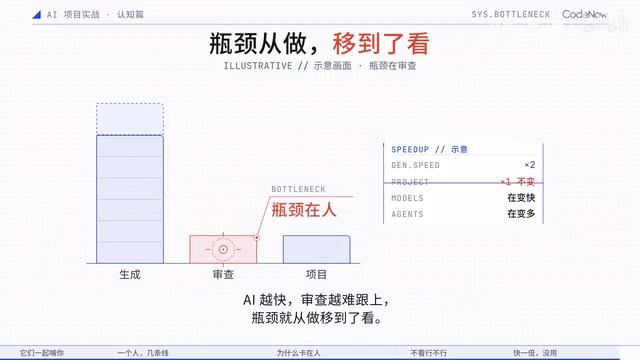
The problem is that the generation side only keeps getting faster: models are speeding up, and more agents are running in parallel. Meanwhile, human review bandwidth is essentially fixed. At this point, making AI twice as fast won't make the project twice as fast—the bottleneck has shifted from "generation" to "review."

Cognitive load and review bandwidth: Human review capacity is limited by working memory capacity and attention span. Cognitive load theory holds that when the number of information elements processed simultaneously exceeds working memory capacity (roughly 4±1 chunks), comprehension and judgment efficiency drop significantly. When reviewing code or AI output, developers must track multiple dimensions at once—logical consistency, edge cases, business rules—which is itself a high-cognitive-load task. Running multiple agents means multiple results to review flood in in parallel, switching costs compound, and effective review bandwidth is compressed further. The review bottleneck is therefore not just a matter of time but of cognitive resources—it won't ease automatically just because the generation side speeds up.
The Cost of Using Without Looking: Errors Also Accumulate Faster
Faced with a review backlog, one temptation is to "skip the review and just use it." But if you don't look, the wrong things flow out along with everything else—the faster generation gets, the faster unchecked errors pile up. In the short term, project progress seems to move forward; in the long term, technical debt and rework costs swell in the dark.
What really needs distinguishing is: which results you don't actually need to read line by line, and which you can't skip a single line of. That judgment is itself a core skill.
The Direction for Speed: Find Leverage on the "Review" Side
The author's view is clear: the faster AI gets, the more you should first practice how to review, rather than urging it to go even faster. To speed things up, you have to find leverage on the review side.
Specifically, there are several directions to pursue:
- Tiered review: Stratify results by risk—let low-risk results pass based on automated checks, and concentrate human attention on high-risk results
- Improve review efficiency: Use diff views, structured output, summary-first approaches, and the like to lower the cognitive cost of each review
- Upfront constraints: State acceptance criteria clearly at the generation stage to reduce rework-style review
Essentially, once generation is no longer the bottleneck, the room to improve engineering efficiency shifts from "getting AI to do more work" to "helping people review faster and more accurately." This isn't a tooling problem—it's a problem of how we work.
Upfront constraints and shifting acceptance criteria left: Making acceptance criteria explicit at the generation stage essentially moves part of the review logic forward into generation constraints. This is similar to "test-first" in test-driven development (TDD)—define "what counts as correct" first, then let the generation process converge in that direction. Concrete practices include: using structured prompts to specify output formats and edge cases, asking AI to attach a self-check list to its output, and for high-risk tasks producing a plan before producing an implementation. This way reviewers shift from "hunting for errors line by line" to "checking against agreed conventions," greatly reducing the cognitive cost of each review and also cutting down on rework-style review caused by vague standards.
FAQ
Q: Can automated checks fully replace human review? A: No. Automated checks are good at catching formalizable errors, but whether business logic is correct and whether a plan is reasonable still requires human judgment.
Q: Does running multiple agents improve project speed? A: The generation side does get faster, but if the review step can't keep up, the extra output just piles up as unprocessed to-dos.
Q: How do you decide which results don't need a close look? A: Stratify by scope of impact and reversibility—low-risk, easily rollback-able results can be passed; results involving core logic or irreversible operations must be confirmed by a human.
One-line Summary
Once AI generation speeds up, the project bottleneck shifts from generation to human review, and speedups should start from the review side.
Paragraph Summary
The article points out that as AI generation capabilities improve and multiple agents run in parallel, output speed has far outstripped human review speed, and the project bottleneck has shifted from "generation" to "review." Automated checks can absorb some low-level errors, but judging business logic and the soundness of a plan still depends on human experience. Choosing to "use without looking" means errors accumulate as generation accelerates, driving up rework costs over the long term. The author argues that the direction for speed should come from the review side: tiered review, improving review efficiency (e.g., diff views, structured output, summary-first), and clarifying acceptance criteria before generation. The core conclusion is that once generation is no longer the bottleneck, the room to improve engineering efficiency lies in helping people review faster and more accurately—which is essentially a shift in how we work.
Related articles

A Single Prompt Triggers a Global PHP Security Storm: Is AI a Savior or a Hidden Risk?
A single AI prompt triggered a global PHP security crisis affecting Wikipedia and the Internet Archive. This article reviews the incident, analyzes the OpenAI-Amazon controversy, and explores the security paradox of lowered vulnerability discovery barriers in the AI era and developer response strategies.

When AI Is Taken Away: How Reliance on Shortcuts Undermines Your Problem-Solving Resilience
A study of 1,222 people found that after using AI to answer questions, once AI was removed, people gave up on more problems than a control group that never used AI. The article analyzes the impact of AI reliance on learning resilience and metacognition, and explores design implications for AI learning tools.

Carta and NewView Partner to Let Startup Employees Cash Out Equity Early
Carta and NewView Capital partner to simplify startup tender offers, helping employees sell equity early. Analysis of the mechanism, liquidity pain points, and impact.